
India IT sector AI disruption: the outsourcing model is coming apart
India IT sector AI disruption is rewriting the outsourcing playbook: 6% workforce cuts, an 18% Nifty IT slide, and hiring that no longer tracks export revenue.
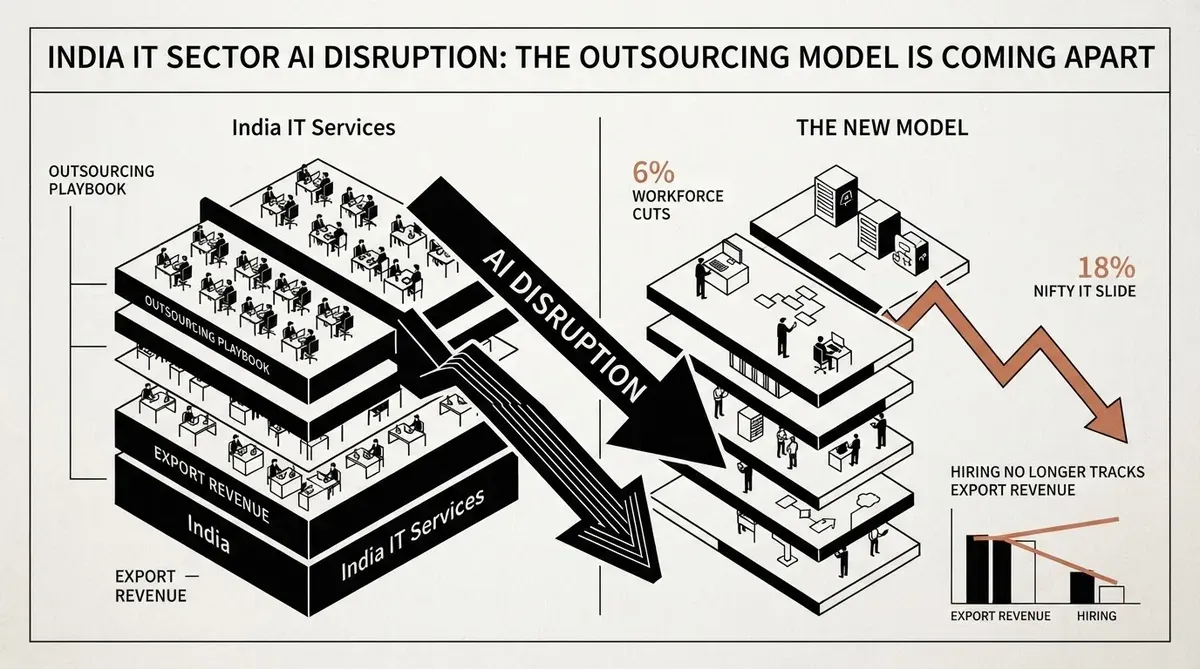
The India IT sector AI disruption is now visible in the employment data: the country's largest IT employers have trimmed workforces by up to 6% during 2026, while the Nifty IT index has fallen 18% this year. Generative AI is dismantling the labor-arbitrage model that built the outsourcing industry, and the fallout extends well beyond the firms doing the cutting.
The India IT sector AI disruption, measured
The most useful measurement comes from Nomura. Its economists Sonal Varma and Si Ying Toh, who call India ground zero for AI's effect on jobs, tallied 83,100 AI-related hires against 31,921 layoffs and attrition linked to AI adoption across 69 anecdotes in Asia. On the surface, that is a net positive. The deeper problem is decoupling: hiring is no longer tracking export revenue, and export revenue is what pays for the headcount. The two curves used to move together, and 2026 is the year they split. India is the natural test case: it concentrated so much of the world's delivery work in one labor pool, and the exposure is proportional to that concentration.
The strongest counter to the pessimism is that same dataset: AI hiring so far outpaces AI-driven job losses by a wide margin, and firms are re-hiring for specialized AI roles even as they cut entry-level positions. That is a real shift, not a rounding error. But automation is hitting the bottom of the funnel first, the entry-level coding and support tasks that once absorbed hundreds of thousands of graduates every year. A sector can report positive net hiring while quietly dismantling the pipeline that fed three decades of middle-class growth. The re-hiring is also concentrated: specialized AI roles demand credentials and experience that displaced entry-level workers rarely have, so the churn does not recycle into the same people.
The attrition half of that 31,921 figure deserves separate attention. Workers are leaving AI-exposed roles and are not being replaced, a quieter channel of shrinkage than outright dismissal. Hiring freezes and unfilled vacancies do the same work as layoffs, with far less visibility.
The macro consequence is harder to price than an index. Indian IT services have long functioned as the country's most reliable escalator into the middle class, hiring graduates by the hundreds of thousands into roles that required no advanced credentials and paid well by local standards. Automation replaces precisely those roles first, which is why the workforce cuts concentrate in the segment the economy depends on most. The 6% reduction at the major employers understates the damage, because it does not count the graduates who are not being hired at all.
The cutbacks are running through the biggest names. Oracle is cutting roughly 10,000 India-based roles as part of a global AI-driven workforce reduction, and staffing firm TeamLease Digital estimates about 40,000 layoffs across India's tech ecosystem in recent quarters. Nasscom, the industry body, has warned that 20-25% of Indian IT firms may struggle to cross over to an AI-first model even while demand for AI services stays strong.
That is the demand paradox. Clients are still spending on Indian IT, but the spending has moved to AI enablement, integration, and agent operations. The same contracts now carry a smaller labor component, which re-prices the core service and thins the margin for any vendor that cannot move up the stack. Nasscom's estimate is the market's way of saying the upgrade is not optional.
The raw numbers tell the same story from several angles.
| Indicator | Figure |
|---|---|
| Workforce cut at major IT employers, 2026 | up to 6% |
| Nifty IT index, 2026 | -18% |
| AI-related hires, Nomura sample | 83,100 |
| AI-linked layoffs and attrition, Nomura sample | 31,921 |
| Oracle India roles cut | ~10,000 |
| Tech-ecosystem layoffs, TeamLease Digital estimate | ~40,000 |
| Firms Nasscom expects may struggle to adapt | 20-25% |
If AI were simply making the model more profitable, the index would show it. An 18% decline says the market sees transition risk where it might have expected margin gains. Investors cannot yet tell which firms own the AI capability and which will be left selling commoditized legacy work.
The government's own chief economic adviser, V. Anantha Nageswaran, has warned that firms relying on India's comparative advantage may no longer need to do so. That is a formal way of saying the country's core export is being priced down as AI agents absorb the work those exports were built on. The India IT sector AI disruption has become a policy problem as much as a market one. New Delhi's response is a pivot toward consumer electronics manufacturing, an attempt to replace services revenue with hardware assembly. The pivot is rational and slow: factories take years to come online, and India already lags in frontier AI, the one capability that would let it sell AI-first services instead of labor. Assembly margins run thinner than services margins ever did, so the trade is value for volume.
The signal is not confined to India. Japan's NEC has begun moving toward departments staffed entirely by AI agents, an organizational form that would have been unthinkable in a labor-rich market a few years ago. If that becomes the benchmark for global enterprises, the demand side of the Indian IT equation shrinks in a way no domestic re-skilling program can fully offset. Outsourcing was never only about wage levels; it was about access to a large, trainable workforce delivered at scale. AI agents compress both of those advantages at once.
For strategists outside India, the mechanism is the lesson. India's IT industry is the world's largest working example of white-collar labor arbitrage, and its 2026 numbers are an early warning for every export-led service economy: the Philippines' BPO hubs, Eastern European engineering shops, Latin American nearshoring centers. When the work itself becomes automatable, the arbitrage premium disappears no matter how cheap or skilled the labor is. The same assets that made Indian IT attractive, scale and cost and English fluency, become liabilities when the buyer can get the output without the headcount. The companies that survive this cycle will own the AI layer or the physical product. The ones in between get squeezed.
The number I keep coming back to is whether the 83,100 AI hires Nomura counted are being paid from export revenue or from balance-sheet bets on a future that has not arrived. If they are the latter, the hiring surge inverts the moment growth stalls. The other ratio worth tracking is the Nifty IT index against the progress of the electronics-manufacturing push; that comparison tells you which bet the market believes.
Why this matters
The India IT sector AI disruption matters beyond India because it turns an abstract fear into priced, measurable events: an 18% index decline, a 6% workforce cut, hiring that no longer scales with exports. For decision-makers in any white-collar export economy, the playbook is the same. Own the AI capability or own the hardware, because selling labor into a market that is automating labor is a declining trade.
AI-generated image.
Related Articles
- AI Redundancy Washing: Tech's 2026 Layoff Wave Outstrips All of 2025
- Cloudflare and Upwork Cut Staff to Accelerate Pivot Toward Agentic AI Models
- Oracle AI Layoffs Cut 21,000 Jobs With More Restructuring Ahead
✔Human Verified
Researched and cross-referenced against primary sources by the Bytevyte editorial team. This article was generated with the assistance of artificial intelligence and reviewed by the Bytevyte editorial team.