
India's TakeMe2Space Bets on Orbital Computing Satellite to Cut Downlink Costs
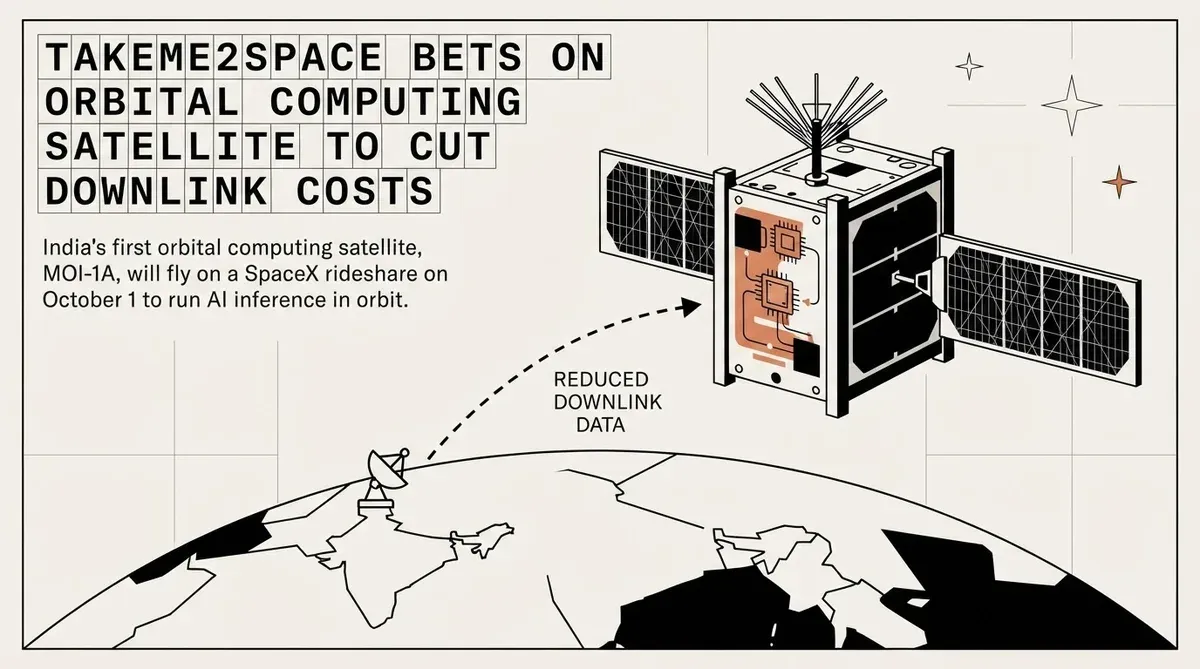
TakeMe2Space has booked a ride for what it calls India's first orbital computing satellite. The sub-50-kilogram spacecraft is built to run AI inference above the atmosphere instead of sending raw imagery back to Earth. The Hyderabad startup's MOI-1A payload is manifested on SpaceX's Transporter-18 rideshare mission, targeted for October 1. TakeMe2Space says 23 customers have signed on across agriculture, mining, defense, insurance, supply chain and education.
The spacecraft carries an Nvidia Orin NX processor drawing roughly 150 watts, a part borrowed from the terrestrial edge-computing market. Customers upload their models, the satellite runs them against sensor data in low Earth orbit, and only the results travel down to the ground.
The commercial case rests on a narrow claim. Running inference in orbit beats downlinking raw pixels only when the sensor and the processor share a spacecraft and the alternative is a metered radio link. Everywhere else, ground data centres keep their advantage in power, cooling, maintenance and connectivity. MOI-1A is a test of whether that narrow case is wide enough to support a business.
TakeMe2Space turned to SpaceX after its original ride, the Indian Space Research Organisation's PSLV-C62 mission, failed. Rebooking on a Falcon 9 rideshare changes both the schedule and the cost of reaching orbit. The company has not disclosed what the slot cost.
Why the downlink is the real constraint
Earth-observation economics hinge on a bottleneck that rarely appears in marketing material. A satellite can image far more territory than it can transmit. Downlink bandwidth is metered, ground-station time is scarce, and the volume of raw multispectral data a modern sensor produces overwhelms the pipe that carries it home.
That is the case for orbital edge computing. When a model classifies a field, flags a vessel, or detects a change in terrain before the data leaves the spacecraft, the operator transmits kilobytes of conclusions instead of gigabytes of pixels. TakeMe2Space says the approach cuts both downlink cost and latency for customers who consume large volumes of satellite imagery.
For a mining operator, the practical difference is a change map delivered during the same orbital pass rather than after a downlink window and a ground-processing queue. The compute cost shifts too. The customer buys a processing service instead of building and operating ground infrastructure, which is what turns a satellite operator into something closer to a cloud provider.
Onboard inference is unforgiving in ways ground computing is not. Radiation degrades electronics, thermal management in vacuum is harder than in a server rack, and hardware failures cannot be serviced. At roughly 150 watts, MOI-1A has enough power to run classification, object detection and change-detection models. It cannot host a frontier foundation model, and no customer should expect it to.
What the 2024 demonstration proved
The October flight is not a first attempt at the technology. TakeMe2Space flew a technology-demonstration mission in late 2024 that validated the core loop: uploading applications to a spacecraft, executing AI inference in orbit, and downloading the results. The company says that mission also exercised sensor fusion and high-speed data handling in low Earth orbit.
MOI-1A is the commercial packaging of that proof. The gap between a demonstration and a product is paying customers, and the 23 signed accounts are the figure that matters. Agriculture and mining users need frequent, narrow answers about specific parcels of land. Insurers need damage assessments. Defense and supply-chain operators need timely awareness of movement and change. Each of those workloads produces a small answer from an enormous source.
Educational institutions round out the list, which points to a second revenue model. Selling compute time on an orbiting accelerator to universities and research groups converts idle capacity between commercial passes into billable hours.
Not all 23 customers carry the same weight. Agriculture and mining are volume buyers of imagery who already pay for analytics on the ground, so moving the processing to orbit is a substitution rather than a new purchase. Insurance and defense are higher-value but slower to sign, since both require audit trails and reliability guarantees that a first-generation commercial payload cannot yet offer.
The customer mix also shows where the near-term money sits. Satellite imagery analytics is already a paid market on the ground. TakeMe2Space's pitch is to move an existing line item from a terrestrial cloud bill to an orbiting one, and to ask buyers to accept new reliability trade-offs in exchange for cheaper downlink. That reallocates spending rather than creating a category.
From a single orbital computing satellite to a network
TakeMe2Space has described a substantially larger second act. It plans to fly what it calls India's first networked orbital data centre on a Falcon 9 in 2028, using two satellites of roughly 100 kilograms each, fitted with Nvidia Thor GPUs and optical laser links. The stated ambition is a constellation of six satellites.
| Attribute | MOI-1A (2026) | Networked mission (2028) |
|---|---|---|
| Launch | SpaceX Transporter-18 rideshare | SpaceX Falcon 9 |
| Spacecraft mass | Under 50 kg | Two satellites at roughly 100 kg each |
| Compute | Nvidia Orin NX, about 150 W | Nvidia Thor GPUs |
| Connectivity | Radio downlink | Optical laser links |
| Stated ambition | Single orbital computing node | Constellation of six satellites |
The shift is qualitative as much as quantitative. A single satellite is a compute node with a radio. A networked constellation is a distributed system that has to route workloads, synchronise state, and keep functioning when any one node fails. Optical inter-satellite links are the enabling technology, and they are hard to build and harder to operate at scale. Moving from one sub-50-kilogram demonstrator to paired 100-kilogram nodes roughly quadruples the mass per spacecraft.
The company has also outlined a 50-kilowatt orbital data centre concept targeted for 2027. That power figure belongs to a different class of machine than the 150-watt MOI-1A, and whether the two roadmaps converge or run in parallel is not clear from the public material. A 150-watt demonstrator and a 50-kilowatt concept are not adjacent products; they imply different launch masses, power budgets and customer sets. TakeMe2Space has not published the funding or payload commitments that would bridge them.
Where the risks sit
Launch risk is not theoretical here. TakeMe2Space's original plan relied on an Indian launch vehicle that failed, forcing the switch to a rideshare slot on a foreign rocket. Rideshare also means the company does not control its own orbital insertion, which constrains the orbit an orbital computing satellite can serve.
Payload mass is the other structural limit. A Transporter rideshare places small spacecraft into a shared orbit, and every kilogram of processor, radiator and power hardware competes with every kilogram of sensor. Scaling compute in orbit means scaling the power and thermal systems that support it, and those grow mass faster than the chip itself does.
The competitive question is sharper than the technical one. Terrestrial data centres enjoy cheap power, abundant cooling, easy maintenance and fibre connectivity. An orbital facility's advantage is proximity to the sensor and the removal of the downlink step. That advantage is strong for Earth observation and weak for general-purpose workloads, where latency to ground users and the cost of lifting mass still dominate.
Investors weighing orbital computing against the wider AI infrastructure buildout should look at unit economics rather than satellite counts. India's spacetech cohort, including Pixxel in hyperspectral imaging and Agnikul in launch, is competing for the same capital. China has launched 12 satellites toward a publicly stated plan of 2,800 AI satellites, a gap that says more about state financing than about technical readiness.
Why this matters
If onboard inference works commercially, the binding constraint on Earth-observation businesses shifts from bandwidth to compute, and the value moves toward whoever operates the processing layer in orbit. TakeMe2Space is trying to claim that layer before the market is large enough to attract heavier competition from hyperscalers or national programmes.
The October 1 launch tests whether a 150-watt processor on a small satellite can carry a commercial business. The 2028 networked mission tests whether that business can scale into something that deserves the data-centre label. Both questions are open, and the first answer arrives within days.
AI-generated image.
Related Articles
- China's Supercomputing-1 Launch Sets the Terms for Orbital AI Computing
- Google's Project Suncatcher Sets Course for the First Orbital AI Compute Test
- SpaceX Orbital Compute: Selling Capacity Before the Satellites Fly
✔Human Verified
Researched and cross-referenced against primary sources by the Bytevyte editorial team. This article was generated with the assistance of artificial intelligence and reviewed by the Bytevyte editorial team.