
Intel and NVIDIA Partner to Build Serpent Lake Chips with Integrated RTX Graphics
Intel and NVIDIA are co-developing Serpent Lake, a new SoC that integrates RTX graphics into Intel CPUs for high-performance laptops by 2028.
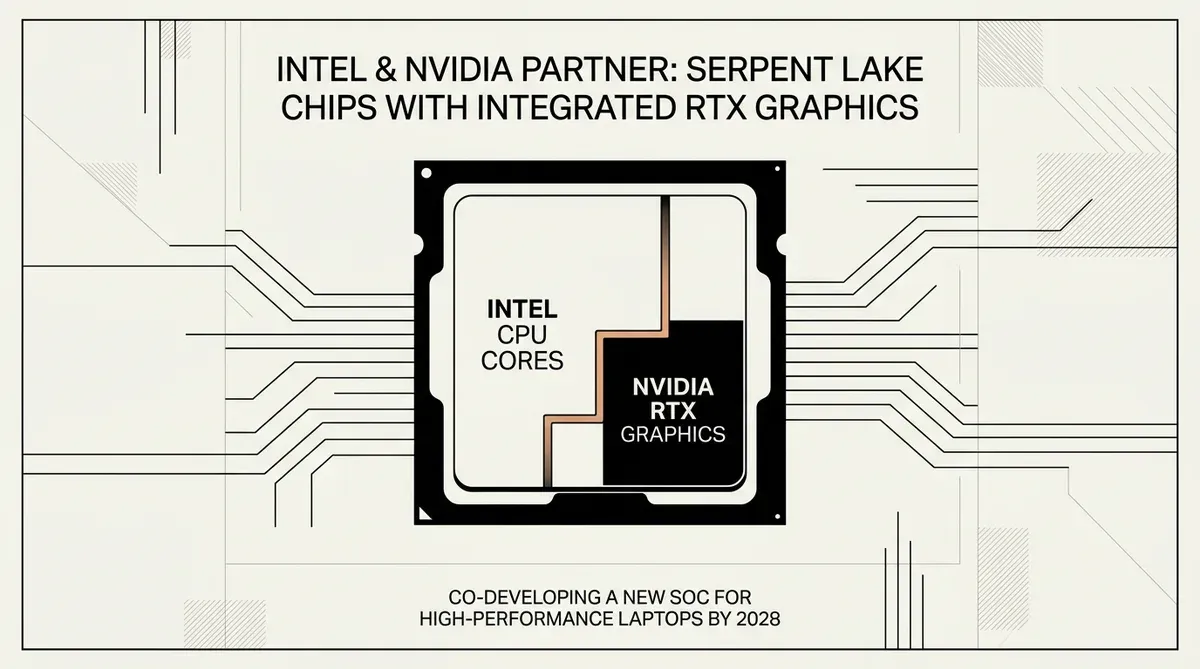
Intel has confirmed a major hardware partnership with NVIDIA to develop a new system-on-a-chip (SoC) codenamed Serpent Lake. This collaboration involves integrating NVIDIA RTX graphics technology directly onto an Intel processor package, aiming to deliver high-end gaming performance in thin-and-light mobile devices. Intel CEO Lip-Bu Tan announced the project this week during an event at Carnegie Mellon University, marking a significant shift in how the two semiconductor giants work together.
The Serpent Lake platform is a specialized version of the upcoming Titan Lake architecture. By placing NVIDIA GeForce RTX GPU tiles alongside Intel x86 CPU cores, the companies intend to create a single-chip solution that rivals the performance of discrete graphics cards. This move is a strategy to provide a powerful x86-based alternative to the integrated ARM-based chips that have gained traction in the laptop market recently. The goal is to maintain the dominance of the x86 ecosystem while matching the efficiency and integration seen in competing mobile platforms.
NVIDIA is backing this joint venture with a $5 billion investment into Intel's foundry services and product roadmap. This financial commitment ensures that the Serpent Lake chips will have dedicated resources within Intel's manufacturing facilities. For consumers, this could mean future laptops will offer the ray-tracing and AI-upscaling capabilities of an RTX GPU without the need for the extra space, heat, and power consumption typically required by a separate graphics chip. This level of integration is intended to simplify laptop motherboards and improve battery life for gaming on the go.
While the partnership is now official, the technology is still in the early stages of development. Intel and NVIDIA are currently targeting a release window between 2028 and 2029. This long-term timeline suggests that Serpent Lake will be a cornerstone of the next generation of high-performance mobile computing, potentially redefining the capabilities of ultra-portable gaming and creative workstations toward the end of the decade. The collaboration is a rare moment of unity between the two companies as they look to secure their positions in an increasingly competitive hardware market.
While we strive for accuracy, bytevyte can make mistakes. Users are advised to verify all information independently. We accept no liability for errors or omissions.
AI-generated image.
Related Articles
- Intel Unveils Wildcat Lake Core Series 3 Chips for Budget Laptops
- Microsoft Surface Laptop 8 Leaks with Next-Gen Intel Panther Lake Chip
- Marvell and Alphabet Co-Develop Custom AI Inference Silicon
✔Human Verified