
Jetson Thor T3000 Robotics Delivers Data-Center AI at the Edge
NVIDIA's Jetson Thor T3000 robotics module delivers 865 FP4 teraflops for humanoid robots, while agent skills software cuts configuration from weeks to days.
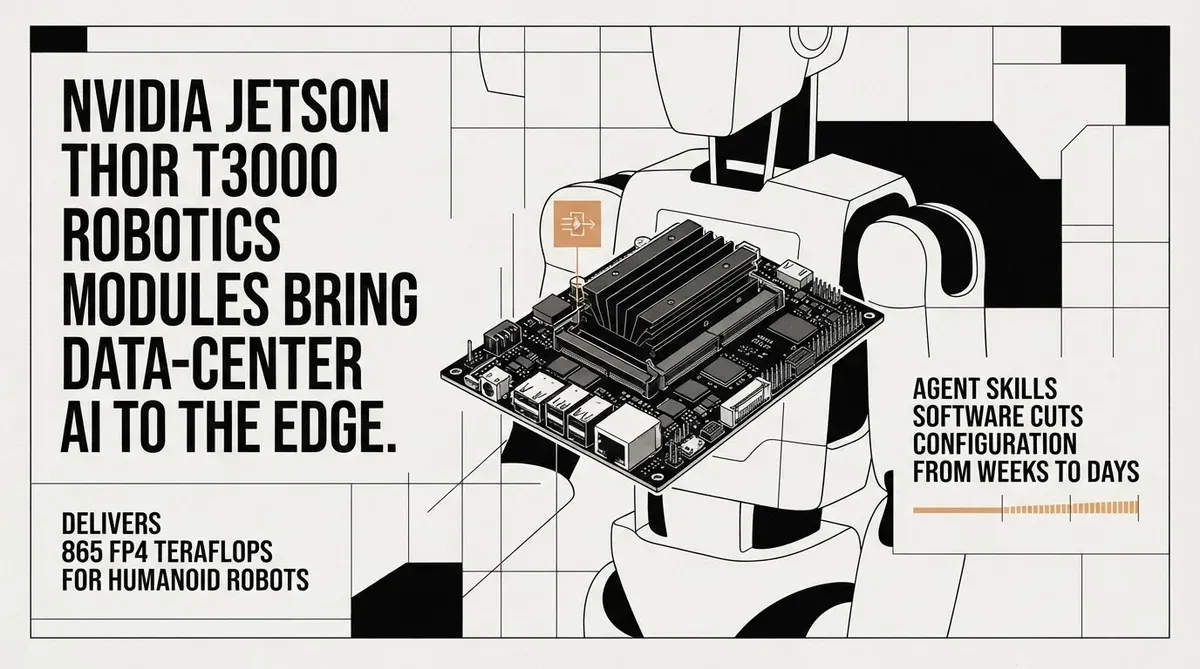
NVIDIA has introduced the Jetson Thor T3000 and T2000 modules, compact edge computers that bring data-center-class AI inference directly into humanoid robots and autonomous machines. The T3000 module delivers 865 FP4 teraflops of compute with 32GB of LPDDR5X memory and 273GB/s of bandwidth, while the T2000 offers 400 FP4 teraflops with 16GB of memory for visual AI agents and autonomous mobile robots. Both modules are built on the NVIDIA Thor architecture and target the growing market for general-purpose robots moving from research labs into mass-market deployment, making Jetson Thor T3000 robotics a key platform for the physical AI era.
Announced this week, the modules will be available for emulation via JetPack 7.2.1 in late July 2026, with physical module shipments scheduled for Q1 2027. The Jetson Thor T3000 robotics module pairs its high-bandwidth memory with an eight-core Neoverse Arm CPU, enabling it to run large foundation models locally including vision-language-action models, large language models, and vision-language models without relying on a constant cloud connection.
Data-Center Performance in a Robot Form Factor
The T3000's 865 FP4 teraflops of AI compute is a substantial leap over previous-generation edge hardware, but it sits below the full Thor AGX developer kit that delivers up to 2,070 FP4 teraflops with 128GB of memory. NVIDIA designed the T3000 as a production module specifically for humanoid robots, where power budgets and physical size constraints rule out the developer kit. The module operates within a power envelope comparable to the broader Thor family range of 40 to 130 watts, making it feasible to integrate into battery-powered robots that need to operate for extended shifts in warehouses or factories.
NVIDIA claims the Thor architecture delivers up to 7.5 times the AI compute of the previous-generation AGX Orin with 3.5 times better energy efficiency. For robotics companies, that efficiency gain matters as much as raw performance because robots operating in the field cannot afford the thermal or power overhead of a data-center GPU. The platform also integrates four 25GbE network interfaces, a high-speed camera engine, and the Holoscan Sensor Bridge for real-time processing of high-speed sensor data from multiple cameras and LIDAR units simultaneously.
Agent Skills Software Slashes Configuration Time
NVIDIA has released a new agent skills software layer alongside the hardware that automates memory optimization on the Thor platform. Manual configuration of memory for complex AI workloads previously took weeks of engineer time, with developers needing to hand-tune memory allocation across multiple AI models running simultaneously on the same module. The new software reduces that timeline to days, compressing a major bottleneck in robot development.
For startups building physical AI systems on the Jetson Thor T3000 robotics platform, this compression of setup time translates directly into faster iteration cycles and lower engineering overhead. A team that previously needed to dedicate a senior engineer for weeks to configure memory for a multi-model pipeline can now accomplish the same task in days with automated tooling. That reduction in development cost is particularly meaningful for smaller companies that cannot afford large hardware engineering teams, and it is a central reason why the Jetson Thor T3000 robotics platform lowers the barrier to entry.
The Cosmos 3 Edge model, a 4-billion-parameter variant of NVIDIA's physical AI foundation model, has been expanded to support real-time reasoning on the Thor platform. This gives robot developers a pre-trained model that understands physical world dynamics and can run inference directly on the edge module without cloud round-trips. The smaller model size requires approximately one quarter of the computing resources compared to larger Cosmos variants, making it practical for edge deployment on the T3000's 32GB memory budget. Developers can also access the model through NVIDIA's JetPack SDK, which bundles the necessary drivers, libraries, and tools in a single release.
The emulation environment available through JetPack 7.2.1 later this month allows developers to begin software development and model optimization before the physical modules ship in early 2027. This advance access is designed to ensure that robot software stacks are ready for the hardware on day one of availability, shortening the time-to-market for commercial robot products.
How Jetson Thor T3000 Robotics Lowers the Barrier for Startups
The combination of the Jetson Thor T3000 robotics module's data-center-class inference capabilities and the agent skills software effectively lowers the entry barrier for smaller companies to build sophisticated robots. Previously, running foundation models on a robot required either expensive custom hardware or reliance on cloud connectivity, both of which added cost, complexity, and latency. The T3000 collapses those requirements into a single module that draws power comparable to a laptop while delivering server-grade AI throughput.
Major robotics companies are already adopting the platform. Agility Robotics has stated that Jetson Thor will allow it to run larger and more powerful policies and reasoning models locally on its robots inside customer facilities, opening doors to building more flexible and general-purpose robots. Boston Dynamics and 1X are also among the early partners, with floor demonstrations at the MACHINA Physical AI Summit in Paris earlier this month featuring NVIDIA Jetson Thor-powered stacks alongside Google DeepMind's Atlas footage and 1X's Neo home robot.
Five major robot makers including Boston Dynamics, NEURA, Richtech, AgiBot, and LG unveiled new robots simultaneously powered by NVIDIA Cosmos and GR00T software in June 2026, signaling the breadth of industry adoption. The GR00T software stack provides a complete AI software stack that supports generative AI models and enables seamless cloud-to-edge integration, giving developers a unified platform rather than assembling components from multiple vendors.
NVIDIA's broader strategy extends beyond the hardware itself. The company is providing open models and software platforms so that companies like Omron, Sony, and Woven by Toyota can train AI on their own proprietary data rather than relying solely on NVIDIA's general-purpose models. This open-model approach lets manufacturers develop industry-specific AI models by fine-tuning on data collected from their own factory floors and robot operations, using the Isaac robot platform and Jetson computers as the foundation.
Market Positioning and Competitive Dynamics
Market analyst TrendForce projects that the humanoid robot chip market could exceed $4.8 billion by 2028, and the Thor family is positioned to capture a significant share of that growth. The developer kit for the higher-end AGX Thor module carries a price tag of $3,499, substantially more than the $1,499 Jetson Orin developer kit. The T4000 module was previously priced at $1,999 per unit with a 70-watt power envelope and 4x performance improvement over its predecessor, and the new T3000 and T2000 are expected to follow a similar tiered pricing strategy to serve different segments of the robotics market.
The pricing dynamics create an interesting strategic picture. The Jetson Thor T3000 robotics module targets humanoid robot builders who need maximum edge compute, while the T2000 serves visual AI agents and autonomous mobile robots where cost sensitivity is higher. This tiered approach mirrors NVIDIA's GPU strategy in the data center, where different SKUs serve different workload profiles at different price points. However, the higher cost of Thor hardware relative to Orin means that for companies planning to deploy robots performing relatively simple tasks, lower-cost chips may still be sufficient.
TrendForce has noted that while the Thor series delivers strong performance, the developer kit price is a significant increase over the previous generation. For short and medium-term deployments where robots execute relatively straightforward tasks, more affordable chips can meet requirements without the Thor price premium. This creates a segmented market where NVIDIA's Thor family competes at the high end while lower-cost alternatives address the volume market for simpler robots. Analog Devices has also announced a collaboration with NVIDIA around Jetson Thor availability, further expanding the ecosystem for the platform.
Why This Matters
The T3000 and T2000 modules mark a turning point where data-center-grade AI compute becomes accessible to robotics companies of all sizes. By shortening configuration time from weeks to days and enabling local inference on edge hardware, NVIDIA is removing the two biggest bottlenecks that have kept physical AI in research labs rather than in commercial deployment. For startups and established manufacturers alike, the path from prototype to deployed robot just became shorter and cheaper, accelerating the timeline for humanoid robots to move from demonstrations into real-world operations. The Jetson Thor T3000 robotics platform sits at the center of this shift, delivering server-class inference at power levels that make field deployment feasible.
Sources
NVIDIA Introduces New Jetson Thor Computers to Advance Mainstream Robotics and Edge AI
AI-generated image.
Related Articles
- NVIDIA and Doosan Group Partner to Drive Physical AI and Energy Solutions for Data Centers
- Intel Core Ultra Series 3 Launches to Consolidate Robotics Compute on SoC
- NVIDIA Ships First Vera CPUs to OpenAI and Anthropic for Agentic AI Workloads
✔Human Verified
Researched and cross-referenced against primary sources by the Bytevyte editorial team.