
K2 Space Series D: The $6.8B Bet on Bigger Satellites
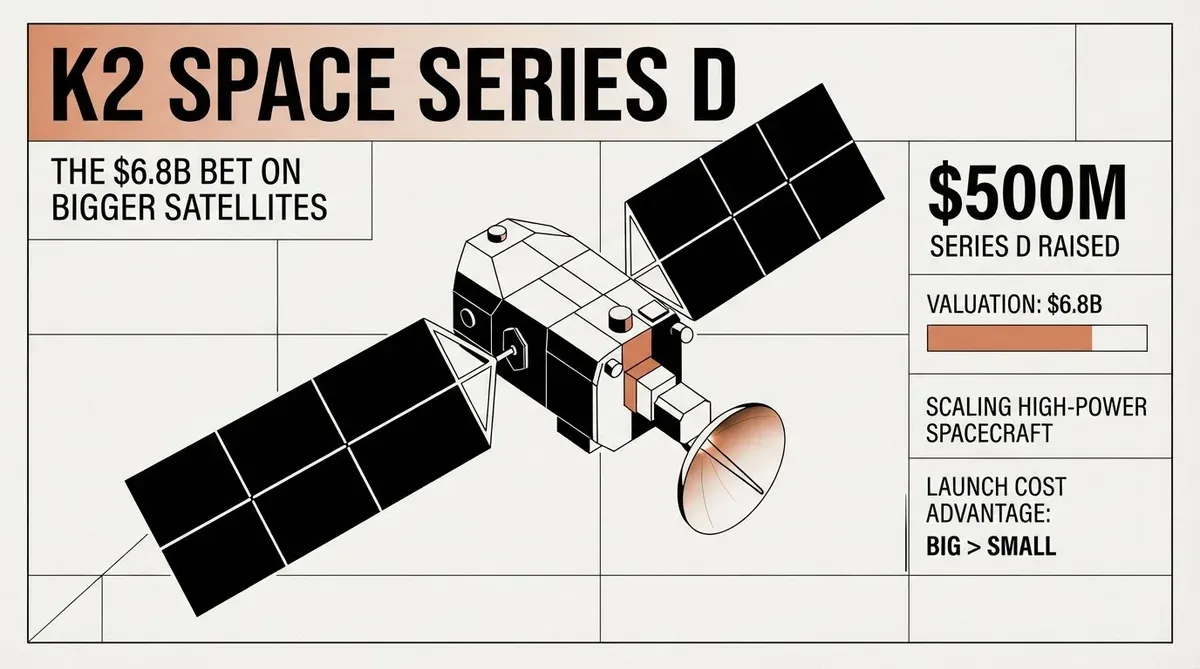
K2 Space has closed a $500 million Series D at a $6.8 billion valuation, more than doubling its value in seven months and pushing cumulative funding past $1 billion. The K2 Space Series D round, announced July 30, was led by Kleiner Perkins and ICONIQ, and it finances a deliberate counter-move to the small-satellite orthodoxy that dominated the industry for a decade: K2 builds spacecraft for higher electrical power and heavier payloads, betting that cheaper launch plus surging defense and orbital-compute demand will make size the winning variable. The hard part now is execution, converting a backlog of signed contracts worth more than $1 billion into satellites delivered at scale, on schedule and on cost.
Kleiner Perkins and ICONIQ were joined by CapitalG, Lightspeed, Altimeter, Spark Capital, Sands Capital, ARK Invest and T. Rowe Price, with existing investors also participating. The mix of growth-stage funds and thematic names such as ARK signals that the big-satellite thesis has broad institutional support rather than a single champion. The round follows a $250 million Series C in December 2025 that priced K2 at $3 billion, so the valuation has roughly doubled in seven months. Signed contracts have grown from about $500 million in December to more than $1 billion, a doubling that gives the new valuation a revenue base rather than a purely speculative one.
K2, based in Torrance, California, targets the top of the satellite power curve. Its first spacecraft, the two-ton Gravitas, launched in March on a SpaceX Falcon 9, generates 20 kilowatts of power and carried payloads for the Department of Defense and commercial customers. The company says that power level matches the largest commercial satellites flying today, and that its 20-kilowatt Hall-effect electric thruster is the most powerful ever operated in orbit, running at about 4.4 times the previous record. K2 prices each satellite at roughly $15 million.
Inside the K2 Space Series D round
The new capital is earmarked for manufacturing rather than research. K2 operates a 180,000-square-foot factory in Torrance and targets production capacity of up to 100 satellites per year. A recently opened engineering hub in the Seattle area adds a second development site alongside the factory floor as the company widens its talent pool. K2 maintains an 85% vertically integrated supply chain, an unusually high share for satellite manufacturing, which it says shortens production time and lowers the cost of each bus.
| Round | Amount | Valuation | Date |
|---|---|---|---|
| Series C | $250 million | $3 billion | December 2025 |
| Series D | $500 million | $6.8 billion | July 30, 2026 |
The size of the round reflects the cost of the ramp. At roughly $15 million per satellite, a production run of 100 units a year implies output worth about $1.5 billion annually, so the Series D is a working-capital down payment on a scale-up that will keep consuming capital. With this round, K2 is moving from prototype demonstrations to industrialized production, and the capital is what funds that shift.
K2 was founded by brothers Karan and Neel Kunjur. Karan is the chief executive; Neel, a former SpaceX engineer, shaped the core architecture. The Series D is the company's largest single raise to date, roughly twice the size of the December round, and it brings total financing above $1 billion, matching the scale of its signed commercial and government contracts.
Why bigger beats smaller
The thesis rests on a shift in launch economics. Heavy-lift prices have fallen enough that satellite mass is no longer the binding constraint it was a decade ago, so K2 designs for power and payload volume instead of kilogram minimization. That inverts the logic of the constellation boom, which pushed the industry toward mass-produced small satellites that are cheap to build and quick to replace.
| Platform | Power | Status |
|---|---|---|
| Gravitas | 20 kW | Launched March 2026 on Falcon 9 |
| Giga-class | 100 kW | Planned, second half of 2028 |
Power is the gating constraint for the payloads K2 is chasing. Communications equipment, sensors, defense systems and computing hardware all consume kilowatts that small buses cannot sustain. The computing segment is where the growth case concentrates: K2's buses are designed to carry computing hardware, and AI inference in orbit is a sustained, power-hungry workload that small satellites cannot support. The next step in the platform plan is the Giga-class bus rated at 100 kilowatts, scheduled to launch in the second half of 2028, a power class no commercial satellite currently reaches. The step from 20 to 100 kilowatts is the difference between matching today's largest commercial satellites and opening a class no current operator flies.
The demand side is already booked. K2 holds a contract to build 30 satellites for SES's meoSphere network, supports Anduril's missile defense program, and was selected as a bus provider for the Space Force's Protected Tactical Satcom-Global program. Together with other commercial orders, those commitments make up the more than $1 billion backlog, and each one depends on the high-power capability the big-bus design exists to provide. The bus-provider model concentrates production: a standardized power and mass envelope serves SES, Anduril and the Space Force from the same line, with payloads varying by mission.
The trade-offs: scale, schedule, cost
Large spacecraft concentrate risk in ways small satellites do not. One big bus is a single asset: a launch failure, a power-system defect or a late payload integration takes down the entire investment, whereas a constellation absorbs attrition across hundreds of units. Buyers with fixed mission dates carry that exposure, which is why defense and telecom customers weigh delivery schedules as heavily as capability.
Manufacturing is the deeper test. The 85% vertical integration cuts cost and production time in theory, but it also means every bottleneck in the chain is K2's own, and moving from demonstration flights to 100 satellites a year is a step change in factory throughput, hiring and quality control. The big-satellite segment has a reputation for flagship prices and multi-year schedules, and K2's model is an attempt to industrialize that segment with cost discipline. Delivery dates on the SES and Space Force programs are fixed commitments, and the Giga-class platform does not reach orbit until the second half of 2028, which leaves a two-year window in which launch pricing and competitive responses can shift. Because the same factory line feeds all three anchor customers, a slip on any one program would ripple across the order book.
The bet is conditional on launch prices staying low. If heavy-lift pricing firms up, the mass advantage flips back to smaller spacecraft, and the valuation premium K2's backers assigned to big-bus design would come under pressure.
The verdict
The K2 Space Series D round is priced against future orders rather than present profit. A $6.8 billion valuation on more than $1 billion in signed contracts implies the market is pricing continued backlog growth as defense budgets and orbital computing expand, and the valuation climb itself is a signal: from $3 billion in December to $6.8 billion in July, in a funding environment where capital has flowed steadily into space infrastructure. K2 framed the milestone as validation of its thesis that building bigger is the future of satellite manufacturing, with plans to scale toward hundreds of satellites over the next few years. The metrics that will settle the bet are production rate, on-time delivery of the SES and Space Force commitments, and whether Giga-class holds its 2028 window.
Why this matters
The K2 Space Series D round tells decision-makers where satellite capital is heading: cheaper launch is making power and payload mass the variables that decide satellite economics. If K2 delivers on schedule and cost, the economics of satellite capacity shift for defense buyers and commercial operators; if the ramp slips, the premium the market assigned to big-bus design will be tested quickly.
AI-generated image.
Related Articles
- SpaceX Targets $2 Trillion Valuation in IPO Filing Focused on AI Infrastructure Pivot
- SpaceX Terrestrial AI Compute Business Generates $28B from Colossus Deals
- PhysicsX Raises $300 Million to Scale Industrial Large Physics Models
✔Human Verified
Researched and cross-referenced against primary sources by the Bytevyte editorial team. This article was generated with the assistance of artificial intelligence and reviewed by the Bytevyte editorial team.