Korea's AI Data Center Push Hits the Grid: What the SK Telecom–Hyosung Deal Reveals About the Real Bottleneck
SK Telecom and Hyosung's November 2026 deal on 345kV substations and 800V DC shows why Korea's grid, not GPUs, may limit gigawatt AI data centers.
Listen
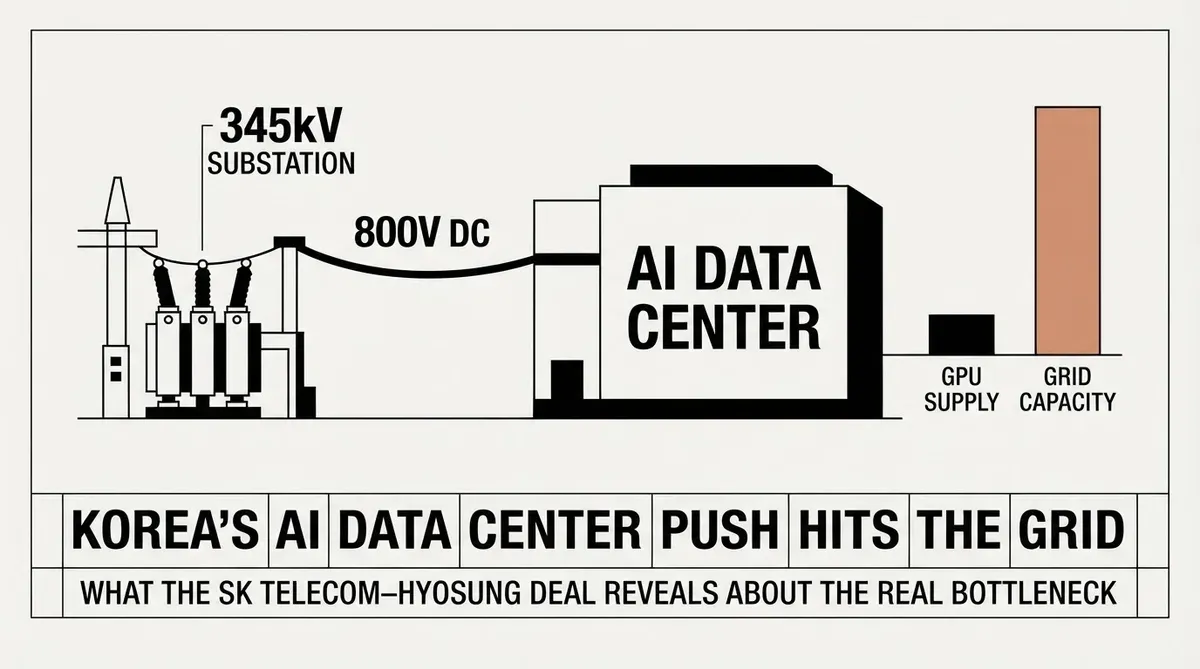
On 16 November 2026, SK Telecom and Hyosung Heavy Industries signed a strategic memorandum of understanding at SKT Tower in Seoul to coordinate power equipment for gigawatt-scale AI data centers. The agreement covers supply of key equipment for 345kV substations, joint demonstration of 800V direct-current distribution, and the search for new data center projects. It is a small document with a large implication: the companies themselves name the power supply chain, not compute hardware, as the starting point for AI capacity.
What the agreement actually says
According to SKT's own announcement, the 345kV substation is the facility that takes power from the grid and converts it into a voltage usable by large data centers. The partners plan to agree production and delivery schedules early, particularly for transformers and other components with long lead times. SKT names delayed equipment procurement as a possible reason installation and operation could slip.
Hyosung's statement names five fields for joint work: supplying equipment, advancing power conversion technology, running and maintaining substations, building data centers, and pursuing new business opportunities. The 800V element is a different matter. It concerns distribution closer to servers, where the companies intend to test direct-current distribution and solid-state transformers. Hyosung says the aim is to reduce losses and equipment burden during conversion. Those are development objectives. Neither company has published a measured efficiency gain, a commissioning date for an 800V installation under this deal, or a contract value.
Why the voltage levels matter
The two voltage figures describe two stages of one chain. The 345kV stage is the entry point: it is where a campus of hundreds of megawatts connects to the transmission network. The 800V stage is inside the facility, where the question is how efficiently power reaches racks. Light Reading's technical summary of 800VDC makes the physics concrete: moving 1 megawatt at 800 VDC requires roughly 1,250 amps, against about 18,500 amps at a traditional 54 VDC. Higher voltage means lower current, thinner conductors and fewer conversion stages.
This is why the press framing of the deal matters. Hyosung and SKT are not describing a chip deal or a model deal. They are describing the equipment that sits between a national grid and a server rack. That is the layer that determines when capacity can be energized.
The grid constraint in the wider Korean picture
The pattern is visible beyond this one memorandum. South Korea's national plan, announced on 29 June 2026, targets 18.4 GW of AI data center capacity by 2035, with a first phase of 8.4 GW by 2029. SK Group, led by SK Telecom, is attached to roughly 15 GW of that. Yet several reports point to the same weak link. A Korea Herald analysis published in June 2026 argued that grid capacity, rather than GPUs, could become the largest constraint on Korea's AI expansion, noting that most of the nation's server facilities cluster around Seoul. A Seoul Economic Daily opinion piece from October 2026 reported that some domestic generating plants stand unused since transmission wiring is missing, and that one Yongin transmission project was only partly complete at the end of last year.
Regulatory data points the same way. Under the Distributed Energy Act, data center power requests above 10 MW require a grid impact assessment. Korea JoongAng Daily, citing KEPCO figures from April 2026, reported 53 data center applications filed since the rule took effect and one approval in the capital area, which was backup power at an existing site. A CBRE Korea tally cited in a September 2026 analysis reported that only a small share of Seoul-area applications had cleared final approval as of March 2026. Earlier, a 2024 Cushman and Wakefield report said KEPCO's confirmation of supply for a Seoul-area site had stretched from two or three months to twelve.
How long equipment takes, and what is not known
The reader question has a precise answer in one respect and a gap in another. The precise part: the sources consistently identify transformers and 345kV substation components as long-lead items, and SKT itself says their procurement can delay operation. Without that figure, any estimate of how long Korean grid gear will take to deliver would be invented. A reader who wants that number should ask KEPCO for its interconnection queue and Hyosung for its order-to-delivery schedule, both of which are the documents that would settle it.
The 800V stage has a similar gap.
The counter-position
The strongest objection is that this deal proves less than it seems. It is a memorandum, not a supply contract. It names no volumes and no dates. A utility approval backlog and a shortage of transformers are different problems, and a partnership between an operator and an equipment maker addresses at most the second. The Korean grid constraint is also partly political and regional: the government is steering capacity away from Seoul, and the transmission build-out to new sites is the slower part of that plan. Solving transformer delivery does not solve transmission lines that have not been laid.
There is also a fair case that equipment is only one of several constraints. Site availability, cooling, water, and permitting appear in the same coverage without being resolved by any of these agreements. Calling transmission equipment the binding constraint everywhere would overreach; the reporting supports it for Korea's capital-region approvals and for the long-lead electrical path, not as a general law of AI campus build-out.
What this means for technology decision-makers
For IT leaders and infrastructure planners, the practical lesson is to put electrical equipment on the critical path of any capacity plan, alongside accelerators. Those questions have answers that are not in press releases.
What to watch next is concrete. The first is whether SKT and Hyosung publish a delivery schedule or contract value for the 345kV equipment. The second is whether KEPCO's approval numbers for data center applications move beyond the current one capital-region approval. The third is whether any demonstration of 800V distribution reports a measured efficiency figure rather than a development goal. Until those arrive, the Korean AI build-out is best read as a race between chip orders and grid approvals, and the public record so far favors the grid as the slower runner.
AI-generated image.
Related Articles
- Texas Data Center Grid Freeze: 474 GW of AI Power Requests Hit the Approval Wall
- DOE's $2 Billion Bet on AI Data Center Grid Capacity Over New Power Plants
- Inside the Korea AI factory deal: Nvidia, Brookfield and NAVER's megawatt ladder
✔Human Verified
Researched and cross-referenced against primary sources by the bytevyte editorial team. This article was generated with the assistance of artificial intelligence and reviewed by the bytevyte editorial team.