
Massachusetts Moves Toward Independent AI Evaluations for Frontier Models
Massachusetts Senate bill would require independent AI evaluations of frontier models every 120 days, with developers paying reviewers. Still under negotiation.
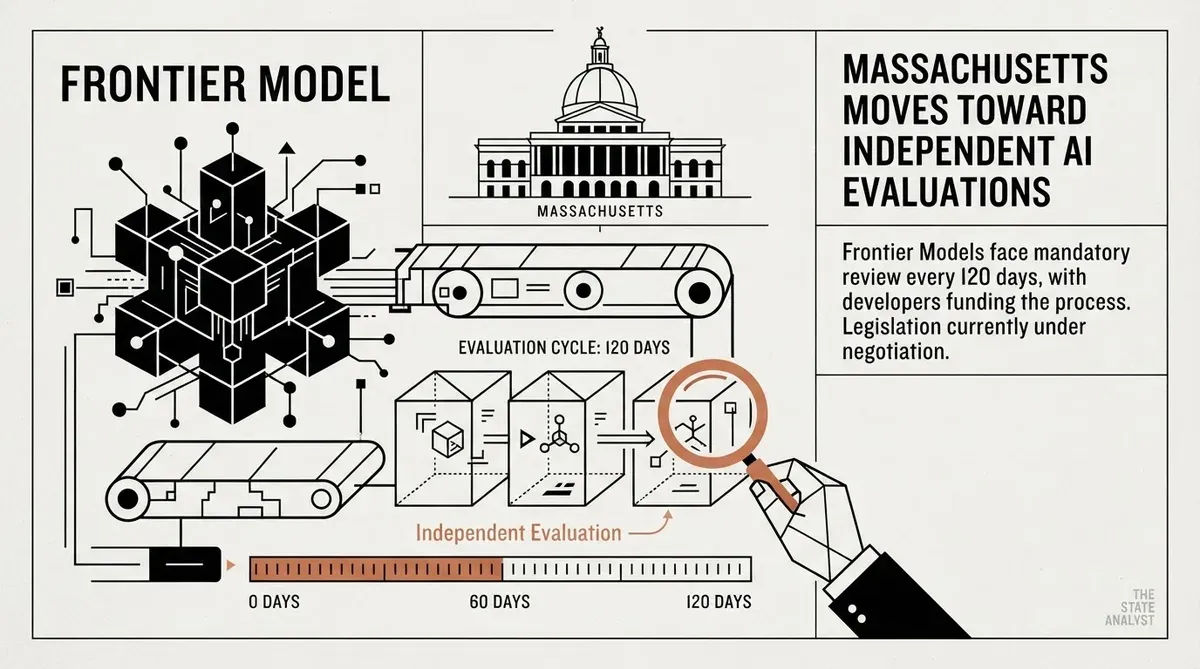
BOSTON (BYTEVYTE) - Massachusetts lawmakers are considering a requirement for independent AI evaluations of the most powerful AI models. The language sits in the state Senate's version of the Mass Wins economic development bill, which is still being negotiated. Governor Healey has asked lawmakers to add AI safety and transparency provisions to the same measure, and the proposal follows major AI-driven cyberattacks.
The Senate-passed version would require leading AI labs to undergo independent reviews of catastrophic risks from frontier models at least once every 120 days. Evaluators could request all materials reasonably necessary to assess those risks, and the developers, not the state, would pay them. The findings would be released to the public, yet the state would have no power to use them to stop AI development. The AI provisions cover large frontier developers with more than $500 million in annual revenue and would be enforced by the attorney general.
How the Proposal Compares With Current Practice
Under the current approach, companies largely assess their own models. Governor Healey has argued for outside reviews of the most powerful systems instead of reliance on company self-assessments. A separate Senate provision would oblige major AI companies to release safety frameworks and would set up a commission to examine whether third-party auditors should be required later. That split matters: the bill as drafted mandates reviews and disclosure now, while mandatory auditing remains a question for a future study.
The positions of the covered companies diverge. Anthropic has endorsed the Senate's rules, arguing that AI companies should not mark their own work. OpenAI has warned that the measure could create confusion for developers. The revenue threshold also limits scope: smaller model builders fall outside the $500 million line, so the reviews would reach only a small group of firms.
Trade-offs and Open Questions
The design trades speed for transparency. A 120-day review cycle creates a regular evidence trail for regulators and buyers, but it also imposes a recurring compliance cost on developers. Because the state cannot halt development based on review findings, the system works as a disclosure regime rather than a licensing gate. Enterprises that rely on frontier models would gain visibility into known catastrophic risks without a legal guarantee that a model will be stopped if problems appear.
Several details remain unresolved. The bill is not yet law, and the final text may change in negotiation. The sources do not specify how evaluators would be selected or qualified. It is also unclear whether the 120-day cadence and the $500 million threshold will survive the conference process. WBUR linked the proposal to recent AI-driven cyberattacks and warnings about risks to humanity, but the cited reporting does not tie any specific incident to the review requirement.
What Decision-Makers Should Watch
For executives at frontier developers, the immediate task is to map which models would fall under the revenue threshold and prepare documentation that an outside evaluator could request. Firms below the threshold should track whether the bill's scope expands. Investors should watch the final text for the cost allocation, the publication rules for findings, and any move from the commission's study toward mandatory third-party auditors.
Why this matters
The proposal tests whether disclosure-based oversight of frontier AI models can work without state authority to pause development. Its final form will show whether the reviews, publication rules and revenue threshold hold through negotiation. For developers and enterprise buyers, the outcome determines how much independent evidence about catastrophic risk becomes available.
While we strive for accuracy and rigor, ByteVyte can make mistakes. Readers are advised to verify all information independently and conduct due diligence before making decisions based on this reporting. We accept no liability for errors, omissions, or decisions made in reliance on this content.
AI-generated image.
Related Articles
- Massachusetts AI safety bill wins Anthropic's backing as OpenAI and Google push annual audits
- Pentagon AI Oversight Bill Targets Frontier Models Already in Military Use
- Illinois AI Safety Audits Set National Precedent as Pritzker Convenes Oversight Cabinet
✔Human Verified
Researched and cross-referenced against primary sources by the Bytevyte editorial team. This article was generated with the assistance of artificial intelligence and reviewed by the Bytevyte editorial team.