
Meta's Alberta Data Center Bets C$13 Billion on Building Its Own Power
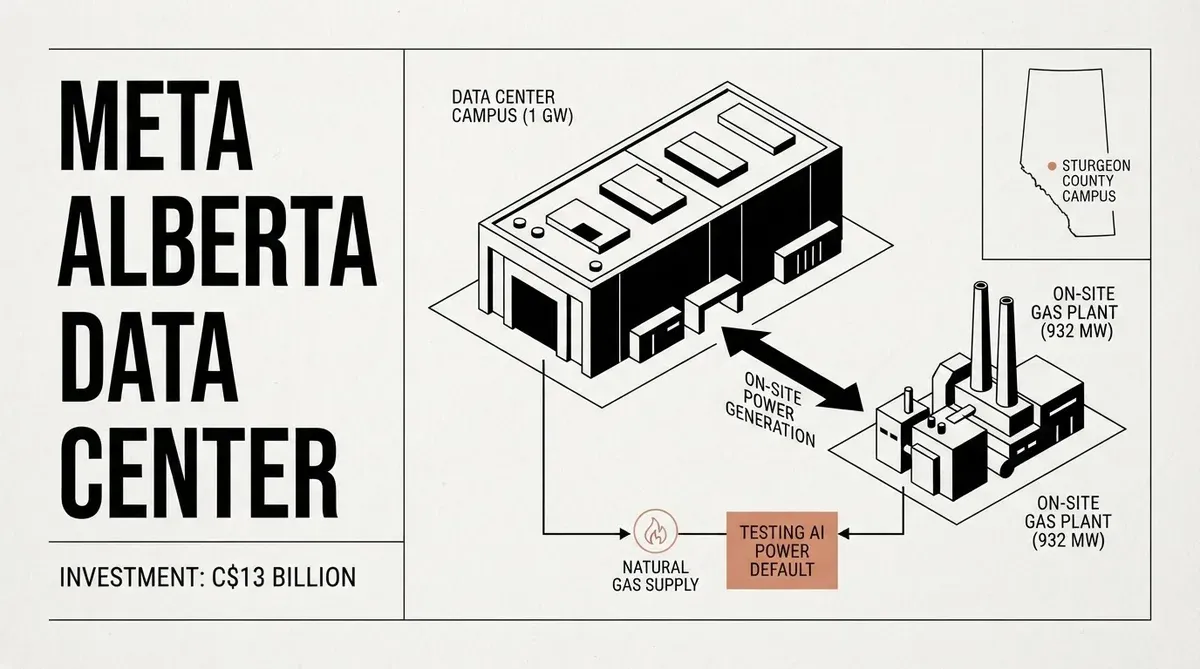
Meta has committed more than C$13 billion, about US$9.17 billion, to its first Canadian data center: a campus in Sturgeon County, Alberta that opens at 1 gigawatt of capacity and is designed to scale to 1.8 gigawatts. The company announced the build in Calgary on July 8, 2026, and it is Meta's largest project outside the United States. Meta's Alberta data center also carries a dedicated 932-megawatt natural gas plant on site, the detail that separates it from a conventional hyperscale lease.
That plant answers the constraint now shaping AI expansion. Hyperscale operators are competing to lock up generation, interconnection and cooling capacity for AI workloads, and building generation on site shortens the path to energized compute. Meta can commission power on its own schedule instead of waiting on a utility's construction plan.
What Meta's Alberta Data Center Commits To
The disclosed figures are specific enough to set against other gigawatt-scale builds.
| Item | Detail |
|---|---|
| Location | Sturgeon County, Alberta, Canada |
| Total investment | More than C$13 billion (about US$9.17 billion) |
| Initial capacity | 1 gigawatt |
| Expansion ceiling | 1.8 gigawatts |
| Dedicated generation | 932 MW natural gas plant |
| Construction jobs at peak | More than 3,000 |
| Permanent operational roles | More than 300 |
| Announcement | Calgary, July 8, 2026 |
The campus is Meta's first in Canada and its largest outside the United States. Sturgeon County's advantage is land and available power rather than proximity to a dense user base, which is why the design starts from generation capacity instead of a leased shell.
The capital cost works out to roughly C$13 billion per gigawatt if the budget covers only the first phase. If the same envelope also funds the path to 1.8 gigawatts, the effective figure falls toward C$7.2 billion per gigawatt. The announced total does not separate the phases, and that distinction determines how the project stacks up against other gigawatt-class campuses.
Two Ways to Secure a Gigawatt
Hyperscalers usually buy power through utility contracts, sometimes with long-term agreements that fund new transmission or generation on the utility's side of the meter. That model keeps capital off the operator's books and hands the siting and scheduling decisions to the utility. Meta has inverted the arrangement at this site.
| Dimension | On-site generation | Utility contract |
|---|---|---|
| Capital ownership | Operator funds the plant | Held by the utility or its rate base |
| Fuel and commodity risk | Carried by the operator | Recovered through tariffs |
| Control of energization date | Set by the operator's build schedule | Set by utility construction |
| Emissions accounting | Attached to the operator's site | Spread across the utility fleet |
| Scaling from 1 GW to 1.8 GW | Needs more plant or grid supply | Needs an amended agreement |
The trade-off is legibility. An operator that builds its own plant knows its commissioning schedule and its fuel contract, and carries both the construction risk and the commodity risk. An operator that waits on a utility receives a regulated tariff and inherits someone else's execution risk. Neither route is cheaper in the abstract. They distribute risk differently, and for a campus measured in gigawatts the schedule is often worth more than the tariff.
Owning the plant converts a recurring utility bill into capital spending plus a fuel contract. That reshapes the operating cost curve for the campus and hands Meta a direct lever on one of the fastest-growing line items in AI. A company running training clusters around the clock can schedule generation it controls against workload peaks rather than against a tariff designed for general customers.
The gas plant's 932 megawatts sit just below the campus's first gigawatt of demand. Meta will need grid supply, further on-site generation, or both to run the site at its initial rating, and exercising the 1.8-gigawatt expansion option would widen that shortfall substantially. The plant's size covers a first phase only; the full power strategy remains open.
Alberta's policy stance is the other half of the calculation. The province has courted AI infrastructure investment, and Capital Power's chief executive has characterized the project as a vote of confidence in the provincial government's AI strategy and a lift to Alberta's appeal among hyperscalers. Those comments landed in the news cycle around September 21, 2026, roughly ten weeks after the announcement, which positions the campus as a reference point for other large-load customers weighing the province. Capital Power operates in that same provincial market, so its read carries weight with the buyers it wants to sign.
The Trade-Offs Alberta Is Accepting
Gas delivers speed and dispatchable power that does not depend on weather. It also ties the campus's fuel costs and operating emissions to gas markets for the life of the plant, a horizon longer than most corporate renewable procurement contracts. The details released so far center on capacity and investment rather than on how the plant's emissions will be accounted for.
Alberta carries a concentration risk of its own. A province whose grid and industrial base lean on natural gas gives an operator speed and predictability, and it also turns the campus's emissions profile into a provincial policy question rather than a purely corporate one. A change in industrial carbon rules would land on a plant this size faster than on a portfolio of smaller distributed loads.
The employment arithmetic deserves stating plainly. Meta expects more than 3,000 construction workers at peak and more than 300 permanent operational roles. Permanent staffing is roughly a tenth of peak construction employment, so the durable job contribution is small against a C$13 billion capital outlay.
For rival operators, the Alberta site removes a chunk of uncertainty. It validates the province's land, power and permitting conditions, and any hyperscaler weighing a Canadian build now has a worked example to price against. Power-intensive computing operators outside AI draw on the same generation and interconnection capacity, so the megawatts Meta has claimed are megawatts other projects cannot use.
Meta's Alberta data center is also the first real test of whether the province's "bring your own power" model scales beyond one anchor tenant. A single campus can be absorbed by Alberta's gas supply and grid. A cluster of them cannot, at least not without new pipelines, new transmission and a regulator willing to approve on-site generation at gigawatt scale.
The workload itself adds a constraint. Training runs and inference traffic draw power unevenly, and a campus rated at 1.8 gigawatts will need generation that can follow those swings. Cooling sits inside the same equation, since the heat that a gigawatt of accelerators produces has to be removed by mechanical systems that consume power themselves. A plant sized near the initial load is a starting point, and the expansion path implies more generation, more grid capacity, or both.
The framing that circulated this week treats the project as evidence in a power race rather than as a capacity milestone. That shift matters for anyone setting AI infrastructure budgets, because it moves the debate from how many accelerators a site can hold to how many megawatts a developer can actually secure.
More than US$9 billion in a single province also resets the negotiating baseline for land, tax treatment and power contracts that follow, whether the next tenant is another AI platform or a power-intensive computing operator chasing the same interconnection queue.
Why this matters
Meta's Alberta data center locates the binding constraint in AI infrastructure: electricity, and specifically who is prepared to build the generation behind it. The open question for decision-makers is whether bringing your own power becomes standard practice for gigawatt-scale campuses, because that would shift the cost structure of AI compute and change the terms every jurisdiction must offer to win the next one. Alberta is now the test case that competing provinces and states will cite. The next markers are whether Meta converts the 1.8-gigawatt option and whether a second hyperscaler commits to the province.
Sources
Breaking Ground on Meta’s First Data Center in Canada
AI-generated image.
Related Articles
- Meta Expands Indian Infrastructure with New AI-Enabled Data Center in Gujarat
- Bell AI Fabric Expansion Hits 1.2 GW With Off-Grid Gas Power
- Google and Intersect Power Launch Meitner Energy Center for AI Infrastructure in Texas
✔Human Verified
Researched and cross-referenced against primary sources by the Bytevyte editorial team. This article was generated with the assistance of artificial intelligence and reviewed by the Bytevyte editorial team.