
Microsoft and OpenAI Restructure Partnership to End Cloud Exclusivity
Microsoft and OpenAI end cloud exclusivity in a major Microsoft-OpenAI partnership overhaul, allowing OpenAI models to launch on AWS and Google Cloud.
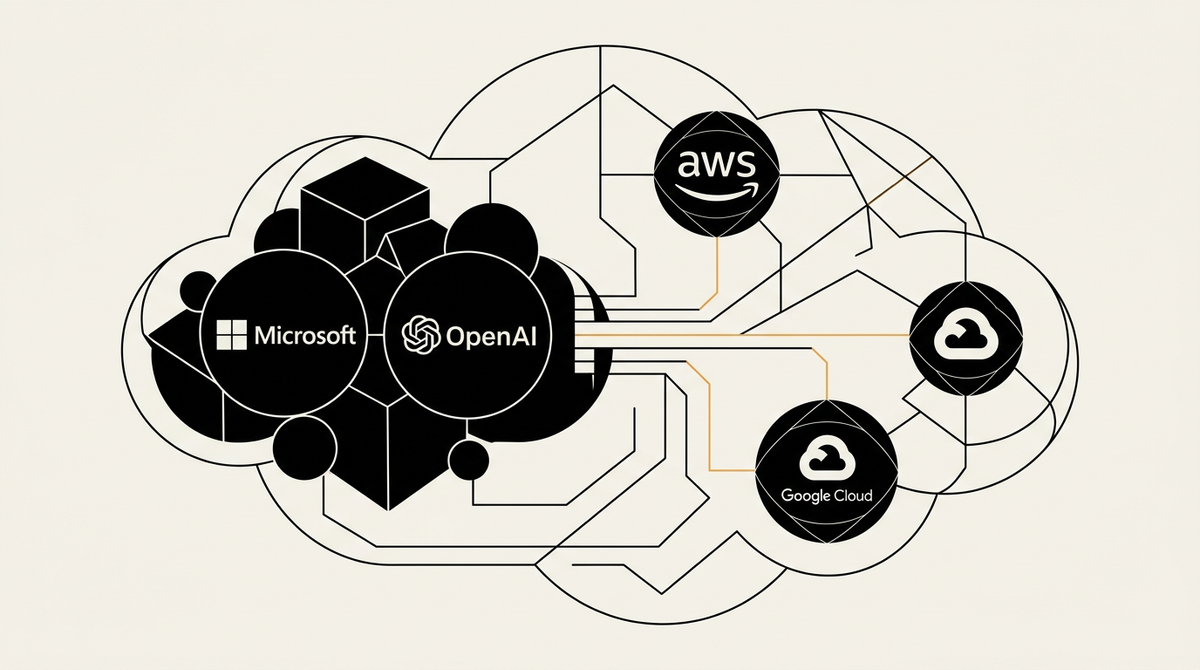
Microsoft and OpenAI have fundamentally altered their multi-billion dollar alliance, transitioning to a non-exclusive relationship that allows the AI startup to utilize rival cloud infrastructure. This strategic shift, announced on April 28, 2026, marks the end of the Microsoft-OpenAI partnership overhaul that previously mandated Azure as the sole hosting provider for OpenAI's advanced models.
Under the revised terms, OpenAI gains the flexibility to deploy its technology on Amazon Bedrock and Google Cloud. While Microsoft remains the primary cloud partner with priority access to new product releases, the exclusivity of the intellectual property licensing agreement has been removed. This licensing extension is now set to run through 2032 on a non-exclusive basis, providing OpenAI with the compute diversity required for its next-generation systems.
Strategic Drivers of the Microsoft-OpenAI Partnership Overhaul
The decision to restructure the deal follows mounting regulatory pressure from authorities in the United States and the European Union. Regulators have been investigating the dominant market position held by the two entities, and this move aims to mitigate antitrust concerns by opening the ecosystem to competitors. Furthermore, the Microsoft-OpenAI partnership overhaul addresses OpenAI's massive demand for compute scale, which has outpaced the capacity of a single provider.
Financial arrangements have also been simplified to reflect a more traditional vendor-client relationship. Microsoft will stop receiving revenue shares for reselling OpenAI models to its customers. In exchange, OpenAI will pay Microsoft a capped revenue share of 20% through 2030. This change signals a shift in Microsoft's strategy as it increasingly focuses on its internal MAI models and diversifies its own AI infrastructure investments.
Impact on the Enterprise AI Landscape
For CTOs and tech leaders, the Microsoft-OpenAI partnership overhaul means that OpenAI's industry-leading models will soon be accessible across a broader range of cloud environments. This reduces vendor lock-in and allows enterprises to integrate these models into existing workflows on AWS or Google Cloud without migrating their entire data stack to Azure.
The timing of the announcement also coincides with the commencement of legal proceedings involving Elon Musk and OpenAI. By distancing themselves from a rigid exclusive structure, both companies are positioning themselves for a more flexible, multi-cloud future while maintaining a core collaborative foundation that has defined the current era of generative artificial intelligence.
While we strive for accuracy, bytevyte can make mistakes. Users are advised to verify all information independently. We accept no liability for errors or omissions.
AI-generated image.
Related Articles
- OpenAI Shifts Enterprise Strategy to Amazon Bedrock Citing Microsoft Partnership Constraints
- Microsoft Launches MAI-Image-2-Efficient for lower AI Costs
- Meta, Microsoft Cut Staff for AI infrastructure investments
✔Human Verified