
Moonshot AI Pre-IPO Round Targets $50B Hong Kong IPO
The Moonshot AI pre-IPO round targets a $50 billion valuation ahead of a year-end Hong Kong listing, with retail access via Gate's KIMI subscription.
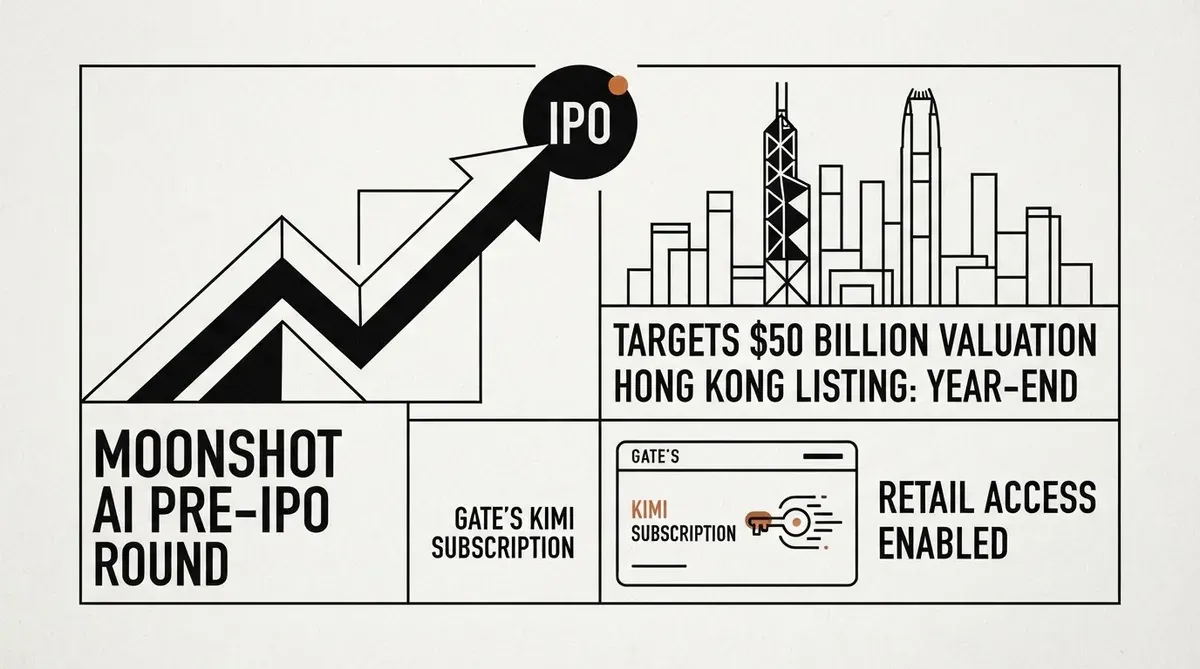
The Moonshot AI pre-IPO round, which opened around August 5, 2026, targets a $50 billion valuation and is set to be the company's final private raise before a Hong Kong listing expected in late 2026 or early 2027. The Beijing-based developer of the Kimi chatbot launched the financing on the back of its Kimi K3 model. Since the model's release, daily revenue has risen to several times the level seen before its debut, and the performance has drawn fresh interest from backers including Alibaba, Tencent, and IDG Capital.
Moonshot was founded in 2023 by Yang Zhilin and has spent the past year turning a strong product cycle into a fast-moving capital story. Kimi K3 has topped coding benchmarks and helped lift annual recurring revenue to roughly $300 million. The model's reception was strong enough to strain Moonshot's infrastructure, a measure of how quickly usage has scaled since the chatbot first appeared.
The valuation path shows the acceleration. A $3.5 billion round in July 2026 valued Moonshot at $35 billion, and its private value has climbed from roughly $4.3 billion to the current target in about a year. The $50 billion figure is equivalent to roughly HK$390 billion, which frames the scale of what the Hong Kong market is being asked to absorb.
| Milestone | Timing | Valuation / Terms |
|---|---|---|
| Private mark before the sprint | Roughly a year before the July 2026 round | ~$4.3 billion |
| $3.5 billion raise | July 2026 | $35 billion |
| G-round opens | August 5, 2026 | ~$50 billion target |
| Gate KIMI subscription | August 11-13, 2026 | $105-$115 per share, ~$50 billion implied |
| Hong Kong listing target | Q4 2026 / Q1 2027 | To be set at pricing |
The table compresses the key point: the gap between July's $35 billion mark and the $50 billion G-round target is a re-rating of roughly 43% in under a month, driven by K3's reception. That pace puts the burden on the next revenue report, since a valuation this far above the $300 million ARR line prices trajectory rather than current earnings.
IPO Readiness: Joint-Stock Conversion and Underwriters
Moonshot has spent the summer preparing the corporate machinery for a public listing. The company converted to a joint-stock structure, a standard prerequisite for a Hong Kong IPO, and has held talks with China International Capital Corporation and Goldman Sachs about underwriting the deal. A shareholder resolution approving the listing has been circulated, with management aiming to complete the process within roughly six months.
The G-round label shows how far into private financing the company has travelled, an unusually long run for a startup founded in 2023. The July raise followed by the G-round within weeks also points to a deliberate strategy of front-loading capital ahead of the listing window, so that compute and infrastructure expansion does not wait on public-market timing.
For Alibaba, Tencent, and IDG Capital, the G-round doubles as a mark-to-market of earlier stakes. A move from $35 billion to $50 billion in weeks lifts their paper gains ahead of the liquidity event, part of why strategic investors accept a price that leaves no room for error on the revenue side.
Retail Demand Enters Through Crypto Pre-IPO Markets
The most distinctive part of the raise is its retail channel. Gate's Pre-IPO platform, in its Phase 3 launch, is running a subscription for Moonshot AI under the symbol KIMI from August 11 to August 13, 2026 UTC. Shares are priced at $105 to $115, implying a valuation of about $50 billion, and subscriptions are payable in USDT and GUSD. The window opens days after the G-round launched, so the retail price band is tested in real time against the institutional target.
That setup puts a crypto-native retail audience directly into a private Chinese AI champion weeks before a listing decision. The subscription is effectively a public vote on the $50 billion price before institutional terms close: strong sell-through would hand Moonshot and its underwriters evidence of demand, while weak take-up would leave the valuation exposed. The Moonshot AI pre-IPO round now has two pricing surfaces, the retail band and whatever terms institutions negotiate, and any divergence between them would be the first signal that the $50 billion mark is soft.
Retail holders also carry the timing risk. If the listing slips from Q4 2026 into Q1 2027, the wait falls on the smallest investors, whose exposure is tied to a single event. A year-end window means Moonshot is betting on one quarter of market conditions, with little room to delay. The published targets themselves vary, from the end of 2026 to early 2027, and the difference is material: a December debut converts the G-round quickly, while a slip to February extends the retail wait and exposes the valuation to a full quarter of new market data.
What the Moonshot AI Pre-IPO Round Must Prove
The multiple is the core tension. A $50 billion pre-money valuation against roughly $300 million in annual recurring revenue leaves little room for a revenue stumble in the quarters before filing. Moonshot is betting that K3's demand curve keeps climbing while it funds the infrastructure expansion the launch exposed, a costly equation for Chinese labs that must work within US export controls on advanced chips. The K3 launch showed demand running ahead of capacity, and a public filing will be judged on reliability as much as growth.
Competition keeps the pressure on. Kimi faces open-weight rivals that publish models at no cost, a dynamic that has kept monetization thin across the category even as usage explodes. The counter is the revenue surge itself. Daily revenue has climbed to several times the pre-K3 level, a concrete figure Moonshot can bring to the listing. K3's benchmark results give it a technical story to match.
A Bellwether for China's AI Listings
Moonshot has moved further down the listing path than most of its Chinese peers, and the outcome will be read by privately held rivals such as DeepSeek and Z.ai as a test of the route to public capital. The playbook now visible runs from joint-stock conversion and underwriter selection to a final G-round at a headline valuation, retail exposure through crypto platforms, and a Hong Kong listing within months.
Crypto pre-IPO markets are becoming a working channel for Chinese AI fundraising rather than a novelty. Gate running a KIMI subscription at a $50 billion implied valuation brings retail into price discovery for rounds that previously closed behind closed doors, and token holders will react to every Kimi release between now and the filing.
What changes for decision-makers: a clean listing at or near $50 billion would validate Hong Kong as the venue for China's AI cohort and give later-stage labs a credible exit path. A valuation cut at listing, by contrast, would ripple through every private round priced in the past year.
Why this matters
The Moonshot AI pre-IPO round is a stress test of China's AI capital-markets pipeline. If retail demand through crypto pre-IPO markets and a year-end Hong Kong listing can fund the compute expansion Moonshot needs, the path opens for the rest of the cohort; if the valuation cracks under scrutiny, later rounds tighten. The Gate subscription closing on August 13 and the revenue figures ahead of the filing will show which way the market leans.
AI-generated image.
Related Articles
- Moonshot AI Pre-IPO Valuation Hits $50B Target in Back-to-Back Fundraising Before Hong Kong Listing
- Moonshot AI Funding Round Doubles to $3.5B at $35B Valuation
- Moonshot AI IPO Push Turns Kimi K3 Capacity Crunch Into a Market Structure Test
✔Human Verified
Researched and cross-referenced against primary sources by the Bytevyte editorial team. This article was generated with the assistance of artificial intelligence and reviewed by the Bytevyte editorial team.