
Multi-Agent AI System Automates 100K Order Confirmations
SAP’s multi-agent AI system automates 100,000 order confirmations annually for Danish wholesaler Lemvigh-Müller, freeing up 3-4 FTEs in procurement.
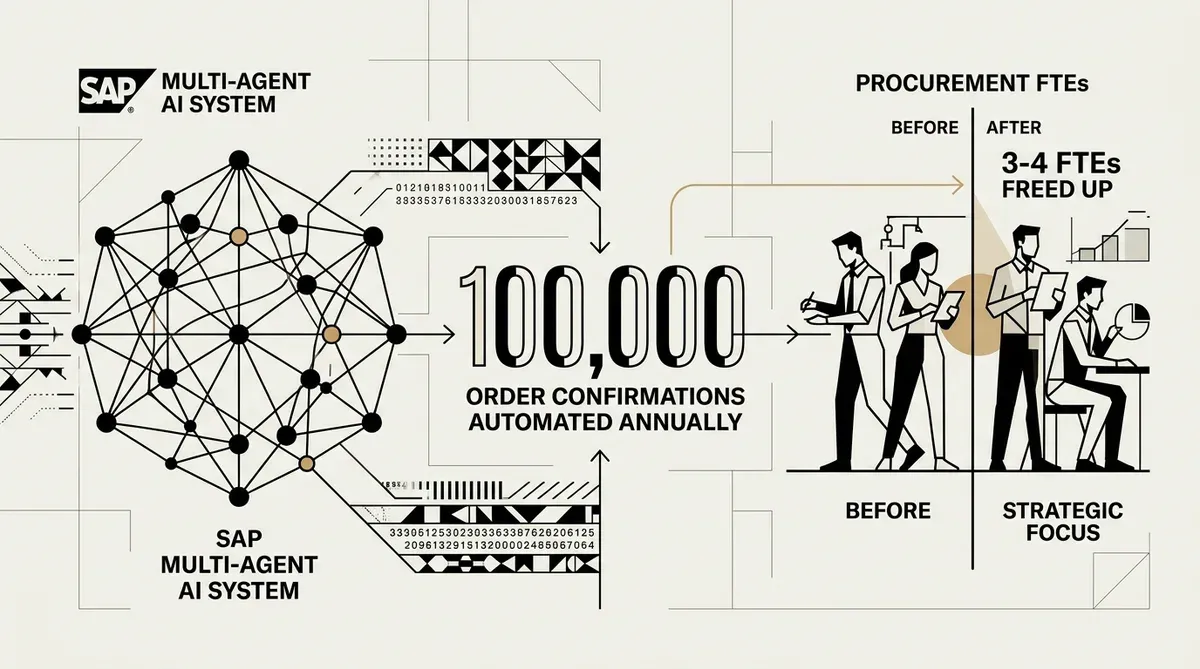
Lemvigh-Müller, a Danish wholesale distributor, has moved a multi-agent AI system into production that automates roughly 100,000 supplier order confirmations each year. The deployment, built on SAP Business AI with implementation partner NTT DATA Business Solutions, targets the approximately 60 percent of the company's 175,000 annual purchase orders that arrive as unstructured PDF attachments rather than through electronic data interchange (EDI). The project advanced from initial concept to live deployment in 10 weeks, and return on investment is expected within several quarters rather than years.
How This Multi-Agent AI System Is Structured
The architecture relies on three specialized AI agents that each handle a distinct stage of the order confirmation pipeline. An email agent sorts incoming supplier messages and identifies those containing order confirmations. A data extraction agent parses the unstructured PDF attachments, pulling out fields such as prices, quantities, and delivery dates. A matching agent then compares the extracted data against the corresponding purchase orders in the SAP system, flagging any discrepancies for immediate review.
This division of labor means each agent focuses on a narrow, well-defined task rather than attempting to handle the entire workflow as a monolithic model. The modular design also allows Lemvigh-Müller to update or replace individual agents as document formats evolve or as new capabilities become available from SAP and its partners. The company works with more than 2,000 suppliers, each of which may send confirmations in different layouts, making the ability to handle varied PDF structures a core requirement.
The system currently addresses the 60 percent of manually handled orders that arrive outside EDI. The remaining 40 percent of non-EDI orders may require additional capabilities or human handling, but the company now processes a majority of its unstructured order confirmations without manual intervention. The three agents coordinate their work autonomously, passing validated data between stages without human oversight except when discrepancies are detected.
Business Impact and Resource Allocation
Lemvigh-Müller expects the automation to free up the equivalent of three to four full-time employees whose time was previously spent cross-referencing PDF confirmations against system records. Those resources can shift to higher-value procurement tasks such as supplier negotiations, contract management, and strategic sourcing. For a wholesale distributor with thin margins, redirecting headcount from data entry to negotiation is a direct improvement in procurement efficiency.
Beyond labor savings, the real-time discrepancy detection changes the quality of supplier interactions. When an email agent flags a price or quantity mismatch immediately, the procurement team can contact the supplier before the order proceeds, rather than discovering the error during invoice reconciliation weeks later. Lemvigh-Müller stated that the system improves delivery data accuracy for its own customers, since correct purchase order data flows through to inventory and fulfillment systems. Price discrepancies, quantity mismatches, and incorrect delivery dates are all caught at the point of entry rather than at the point of payment.
The ROI timeline of several quarters rather than years is notable for enterprise AI deployments. Many large-scale automation projects require 12 to 18 months before they break even on implementation costs, but the 10-week development cycle and immediate reduction in manual effort compress that window substantially. The project was a collaboration among Lemvigh-Müller, SAP, and NTT DATA Business Solutions, with each party contributing domain expertise to the agent design.
Implications for Enterprise AI Adoption
The Lemvigh-Müller deployment illustrates a pattern that is becoming more common in enterprise AI: narrow, task-specific agents orchestrated into a workflow rather than a single large model trying to handle every step. Each agent operates within a bounded scope such as sorting email, parsing a PDF, or comparing two data sets, which makes performance easier to measure and errors easier to isolate. If the data extraction agent misreads a field, that error does not cascade into the matching stage because the matching agent validates against the SAP system independently.
The speed of deployment is another signal. A 10-week timeline from concept to production suggests that the underlying platform, SAP Business AI, provides enough pre-built components that integration work concentrates on connecting the agents to existing business processes rather than building infrastructure from scratch. For other companies evaluating similar automation, the window between decision and value realization may be shorter than traditional enterprise software projects would suggest. The use of three distinct agents rather than a single model also means each component can be trained or fine-tuned separately, reducing the data requirements for any one model.
The collaboration among Lemvigh-Müller, SAP, and NTT DATA Business Solutions also highlights the role of implementation partners in agent-based projects. The AI models themselves may be general-purpose, but the integration with specific ERP configurations, supplier communication patterns, and document formats requires domain expertise that most companies do not maintain internally. The 10-week timeline was achievable in part because the implementation team already understood both the SAP platform and the wholesale distribution context.
The Broader Shift toward Agent-Based Automation
Multi-agent architectures have emerged as one of the dominant patterns in enterprise AI over the past year. Rather than deploying a single chatbot or copilot that attempts to answer any question, companies are assembling teams of specialized agents that each handle one part of a process and pass results to the next agent. This mirrors the way human teams divide complex workflows into specialized roles, and it carries the same advantage: when one agent fails, the others can continue operating.
The SAP deployment at Lemvigh-Müller is one of the more concrete examples of this pattern producing measurable business outcomes. While many companies have experimented with agent frameworks in proof-of-concept environments, moving a multi-agent AI system to production and tying it to a specific transaction volume of 100,000 order confirmations per year provides a reference case that other enterprises can use to build their own business cases. The volume is large enough to demonstrate scalability but small enough that the implementation risk was manageable.
The focus on procurement is strategic. Supply chain operations generate enormous volumes of unstructured documents including order confirmations, invoices, shipping notices, and quality certificates that have resisted traditional automation because each supplier sends documents in different formats. EDI solves this for large trading partners but is too expensive and rigid for the long tail of smaller suppliers. AI agents that can read any PDF and extract the relevant fields close that gap without requiring suppliers to change their systems or adopt new protocols.
What This Means for Decision Makers
For CTOs and procurement leaders evaluating similar projects, the Lemvigh-Müller case suggests three actionable takeaways. First, the multi-agent architecture reduces deployment risk because individual agents can be tested and validated independently before being connected into the full workflow. Second, the 10-week timeline shows that agent-based automation can deliver value within a single fiscal quarter, making it feasible to pilot during a current budget cycle rather than planning for the next one. Third, the ROI projection of quarters rather than years means the financial case does not depend on multi-year projections that often fail to materialize.
The deployment also raises a strategic question for companies that have not yet invested in EDI or similar structured data exchange with their suppliers. Agent-based PDF parsing may reduce the urgency of pushing suppliers toward EDI, since the AI can handle unstructured documents today. However, EDI still offers lower per-transaction costs at high volumes, so companies processing millions of transactions annually may still benefit from structured data exchange for their largest suppliers while using agents for the long tail. A hybrid approach where EDI handles high-volume partners and agents handle the remainder may be the optimal architecture for many distributors.
For SAP itself, the Lemvigh-Müller project is a reference architecture that the company can take to other customers in wholesale, distribution, and manufacturing. The pattern of email agent, extraction agent, and matching agent is generic enough to apply to invoice processing, shipping confirmation, certificate verification, and other document-heavy workflows that connect external suppliers to internal ERP systems. Each of those domains faces the same core problem: unstructured documents arriving from external parties that lack standardized formats.
The key metric going forward will be whether the system maintains its accuracy as the volume and variety of supplier documents grows. A multi-agent AI system that works well with 2,000 suppliers may encounter edge cases as new suppliers with unfamiliar document layouts join the network. Lemvigh-Müller's ability to handle those edge cases without degrading throughput will determine whether the system scales beyond its initial scope or remains a bounded automation for the most common document formats. The modular architecture gives the company an advantage here, since individual agents can be updated as new document patterns emerge, but the operational discipline to monitor and retrain those agents will determine the long-term value of the deployment.
Sources
AI Agents to Take Over 100,000 Manual Order Confirmations at Lemvigh‑Müller
AI-generated image.
Related Articles
- SAP Partners with Universities to Train Students on Agentic AI Systems
- SAP Sustainability AI Agents Debut to Automate Corporate Compliance and ESG Workflows
- Automotive Supplier Martur Fompak Links SAP Joule to Humanoid Robots for Intralogistics
✔Human Verified
Researched and cross-referenced against primary sources by the Bytevyte editorial team.