
HuggingFace vLLM Server Deployment Possible in One Command
HuggingFace vLLM server deployment now takes one command. Spin up private OpenAI-compatible LLM endpoints with pay-per-second billing and multi-GPU sharding.
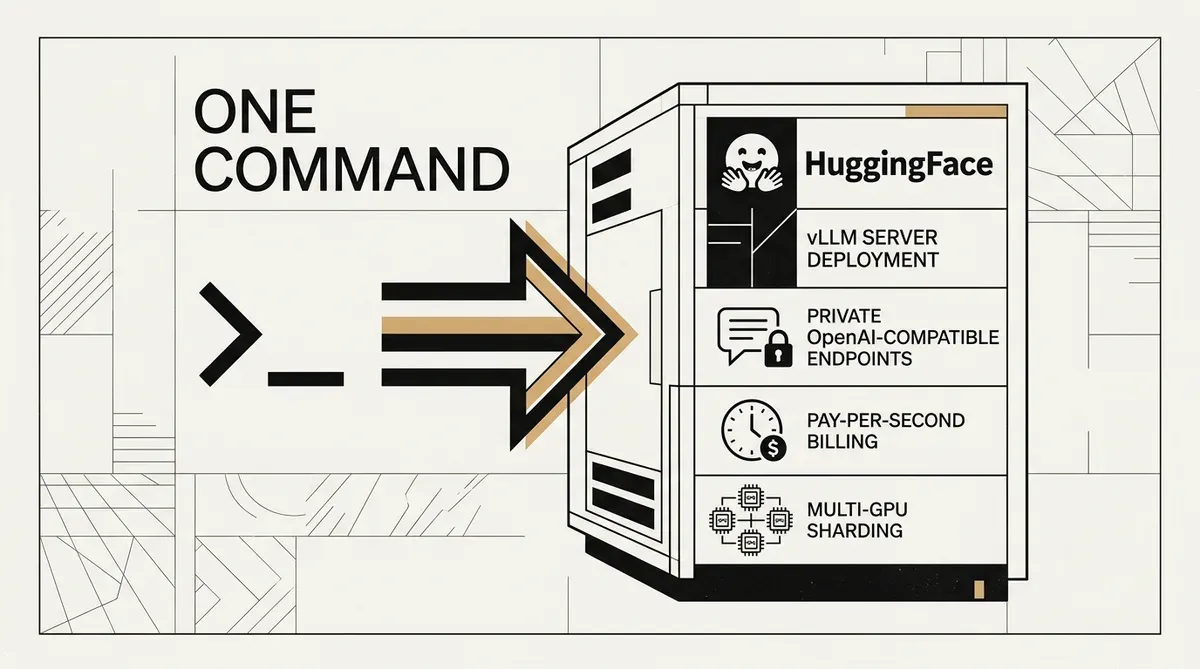
HuggingFace has introduced a feature that lets developers spin up a private, OpenAI-compatible LLM endpoint on its infrastructure with a single command, eliminating the need to provision servers or manage Kubernetes. Announced on June 26, the capability builds on the company's Jobs platform and uses the official vllm/vllm-openai Docker image to deliver pay-per-second inference. This HuggingFace vLLM server deployment option is now available to all users with huggingface_hub version 1.20.0 or later.
The HuggingFace vLLM server deployment workflow centers on the hf jobs run command. Once running, the endpoint accepts queries from a local laptop, a Jupyter notebook, or any internet-connected client. Requests authenticate via the user's HuggingFace token passed as a bearer token, keeping the endpoint private to the account owner. The OpenAI API compatibility means any tool built for that interface can connect directly to the server, whether it is a custom Python script, a curl command, or an external agent.
Pricing starts at approximately $1.50 per hour for an a10g-large GPU instance. Users pay only for the seconds the job runs, making the service suitable for short-lived tests, model evaluations, and batch generation tasks where a full-time inference deployment would be wasteful. For a team running evaluations for a few hours per week, the cost is a fraction of what a dedicated GPU instance would incur, and there are no minimum commitment periods.
Scaling to Frontier Models
The HuggingFace vLLM server deployment supports multi-GPU sharding through tensor parallelism, enabling models as large as Llama 405B to run across multiple GPUs. This capability is critical for organizations that need to evaluate frontier-scale models without committing to long-term infrastructure contracts. Tensor parallelism distributes the model layers across available GPUs, reducing per-GPU memory pressure and allowing larger context windows than a single card can support. Users can specify the degree of parallelism at launch time, scaling from a single GPU up to multiple nodes for the largest open-weight models.
HuggingFace also provides SSH access directly into the running container, allowing engineers to monitor performance, inspect logs, and debug issues in real time. Persistent volumes can be attached to the job, so model weights and configuration files do not need to be re-downloaded for each run. This is particularly useful for teams iterating on prompt engineering or fine-tuning configurations that require repeated inference passes. The container environment is accessible exactly like any remote server, so existing debugging workflows transfer without modification.
Because vLLM speaks the OpenAI API format, any tool or agent that targets that interface can use the HuggingFace endpoint as a backend. The company specifically notes that coding agents such as Claude Code can route queries through the server. Developers query the endpoint via standard curl commands or Python requests, and the same setup can later be promoted to HuggingFace's production Inference Endpoints when the workload matures. This progression from experimental one-off to production service happens without changing the underlying API or model configuration, removing a common source of friction in ML workflows.
Strategic Implications for AI Infrastructure
The one-command deployment model is a direct challenge to the prevailing infrastructure-as-code approach that dominates cloud-based AI workloads. By abstracting away Kubernetes configurations, GPU provisioning, and network setup, HuggingFace lowers the barrier to running private model inference to nearly zero friction. This is especially relevant for smaller teams that lack dedicated MLOps staff but need to evaluate models on enterprise-grade hardware. A single developer can now do in seconds what previously required a cross-team provisioning request.
For organizations evaluating multiple models, HuggingFace vLLM server deployment provides the ability to spin up an endpoint in seconds and tear it down just as quickly, changing the economics of model comparison. Instead of maintaining parallel deployments across cloud providers, teams can run side-by-side evaluations on HuggingFace infrastructure and pay only for the compute consumed. The pay-per-second model makes it economically viable to run a dozen short evaluations per day without worrying about minimum commitment periods or reserved instance costs. A benchmarking session that would have cost hundreds of dollars in fixed infrastructure now costs a few dollars in ephemeral compute.
The move also strengthens HuggingFace's position in the inference market at a time when competitors like Replicate, Together AI, and Fireworks AI offer similar managed endpoints. By tying the new capability directly to the hf jobs system, already familiar to users of the platform's training and fine-tuning workflows, HuggingFace makes inference a natural extension of the model development lifecycle rather than a separate operational concern. The platform now covers the full loop: training, evaluation, and deployment, all within the same ecosystem. Users never leave the HuggingFace environment from the moment they download a model to the moment they serve it in production.
Considerations for Production Paths
For CTOs and engineering leaders evaluating this path, the primary advantage of HuggingFace vLLM server deployment is the reduced infrastructure overhead for LLM evaluation. Teams that previously needed a dedicated MLOps engineer to set up model serving can now run the same workloads with a single CLI command. The SSH access and volume attachments provide enough operational visibility for debugging without requiring a full observability stack. For early-stage startups where every engineer is already stretched thin, this efficiency gain is material.
The primary trade-off is vendor lock-in to HuggingFace's GPU fleet. Organizations running sensitive workloads should verify that data handling policies match their compliance requirements, though the private endpoint architecture, authenticated per-request with a user token, provides reasonable isolation for development and testing use cases. The container runs in an isolated environment, and SSH access is gated by the same authentication layer. For most evaluation and benchmarking scenarios, this level of isolation is sufficient.
For production-scale workloads, the company's Inference Endpoints remain the recommended path, offering autoscaling, SLAs, and dedicated compute. The one-command vLLM feature fills the gap between zero infrastructure and full production, giving teams a glide path from experimentation to deployment without switching tools or platforms. A team can validate a model with a single command, attach it as a backend for a coding agent like Claude Code, and then promote the same model configuration to a dedicated endpoint when usage patterns stabilize. The API contract remains identical across both tiers, so no code changes are required during the transition.
Broader Market Context
The timing of this launch reflects a broader shift in the AI infrastructure market toward simplifying the deployment experience. Cloud providers including AWS, GCP, and Azure have all released managed ML deployment services in the past year, but each still requires users to work through console interfaces, configure networking, and manage IAM policies. HuggingFace's approach collapses that into a single command executed from a terminal, which matches how most AI researchers and engineers already interact with models. The abstraction layer is the command line, not yet another web dashboard.
For the vLLM project itself, HuggingFace serving as an official deployment target validates the inference engine's role as a standard interface for open-weight models. The project, which originated at UC Berkeley, has become one of the most widely used open-source inference engines, and its integration into HuggingFace's Jobs system gives users a direct path from downloading a model from the Hub to running it on compatible hardware without additional engineering work. The combination of the largest model registry and one of the fastest inference engines creates a distribution channel that competing model registries will find difficult to match.
The one-command deployment also creates new possibilities for automated evaluation pipelines. Continuous integration systems can spin up a vLLM endpoint as part of a test suite, run a series of benchmark queries, and tear the endpoint down, all within the same CI job. The pay-per-second billing means that each CI run incurs only the cost of the actual inference time, making automated quality gates for model changes economically feasible for teams of any size. This kind of tight integration between model serving and development workflows was previously only available to organizations with dedicated infrastructure teams.
Sources
Run a vLLM Server on HF Jobs in One Command
AI-generated image.
Related Articles
- Z.ai Debuts GLM-5.2 with 1 Million Token Context and Open MIT License
- NVIDIA and Hugging Face Advance LLM Training with Task-Seeded Synthetic Data Generation
- OpenAI Launches The Deployment Company with $4 Billion to Scale Enterprise AI
✔Human Verified
Researched and cross-referenced against primary sources by the Bytevyte editorial team.