
Muse Spark 1.3: Meta's most powerful model arrives with a paid-API pitch
Muse Spark 1.3, Meta's most powerful model yet, posts a frontier-level benchmark score of 62, but developers pay for the API while consumers get the model free.
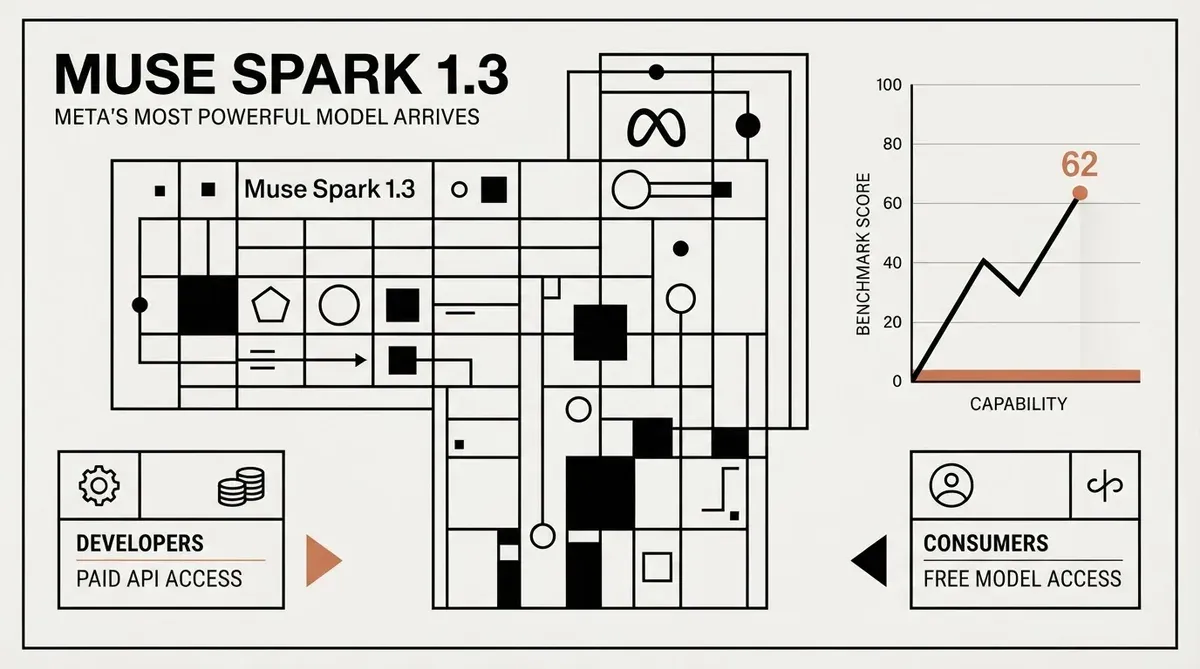
Meta has released Muse Spark 1.3, the most powerful large language model it has shipped to date, and the company is using the release to claim that it has now caught up with Anthropic and OpenAI at the frontier. The rollout began this week in Muse Code and the Meta Model API, placing Meta inside an unusually dense stretch of announcements in which Anthropic, OpenAI, and Google each introduced major models of their own.
Meta chief AI officer Alexandr Wang calls the release the company's largest single jump in model performance so far. In his account, the model is competitive with Anthropic's Claude Fable 5.1, better than OpenAI's GPT-5.6 Sol at generating code, and ahead of the current Chinese models. Independent evidence for the broader claim comes from Artificial Analysis, whose Intelligence Index gives Muse Spark 1.3 a score of 62, behind only Claude Fable 5.1 and Claude Opus 5 and above OpenAI's current lineup.
The model is aimed at long-running agentic work rather than single-turn chat. Meta says it can keep several workflows alive inside one extended thread, assemble its own context from messy and conflicting sources, repair gaps in its plan as they appear, and carry what it has learned into a finished deliverable instead of returning a series of disconnected answers. It is trained to ask clarifying questions when a prompt is vague, to pull the user back in when it is stuck, and to request confirmation before taking consequential actions. On long tasks it adapts to the user's preferences, sending frequent updates or working quietly in the background, and Meta says it preserves detailed requirements across multi-step jobs more reliably than earlier versions of the model. The company frames the release as a step toward what it calls personal superintelligence.
Availability is staggered by channel. Muse Spark 1.3 ships immediately in Muse Code and the Meta Model API, and Meta says months of broad adoption of those two products shaped the release, which it tuned for practical real-world use as much as for benchmark performance. The reasoning modes carried over from previous versions are live from day one, but the max reasoning configuration is held back while additional safety testing is completed. The ordering carries its own message: developers get the model first, consumers follow within days, and the highest-capability reasoning tier arrives last.
The rollout across channels and configurations breaks down as follows.
| Channel or configuration | Status |
|---|---|
| Muse Code | Available now |
| Meta Model API | Available now to developers who pay for access |
| Standard reasoning modes | Live at launch |
| Max reasoning configuration | Deferred pending safety testing; limited preview for partners |
| Facebook, Instagram, Meta AI | Consumer rollout in the coming days |
What the headline score does and does not prove
The 62 from Artificial Analysis is the strongest outside evidence Meta has offered in this release cycle, and it deserves a careful reading. The number is tied to the max configuration, which sits in limited preview with Meta's partners rather than in general availability, so the build most developers can call today is not the exact one carrying the headline result. Read strictly, the index places two Claude systems above Muse Spark 1.3 and OpenAI's current models below it, which is a narrower statement than Wang's claim of outright superiority in coding.
An index that folds many popular benchmarks into a single figure cannot settle that kind of comparison, and Meta's coding-specific claims rest on its own testing for now. Timing matters too. Muse Spark 1.3 is Meta's fourth model release in five months, and it landed in a week when Anthropic, OpenAI, and Google were all announcing flagship systems. That cadence is a competitive choice: shipping at this pace keeps Meta inside every developer evaluation cycle and puts its announcement in the same news window as its rivals instead of a beat behind them. For enterprise buyers that run their own evaluations before committing, a third model at this level also changes the leverage in procurement conversations.
Muse Spark 1.3 targets long-horizon agent work
The feature list shows where Meta is placing its bet. Self-correcting plans, tool-driven context gathering, and sustained multi-workflow threads are the parts of agent development that break most often in production, where models drift from instructions or stall on ambiguous input. Training the model to ask for help and to confirm consequential actions is a direct answer to the reliability problem that has kept agents out of serious business use.
That posture carries its own trade-off. Confirmation checkpoints make the model safer to delegate to, but they also limit how far it can run unattended, which matters for teams that want an agent to finish an open-ended job overnight. And until max reasoning clears safety testing, the true ceiling of the architecture is something paying developers cannot yet measure. Enterprises that standardize on the current build will also need to re-run their evaluations once the max configuration ships, since the model they benchmarked may not be the one they eventually run in production.
Paid API for developers, broad reach inside Meta's apps
The sharper strategic signal sits in distribution. Muse Spark 1.3 is reachable by developers who pay for access through the Meta Model API, while the same model is scheduled to surface inside Facebook, Instagram, and the Meta AI assistant in the coming days. Meta's release materials do not detail pricing for the API, so the cost of running the model remains an open question for teams comparing it against Claude Fable 5.1 or GPT-5.6 Sol.
The company is effectively running two economic paths for one model. Developers get a dedicated paid channel for production workloads, and consumers get the same capabilities inside apps Meta already operates at scale and monetizes through advertising. That division lets the API carry direct revenue while the consumer surfaces handle distribution. If the model holds up in production, enterprises gain a third credible option in an API market that this week's rival launches just made more crowded.
For developers the immediate question is whether Muse Spark 1.3 justifies adding another vendor to the stack at a moment when every major lab has shipped something new within days. The production-focused agentic design and the third-party score make a credible case, but the widely available build is not the one that produced the headline number, and Meta's coding-superiority claims await independent confirmation. The next milestones are the general release of max reasoning after safety testing and the pricing Meta attaches to the API.
Why this matters
For much of this cycle, Meta's models have been treated as capable but a step behind the leading labs, and Muse Spark 1.3 is the release that challenges that reading with an outside benchmark score to back it. If the model performs in the real world as it performs on the index, enterprises gain a serious third option in the frontier API market and Meta gains evidence that its AI investments can be monetized through developer access rather than absorbed as a feature of its consumer apps. Both halves of that case still depend on safety testing finishing and on the widely available model matching the preview's results.
AI-generated image.
Related Articles
- Meta's Muse Spark 1.1 API Undercuts Rivals at $1.25 per Token
- Muse Spark 1.2 Contributor tier: $0.10 tokens, paid in code
- DeepSeek DSpark Framework Speeds LLM Inference 85% in Open-Source Push
✔Human Verified
Researched and cross-referenced against primary sources by the Bytevyte editorial team. This article was generated with the assistance of artificial intelligence and reviewed by the Bytevyte editorial team.