
Negócio de Computação de IA Terrestre da SpaceX Gera US$ 28 Bi com Acordos Colossus
O negócio de computação de IA terrestre da SpaceX gera US$ 28 bi anualmente com acordos Colossus com Anthropic, Google e Reflection AI, superando a receita de lançamentos e Starlink.
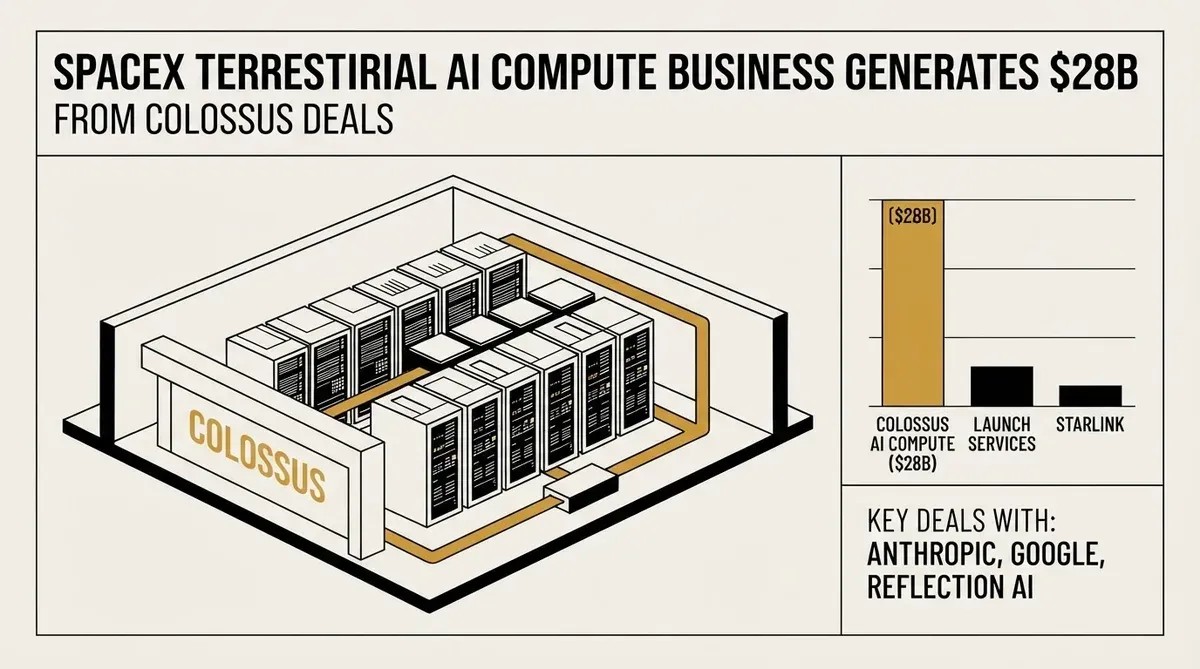
SpaceX's terrestrial AI compute business, built through the Colossus data center complex, now generates more than $28 billion in annual revenue from long-term contracts with Anthropic, Google, and Reflection AI. The figure is roughly nine times SpaceX's 2025 AI revenue of about $3.2 billion and individually exceeds what the company earns from its rocket launches and its Starlink satellite internet service, according to analyst estimates and Reuters calculations.
SpaceX terrestrial AI compute revenue is anchored by two major agreements. Anthropic has committed $1.25 billion per month through May 2029 for access to over 300 megawatts of compute capacity and more than 220,000 Nvidia GPUs at the Colossus 1 facility. Google pays $920 million per month for its share of Colossus capacity, and Reflection AI has signed separate contracts for compute access at the data center complex. Taken together, the monthly billings from these three customers total well over $2.1 billion.
From Rockets to Racks
J.P. Morgan projects that SpaceX will scale its terrestrial AI compute footprint to approximately 9 gigawatts by 2029, a capacity roughly four times the power output of the Hoover Dam. The brokerage views orbital compute as an incremental capacity addition beyond 2029, not a near-term replacement for ground-based infrastructure. Anthony Milovantsev at Altman Solon has described the narrative that orbital data centers will fundamentally disrupt terrestrial facilities as overstated, with any displacement remaining a decade or more away. The analyst consensus is clear: the Colossus boom is a ground story.
The Colossus business is a structural shift in SpaceX's revenue profile. The company's traditional revenue came from launching payloads and selling Starlink subscriptions. Expanding into AI compute turned excess ground-based capacity into a revenue stream that now outpaces both of those established businesses individually. For comparison, SpaceX's launch services business handles contracts for NASA, the Department of Defense, and commercial satellite operators, while Starlink has grown into a global broadband provider with millions of subscribers. The Colossus compute business already exceeds either of those segments on a standalone revenue basis.
The Colossus complex itself consists of at least two facilities. Colossus 1 houses the 220,000 Nvidia GPUs that Anthropic accesses under its contract. Colossus II is expected to come online as demand grows. The scale of GPU deployment at these facilities places SpaceX alongside specialist AI infrastructure providers like CoreWeave and Lambda, though SpaceX brings the additional advantage of vertically integrated access to land, power infrastructure, and capital from its aerospace operations.
The Economics of SpaceX Terrestrial AI Compute
Building and operating terrestrial data centers is a known process with established supply chains, power infrastructure, and fiber connectivity. SpaceX's ability to deploy Nvidia GPUs at scale mirrors what specialist AI infrastructure companies have done, but the company benefits from existing relationships with power utilities and site selection capabilities developed for its rocket and satellite operations. The operating costs of these facilities are driven primarily by power consumption and GPU depreciation, both of which are well understood in the data center industry.
The contracted compute backlog from Anthropic and Google alone is worth nearly $2.2 billion per month. Anthropic's $45 billion deal through May 2029 is the anchor. Google's $920 million monthly payment is the second pillar. J.P. Morgan's timeline of terrestrial expansion through 2029 followed by orbital additions suggests a dual strategy: monetize the infrastructure that can be built today while developing technology for space-based clusters that will supplement ground capacity later.
SpaceX's FCC filing for a million-satellite orbital compute constellation signals long-term ambition in that direction, but the near-term revenue is firmly tied to terrestrial operations. The brokerage's expectation that terrestrial compute will grow to 9 gigawatts by 2029, with orbital added only after that point, underscores the gap in readiness between the two delivery models. The physical constraints of deploying compute in orbit are significant: each satellite must be launched, maintained, and cooled in a vacuum, and the latency involved in beaming data to and from orbit introduces complications for AI training workloads that require rapid data movement.
Risks in the Revenue Stack
The $28 billion annual figure is not guaranteed recurring income. The agreements contain termination provisions that allow customers to exit under certain conditions. A shift in AI training demand, a market downturn, or a contractual dispute could trigger exit clauses that reduce the contracted backlog. Analysts have specifically cautioned that the contracts should not be viewed as guaranteed long-term recurring revenue.
Concentration is another risk. Three customers account for the entire Colossus revenue. Losing any single client would create a significant gap. SpaceX's plan to grow to 9 gigawatts of terrestrial compute by 2029 depends on continued demand growth from existing customers and new additions to the client roster.
For context on the scale of the deals, the combined $2.17 billion per month from Anthropic and Google covers the vast majority of the projected annual figure. These are long-term commitments that provide SpaceX with visibility into future cash flows, but they also create dependency on the continued success and demand requirements of two AI frontier labs. A consolidation among AI model providers or a shift toward smaller, more efficient models could reduce the demand for massive GPU clusters. The rapid pace of model efficiency research means that future AI systems may require fewer GPUs per unit of capability, which could affect the long-term appetite for Colossus-scale compute.
Implications for the AI Infrastructure Market
SpaceX's pivot into AI compute shows that companies with access to large amounts of power, land, and capital are becoming hyperscale compute providers regardless of their original business. The company now competes directly with traditional data center operators, cloud providers, and specialist AI infrastructure firms. The 9-gigawatt terrestrial compute target by 2029 would make SpaceX one of the largest AI compute operators globally.
That scale has consequences for GPU supply, power grid capacity, and the competitive dynamics between AI frontier labs that can secure compute and those that cannot. Anthropic's willingness to commit $45 billion through 2029 indicates that guaranteed compute capacity at scale is itself a strategic asset worth a premium. For smaller AI companies and research labs, the Colossus deals exemplify a market where compute access is increasingly concentrated among a small number of well-funded players.
The IPO of SpaceX, reported under the ticker SPCX, will likely be shaped heavily by this AI infrastructure business. Investors evaluating SpaceX will need to weigh the contracted compute backlog against the termination provisions and customer concentration. The orbital compute narrative, while compelling as a long-term story, does not contribute meaningful near-term revenue to the valuation. The terrestrial contracts, on the other hand, provide the kind of recurring, contracted revenue that public markets typically reward with higher multiples.
For AI companies negotiating compute access, the Colossus deals set a benchmark. A $1.25 billion per month commitment for 300 megawatts and 220,000 GPUs establishes a pricing level that other infrastructure providers must match or undercut. That pricing power is a direct result of the scarcity of large-scale compute capacity in the current market, a dynamic that the Colossus expansion to 9 gigawatts aims to address.
Why This Matters
SpaceX's Colossus deals show that the company's most important near-term asset is not its rockets or its satellite network but its ability to build and operate terrestrial AI infrastructure at an unprecedented scale. For AI companies, the lesson is that compute access, not just model architecture, is becoming a decisive competitive advantage. For the broader technology industry, SpaceX's transformation from aerospace company to AI infrastructure provider signals a larger restructuring in how compute capacity is owned, operated, and allocated. The orbital data center story may eventually arrive, but for this decade, the real action is on the ground.
Related Articles
- Anthropic Garante Acesso Exclusivo ao Supercomputador Colossus 1 Através da SpaceXAI partnership
- Anthropic Garante Acordo de Compute de $1,25B Mensais com a SpaceX e Adquire a Stainless para Expandir o Enterprise AI Ecosystem
- SpaceX Garante Opção de Aquisição de US$ 60 Bilhões para a Startup de Codificação por IA Cursor
✔Human Verified
Pesquisado e cruzado com fontes primárias pela equipe editorial da Bytevyte.