
NVIDIA Blackwell Ultra Drives Shift Toward Industrial AI Factories
NVIDIA defines AI factories as the new economic engine for enterprise intelligence, powered by the Blackwell Ultra GB300 NVL72 platform.
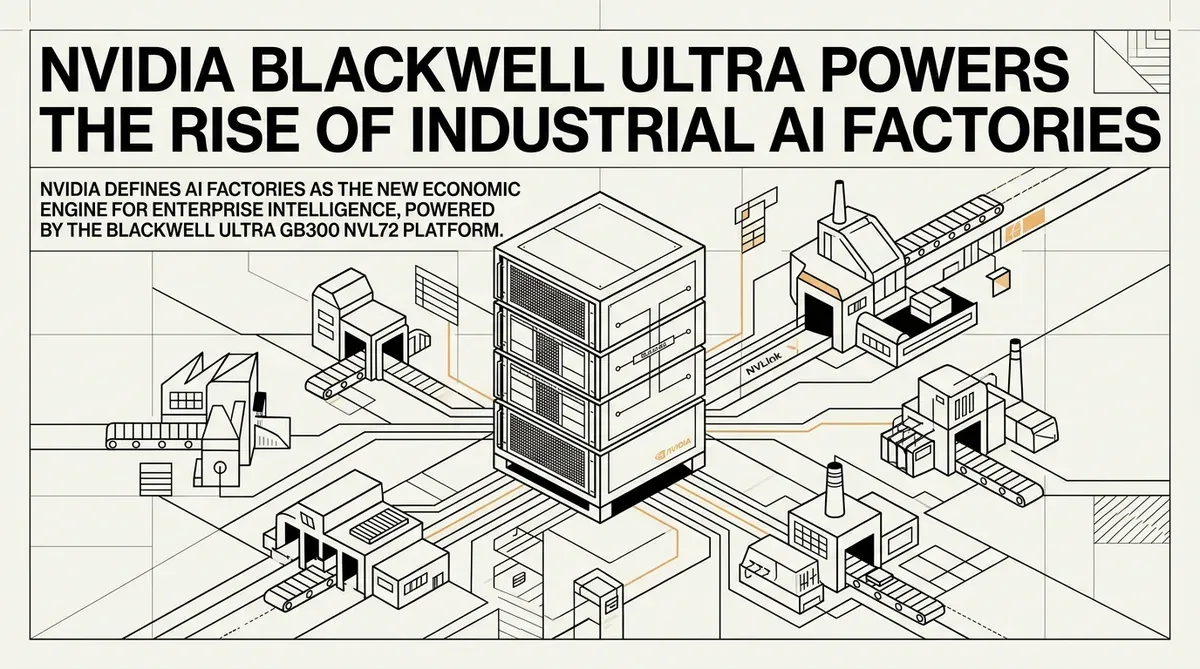
NVIDIA has introduced AI factories as the foundational infrastructure for enterprise intelligence. This transition moves data centers from traditional prompt-response systems to environments built for long-running, multi-agent reasoning. The company announced that its Blackwell Ultra platform, specifically the GB300 NVL72, is the primary engine for these facilities. This hardware provides a 35x reduction in the cost per token compared to previous Hopper-based systems.
The economics of AI factories depend on converting electricity into digital intelligence. As agentic AI becomes standard for corporate operations, performance per watt and token generation costs are the metrics that determine commercial viability. According to NVIDIA, the GB300 NVL72 achieves a 50-fold improvement in token output per megawatt over earlier generations. This efficiency allows enterprises to run complex reasoning tasks that were previously too expensive to scale.
The Strategic Shift to Agentic AI Factories
Modern infrastructure is changing to support autonomous agents that solve multi-step engineering and business problems. NVIDIA uses this model internally. The company has deployed hundreds of autonomous agents within its own AI factory to assist in hardware and software engineering. This internal use is a blueprint for how other organizations can integrate agentic workflows into production cycles.
Data center designs are expanding to gigawatt-scale to accommodate these operations. NVIDIA uses digital twins to optimize physical layout and thermal performance before construction. This process ensures that high-density Blackwell Ultra systems operate efficiently within the power constraints of utility grids.
The company also introduced the Vera CPU to support agentic environments. This processor is optimized for AI sandboxes where multiple agents interact and reason in a secure setting. The Vera CPU handles management tasks so Blackwell GPUs can focus on token generation and inference.
Economic Implications for Enterprise Intelligence
For decision-makers, AI factories change how compute is valued. These systems are revenue-generating assets where the output is intelligence rather than a capital expense for general IT. The 50x increase in throughput per megawatt provided by the Blackwell Ultra platform affects the bottom line for companies building proprietary models or large-scale agent fleets.
Token economics suggest that competitive advantage will belong to firms that generate high-quality reasoning at the lowest energy cost. The GB300 NVL72 will ship to partners later this year. The development of gigawatt-scale intelligence hubs is now a central part of global industrial policy.
While we strive for accuracy, bytevyte can make mistakes. Users are advised to verify all information independently. We accept no liability for errors or omissions.
Sources
AI Factories: The New Infrastructure of Intelligence
AI-generated image.
Related Articles
- NVIDIA Unveils AI Factories to Power the Next Generation of Autonomous Agents
- AWS Integrates NVIDIA Blackwell GPUs into SageMaker with New G7e Instances
- Lenovo Unveils Production-Scale AI for Manufacturing
✔Human Verified