
NVIDIA Vera Rubin Platform Powers New Dell Servers to Slash AI Costs
NVIDIA Vera Rubin platform powers Dell's new PowerEdge XE9812 to reduce AI inference costs by 10x and accelerate agentic workloads.
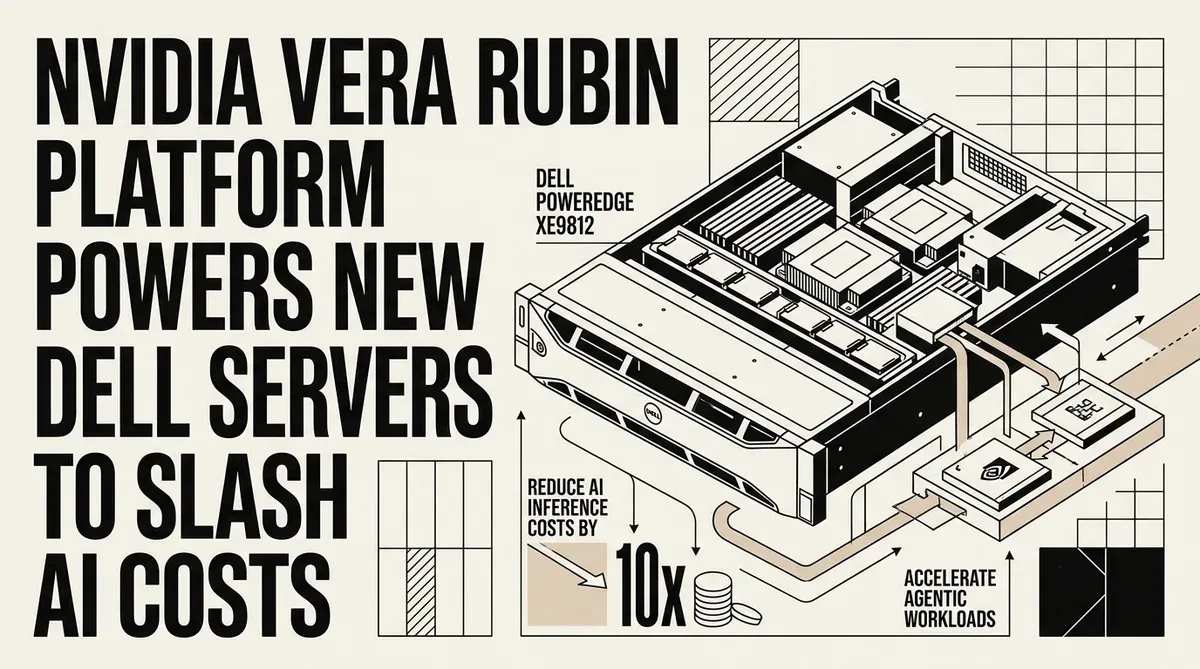
NVIDIA and Dell Technologies have unveiled a new AI infrastructure collaboration designed to drastically lower the operational costs of running autonomous agents. Announced this week at Dell Technologies World, the partnership centers on the Dell PowerEdge XE9812 server, which utilizes the NVIDIA Vera Rubin NVL72 platform. This hardware combination aims to reduce the cost-per-token for large-scale AI inferencing by up to 10 times compared to previous architectures, addressing a major barrier to enterprise AI adoption.
The NVIDIA Vera Rubin architecture introduces a dedicated CPU designed specifically for agentic AI workloads. According to NVIDIA, this processor runs these complex tasks 50% faster than traditional x86-based systems. A key technical advantage is the 1.2 TB/s memory bandwidth, which is three times higher than competing solutions. This high bandwidth allows the system to handle the rapid data movement required for autonomous agents to function effectively in production environments.
Strategic Impact of the NVIDIA Vera Rubin Platform
The shift from experimental AI pilots to full-scale production requires a significant reduction in compute expenses. Dell and NVIDIA are targeting this transition by offering on-premises solutions that compete directly with public cloud providers. Dell has stated that enterprises deploying these systems locally can reach a break-even point against cloud API costs in as little as three months. This financial incentive is paired with the launch of PowerRack, a fully integrated system that combines compute, networking, and storage into a single rack-scale solution.
To support the intense heat generated by these high-performance systems, Dell introduced the PowerCool CDU C7000. This rack-mount cooling unit provides over 220kW of capacity and is the first of its kind built specifically for the NVIDIA Vera Rubin NVL72. These advancements in thermal management are necessary to maintain the performance levels required for frontier models like Gemini 3 and Grok, which the companies are working to bring on-premises through strategic partnerships with Google and SpaceXAI.
Initial shipments of the Vera-powered units have already reached major industry players, including OpenAI, Anthropic, Oracle, and SpaceXAI. For smaller-scale needs, Dell is also launching Deskside Agentic AI workstations. These allow businesses to run autonomous agents locally, ensuring data sovereignty while maintaining the performance benefits of the new architecture. As demand for AI computation continues to rise, this integrated hardware approach provides a clear path for organizations to scale their AI operations while controlling long-term costs.
While we strive for accuracy, bytevyte can make mistakes. Users are advised to verify all information independently. We accept no liability for errors or omissions.
Sources
NVIDIA CEO Jensen Huang at Dell Technologies World: ‘Demand Is Going Parabolic’
Dell Technologies Closes the Gap Between AI Ambition and AI Outcomes
AI-generated image.
Related Articles
- NVIDIA Starts Mass Production of Rubin R100 GPUs and Vera CPUs for Next-Gen AI
- NVIDIA and Ineffable Intelligence Partner to Advance Reinforcement Learning Infrastructure
- Dell and Kioxia Reveal 9.8 PB AI Flash Storage Server for Massive Data Lakes
✔Human Verified