
Dell and Kioxia Reveal 9.8 PB AI Flash Storage Server for Massive Data Lakes
Dell and Kioxia unveil a 9.8 PB AI flash storage server in a 2U chassis, offering 8x power efficiency for generative AI and large-scale data lakes.
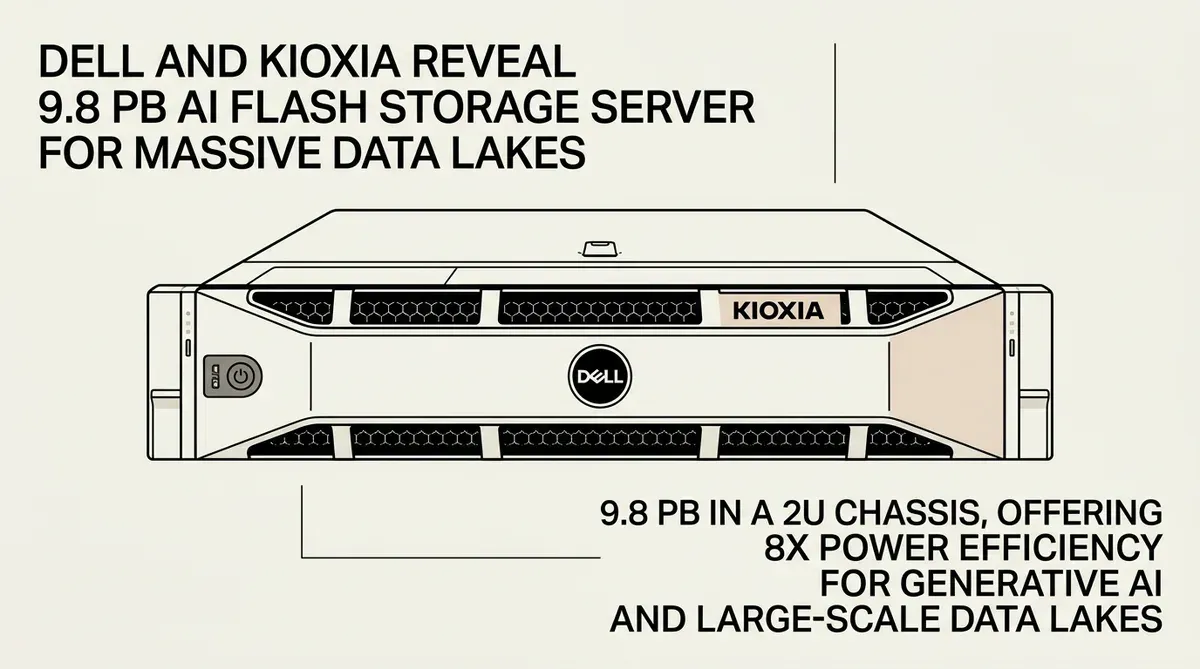
Dell Technologies and Kioxia have collaborated to launch a high-density AI flash storage solution that reaches 9.8 petabytes (PB) of capacity within a single 2U server chassis. This milestone, announced this week at Dell Technologies World 2026, addresses the escalating data demands of generative AI training and large-scale data lakes. By integrating 40 Kioxia LC9 Series NVMe SSDs into a Dell PowerEdge R7725xd server, the companies have established a new benchmark for storage density.
The hardware configuration utilizes the E3.L form factor of the Kioxia LC9 Series, with each individual drive providing 245.76 terabytes (TB) of capacity. These SSDs are built on 8th Generation BiCS FLASH technology and support PCIe 5.0 interfaces, enabling data transfer speeds of up to 12,000 MB/s. The underlying server platform, the Dell PowerEdge R7725xd, is powered by AMD EPYC processors, providing the necessary compute overhead to manage the massive throughput required for AI workloads.
Strategic Impact of AI Flash Storage
The introduction of 9.8 PB in a 2U form factor is a significant shift in data center efficiency. Standard high-density deployments typically rely on 30.72 TB drives, which would require eight times the physical rack space and power consumption to match the capacity of this new AI flash storage system. For enterprise decision-makers, this density translates directly into lower operational costs and a smaller physical footprint for massive data repositories.
This development is particularly relevant for organizations managing the AI lifecycle, where data ingestion and model training require rapid access to vast datasets. The power efficiency gains are substantial; Kioxia stated that the new configuration offers an eightfold reduction in power consumption compared to traditional high-density SSD arrays. This efficiency is a critical factor for CTOs looking to scale AI capabilities while adhering to strict energy and cooling constraints in modern data centers.
Market Implications and Deployment
The partnership between Dell and Kioxia highlights a growing trend of hardware optimization specifically for the AI era. As datasets for large language models continue to expand, the bottleneck often shifts from raw compute to storage I/O and capacity. By delivering nearly 10 PB in a 2U chassis, the AI flash storage solution allows firms to consolidate their data lakes, reducing the complexity of managing distributed storage clusters.
The Kioxia LC9 Series SSDs are designed to meet the rigorous endurance and performance requirements of enterprise environments. The use of the E3.L form factor ensures better thermal management and signal integrity for PCIe 5.0 speeds, which is essential when packing 40 high-capacity drives into a compact space. Organizations can expect these systems to play a central role in the next generation of AI-optimized infrastructure, providing the high-speed access necessary for real-time data processing and model refinement.
While we strive for accuracy, bytevyte can make mistakes. Users are advised to verify all information independently. We accept no liability for errors or omissions.
AI-generated image.
Related Articles
- DeepSeek V4 Launch Introduces Trillion-Parameter Pro and High-Speed Flash Models
- Intel, Dell, and Nokia Unveil High-Efficiency 5G Far-Edge Network Solution
- Neurovia AI Launches NeuroStream Video Compression to Cut 4K Storage Costs by 95%
✔Human Verified