
Nvidia's Doubling Promise Meets Its First Real Test: GPU Rental Prices
Nvidia's Jensen Huang says chip sales will double in 2027, while rising GPU rental prices from Nebius give the AI capex debate its first real price signal.
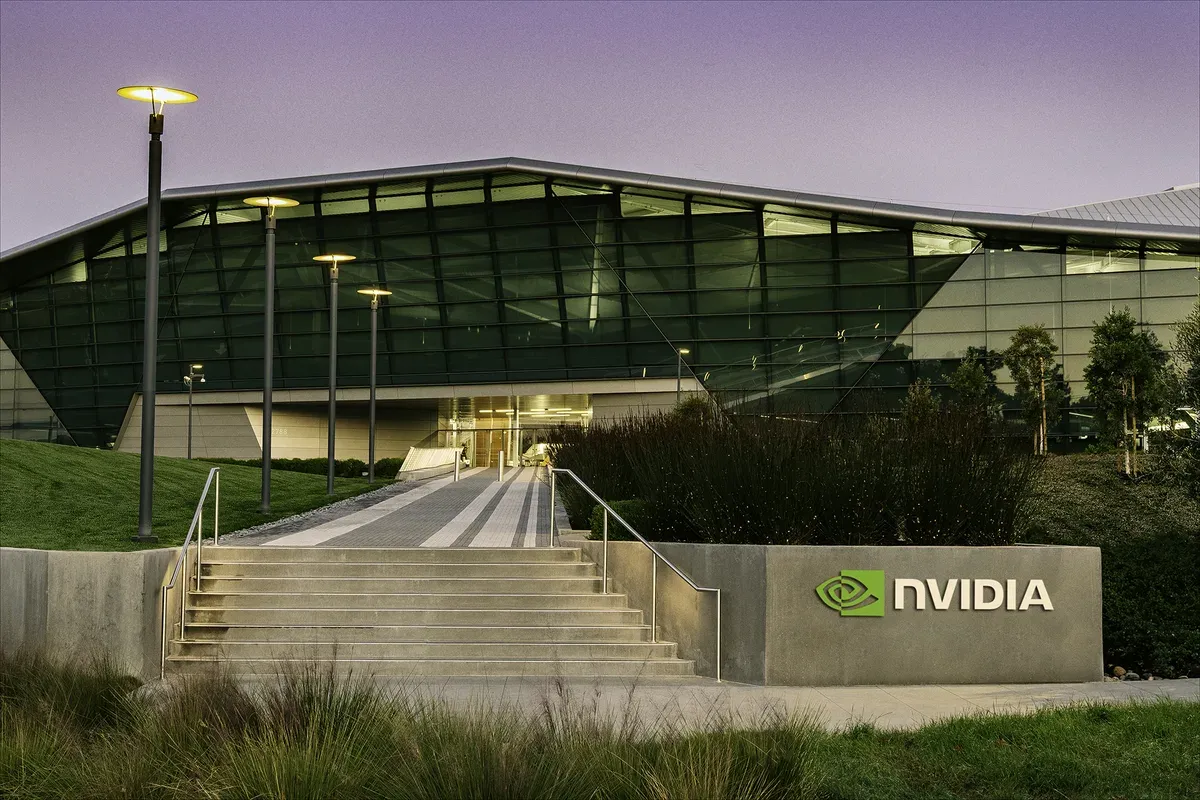
Jensen Huang has told an AI audience in Scotland that Nvidia's chip sales in 2027 should reach roughly twice the current annual level. The forecast, delivered on 17 September, is the most concrete forward revenue commitment the company has attached to a calendar year. It also arrived in the same week that the compute market produced something it has lacked all year: a genuine price signal. GPU rental prices moved up, and that single data point should carry more weight in the AI capex debate than any benchmark published this quarter.
The signal came from Nebius. The cloud infrastructure provider told customers it would raise prices across its chip rental stack. Advanced Micro Devices shares climbed 6.3% the same day, 17 September, and the two events were widely read as connected. A provider lifting posted rates is describing its own order book. Rental pricing is the closest thing this market has to a clearing price for compute, and it is the variable that turns a capex narrative into an arithmetic problem.
Huang's claim and Nebius's repricing describe the same market from opposite ends. Nvidia sells the silicon; Nebius rents it out. If the Nvidia chief executive is right that 2027 volumes double, rental rates should keep climbing, because demand that absorbs twice the hardware has to bid for a scarce pool of capacity along the way. Nvidia has identified the co-packaged optics (CPO) supply chain as the expected beneficiary of the next capacity step-up, which hints at where the company believes the constraint will bind.
A doubling in volume has a second implication that is easy to miss. Nvidia would be adding that capacity into a market where the nearest competitor just moved on the strength of a rental repricing. Scaling output that aggressively is a share-defence strategy as much as a growth plan, since the fastest way to blunt a rival's pricing power is to make sure the market is not short of alternatives. The CPO supply chain benefits either way, because it sits upstream of whichever vendor wins the socket.
Why GPU Rental Prices Are the Signal That Matters
Capability benchmarks have been the industry's preferred shorthand for progress, and they are nearly useless for capital allocation. A model that scores higher on reasoning tests tells a buyer nothing about whether the accelerator it runs on will earn its depreciation. A rental rate does. When a provider with capacity to sell raises its price, it reports that the marginal buyer is still willing to pay more than the last one did.
Data centre operators set capex against expected rental yields. Rising posted rates lift the return on new capacity, which pulls orders forward. That mechanism is why a rental repricing carries more information than a demand forecast: it changes the buyer's math, while a forecast only describes it. Scarcity, more than capability, is what determines the return on a building full of accelerators.
Three signals from the same week now sit on the same axis:
| Signal | Date | What it indicates |
|---|---|---|
| Nvidia guidance: 2027 chip sales roughly 2x the current annual level | 17 Sep 2026 | Supply-side commitment; no booked order disclosed |
| Nebius raises prices across its chip rental stack | 17 Sep 2026 | Posted rental rates rising with utilisation |
| AMD shares gain 6.3% | 17 Sep 2026 | Equity market treats rental repricing as demand evidence |
| Anthropic essay on measured AI development | 15 Sep 2026 | Narrative demand risk; no observable GPU slowdown followed |
The last row is the one that complicates the story. Anthropic's public argument for measured AI development prompted a sell-off in AI chip names, yet no observable slowdown in GPU demand has appeared in the days since. Pricing data and narrative data are pointing in different directions, and only one of them is falsifiable within a quarter.
The Strongest Case Against the Doubling
The bear case deserves a fair hearing, because two of its pillars are solid. The first is incentive: Huang runs the company that benefits from every dollar of capex his forecast justifies, and a revenue projection is not a purchase order. The second is sample size. Nebius is one provider. Its repricing could reflect its own power contracts, financing costs, or a deliberate decision to ration scarce capacity toward customers willing to pay more. A single neocloud raising rates establishes a hypothesis that a second provider would have to confirm.
Rationing is the strongest version of that objection. A provider can raise posted rates precisely because it cannot add capacity fast enough, which makes the repricing a statement about supply as much as about demand. Both readings imply the same near-term direction for the rental rate and diverge only later, once new capacity arrives. The rate itself is the number to track, whatever the reason behind the rise.
The demand-side scenario deserves its own line. If frontier labs slow their buildout, the doubling fails and rental rates fall first. That is coherent, and it is the scenario Anthropic's essay invited investors to price. It has simply not surfaced in the data. Utilization and rental pricing are the two places a slowdown would appear earliest, and neither has moved down since the essay was published on 15 September.
A third risk gets less attention: the doubling could fail on supply rather than demand. Twice the volume requires roughly twice the advanced packaging, high-bandwidth memory and optical interconnect. The CPO reference points at exactly that layer. If the upstream chain cannot deliver the step-up on Nvidia's schedule, the revenue forecast slips regardless of how badly buyers want the parts.
There is rough arithmetic investors can follow. A 2027 output level at twice the current run rate requires a comparable step-up in the packaging, memory and optical supply that feeds it. Supplier guidance that falls short of that step-up is a leading indicator that the revenue forecast gets revised before the demand curve does.
Where I Think the Risk Sits
My read is that the doubling is more likely to be capped by Nvidia's own supply commitments than by a demand collapse. That flips the usual framing. The question stops being whether AI capex is a bubble and becomes whether the packaging, memory and optics chain can be financed and built fast enough to hit a 2027 number that Huang has now made public.
That also makes the forecast self-pressuring. Huang has put a specific multiple on the record, and Nvidia will have to show capacity commitments, supplier qualifications and lead times that support it. Those disclosures matter more than the next model launch.
I would also discount the equity reaction. AMD gaining 6.3% on a competitor-adjacent repricing says more about how thin conviction is in this sector than about AMD's own order book. The stock moved on a price signal generated by another company's customers, which is a fragile basis for a re-rating and cuts the other way when the next repricing goes down.
What would change my mind? A second and third provider raising GPU rental prices across their stacks, which would turn the Nebius move from an anecdote into a market price. Or the opposite: a major provider cutting posted rates while Nvidia holds to the doubling, which would mean supply is arriving faster than demand can absorb it.
Why this matters
The AI capex debate has run on narrative for two years, and narrative is expensive to argue with. Rental pricing gives it a number. If GPU rental prices keep climbing through the next two quarters, the doubling claim looks conservative and the buildout looks underfinanced. If they flatten while Nvidia commits to twice the volume, the constraint has moved upstream into the supply chain, and the companies building packaging, memory and optics become the ones whose capacity commitments decide whether the forecast lands.
Related Articles
- Nvidia Q2 earnings: a $92B test of the AI boom
- Nvidia AI server price hike tops 15% as memory costs surge
- Nvidia Nebius Investment: 9.3% Stake in Neocloud Platform Signals Strategic Shift
✔Human Verified
Researched and cross-referenced against primary sources by the Bytevyte editorial team. This article was generated with the assistance of artificial intelligence and reviewed by the Bytevyte editorial team.