
Biren Share Placement Raises $515 Million as Third Cash Call Tests China's GPU Challengers
Biren share placement raises HK$4.04bn ($515m) in Shanghai Biren's third cash call in nine months, as dilution and a July discount hit the stock.
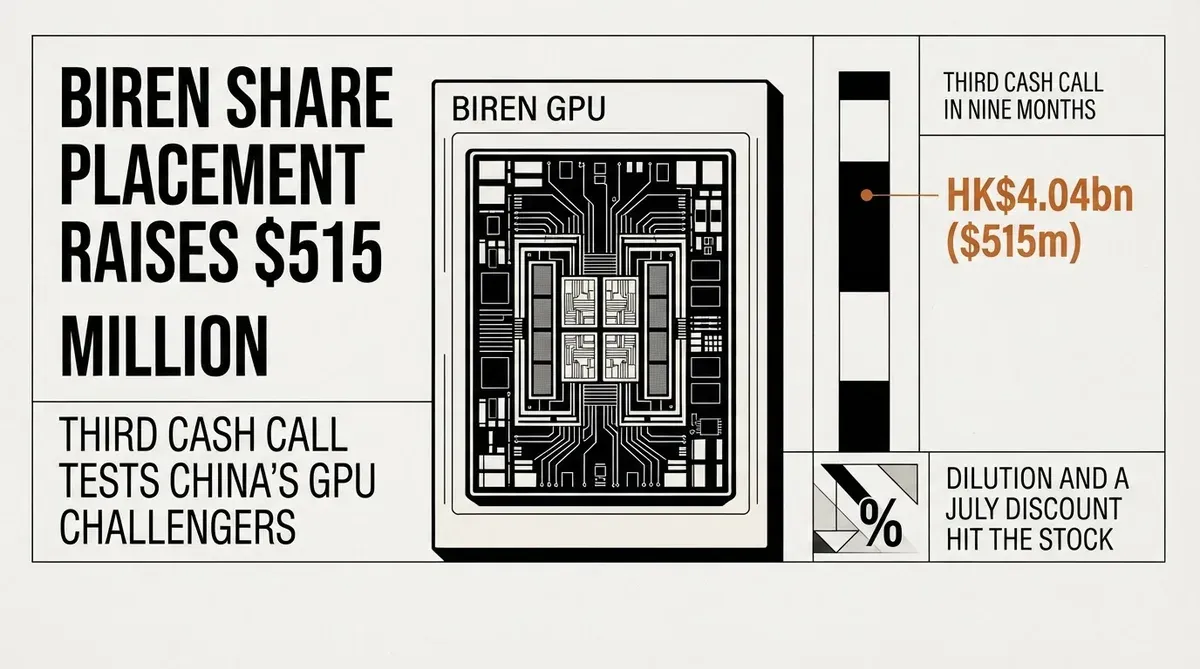
Shanghai Biren Technology is back in the Hong Kong equity market for HK$4.04 billion ($515 million), its third cash call in nine months. The Biren share placement covers 130 million new H shares priced at HK$31.08 each and is being arranged through CICC Hong Kong Securities and UBS's Hong Kong branch, according to the company's filing. Gross proceeds total HK$4.04 billion, with about HK$4.02 billion arriving after expenses.
That price is roughly a third below the July 2026 follow-on, and the dilution pulled the stock down in early Hong Kong trading on Thursday, with declines of between 6% and 12% reported during the session. Biren's shares remain up about 70% year to date, but they sit more than 50% below a June 2026 peak. The company had been weighing a raise closer to US$1 billion before settling on a smaller round.
Biren designs general-purpose GPUs for AI training and inference and sells them as domestic alternatives in China's data-centre build-out. Export controls that limit access to top-tier Nvidia parts have turned that segment into a magnet for state backing and private capital. Its IPO prospectus earmarked roughly 85% of listing proceeds for research and development, and the company has said the new money will fund its AI business and general working capital.
What Three Rounds in Nine Months Cost
The sequence of Biren's 2026 fundraising shows how quickly the terms have changed.
| Round | Date | New H shares | Price per share | Gross proceeds |
|---|---|---|---|---|
| IPO | January 2026 | 284.8 million | HK$19.60 | HK$5.58 billion |
| First follow-on placement | July 2026 | Not disclosed | Not disclosed | About HK$7.07 billion |
| Second follow-on placement | October 2026 | 130 million | HK$31.08 | HK$4.04 billion |
Two details stand out. The October price of HK$31.08 is 59% above the HK$19.60 at which Biren sold its IPO shares in January, so buyers are still paying a premium relative to the listing. The round size moved the other way: Biren had been exploring roughly US$1 billion, and the placement landed at a little over half that. A company raising above its IPO price but below its own July terms is being repriced by its shareholder base.
Context matters for reading that price. Biren's January debut jumped sharply on its first day, the strongest opening for a Hong Kong listing that raised at least US$700 million since 2021, and the stock has held a 70% gain this year even after the drawdown from June. The valuation rests on a single thesis: that Chinese data-centre operators will buy domestic GPUs at scale while export controls keep the best Nvidia parts out of reach. Banks had spent weeks gauging demand for a deal roughly twice the size of the one Biren finally priced. Each placement is a fresh vote on how quickly the substitution thesis converts into orders.
Growth That Still Needs the Market
Across its January IPO and two follow-on placements, Biren has pulled in roughly HK$16.7 billion, about US$2.1 billion, in nine months. That figure is the crux of the stress test facing China's GPU challengers. Fast-growing chip designers can absorb enormous sums in development and production tooling before any of it converts into shipped volume, and Biren has not yet shown that its own cash generation can carry that load.
The structure of the spending points the same way. Research and development takes the large majority of listing proceeds, and the second raise arrived only months after the first. A business funding itself from operations would not need three trips to equity investors inside a single year. What Biren does have is demand, since export controls have pushed Chinese data-centre operators toward domestic silicon.
Biren is not raising alone. Chinese AI companies have been tapping equity markets at a record pace through 2026, so its placements compete for the same institutional money as a long list of peers telling similar stories. A sector-wide fundraising wave gives buyers leverage, and Biren's shrinking round and one-third discount to its July terms look like that leverage being applied.
The July round is the benchmark that stings. Biren raised nearly HK$7.07 billion then; it is now taking HK$4.04 billion at a price about a third lower. The three months between the two rounds have not closed the gap between the capital the company needs and the capital buyers will supply at the old price.
Both things can be true at once. The domestic market is large enough to justify Biren's spending, and the spending is large enough that revenue cannot yet cover it. Every placement buys time and production capacity while shrinking the claim of existing shareholders. When the shares were rising, that trade looked cheap; with the stock down by half from its June peak, each new round is a harder sale.
The Options, and What Each One Costs
Biren faces a real choice about the pace of the next phase, and the trade-offs cut in opposite directions.
Continuing to raise equity while investors will still buy keeps development at full speed and protects the company's position in a domestic market where several rivals chase the same Nvidia substitution opportunity. The cost is dilution at falling prices. Existing holders have absorbed 130 million new shares in this round on top of the 284.8 million sold at the IPO, and a fourth raise at a further discount would compress their stake again.
Slowing the spending would protect the share register but risks something harder to reverse. GPU development is a multi-year commitment, and a company that pauses work on its next generation gives rivals room to qualify their own silicon with the same customers. For a chip designer whose main asset is the confidence of large data-centre buyers, a visible slowdown can cost more than a discounted placement.
A third path exists, and it is the one the market is pricing: keep raising, but accept smaller rounds and lower prices as the sector matures. That is what the Biren share placement looks like. It funds the business without answering the underlying question of when equity dependence ends.
Customers are the third party in this calculation. Chinese data-centre operators need domestic silicon at volume, and Biren's ability to deliver depends on how much capital it can convert into wafers, packaging and software work. A smaller raise slows that conversion. The placement keeps Biren in the game rather than advancing it, and the gap between the money raised and the money needed is what the next two quarters will expose.
The Biren Share Placement as a Stress Test
Revenue trajectory, not fundraising, will settle this. Biren has raised at a premium to its IPO and at a discount to its July terms inside the same nine-month window, which tells investors the equity market is still open but no longer generous. If the next capital call arrives within two quarters, the stress test has failed and China's GPU challengers remain a sector financed by shareholders rather than customers. If Biren can stretch the interval and show capital converting into shipped silicon, the model holds.
For now, the placement is best read as a company buying optionality at a price it did not choose. The HK$4.02 billion in net proceeds extends the runway, and the discount to July sets a new reference point that future rounds will be measured against.
Why this matters
The Biren share placement matters beyond one company because it shows how China's domestic AI chip effort is funded in practice. The demand created by export controls is real, but the capital required to serve it arrives through repeated equity raises rather than from the customers buying the chips. Anyone tracking the sector should watch the interval between placements, since that gap is the clearest available measure of whether these challengers are becoming self-funding businesses or remain dependent on public markets.
AI-generated image.
Related Articles
- Alibaba Share Placement: A Record $10.2B Raise to Fund AI
- Z.AI $5 Billion Raise Targets Next-Gen GLM Models as Shares Slide
- Nvidia's Doubling Promise Meets Its First Real Test: GPU Rental Prices
✔Human Verified
Researched and cross-referenced against primary sources by the Bytevyte editorial team. This article was generated with the assistance of artificial intelligence and reviewed by the Bytevyte editorial team.