
NVIDIA, SK Telecom and Rebellions Plan Korean NPU Racks on NVLink Fusion for 2028
NVIDIA, SK Telecom and Rebellions plan R200 NPU systems on NVLink Fusion, with SK Telecom deployment expected ready in 2028. Details and open questions.
Listen
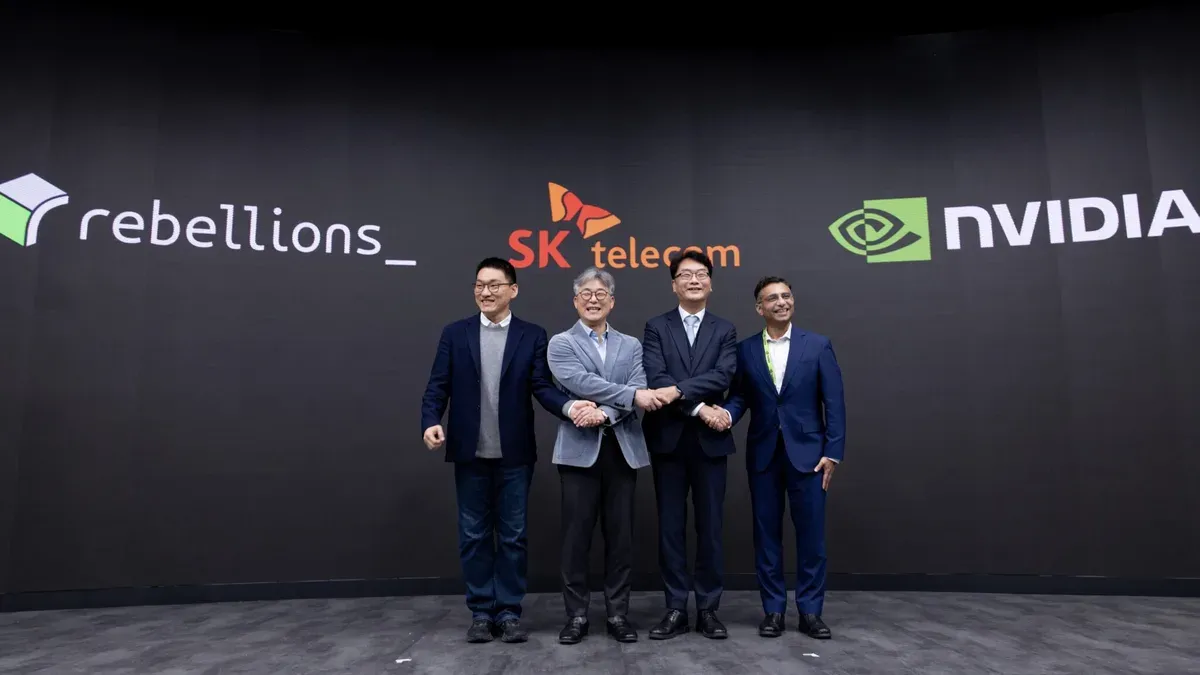
SEOUL / LONDON (BYTEVYTE) - NVIDIA, SK Telecom and Rebellions have agreed to connect Rebellions' Rebel R200 neural processing units (NPUs) to NVIDIA's platform through NVLink Fusion, and the systems built this way are slated to be operational by 2028. The collaboration, announced on November 8, 2026 with support from Korea's Ministry of Science and ICT (MSIT), is a development and deployment plan rather than infrastructure already running.
Under the agreement, Rebellions will connect its R200 NPUs to NVIDIA's hardware and assemble full-rack machines on the NVIDIA MGX design. SK Telecom plans to run those machines in its own AI data center, combining them with its in-house models such as A.X K2 and with consumer-facing offerings built under Korea's AI for All initiative. NVLink Fusion extends NVIDIA's platform to custom XPUs, so specialised processors can use NVIDIA's scale-up networking.
How NVLink Fusion changes the options for Korean NPU makers
NVLink Fusion gives Rebellions a route into NVIDIA-based racks without designing its own scale-up network. Rebellions will use the networking to link R200 units within a rack. The companies also plan a disaggregated-inference design in which NVIDIA GPUs handle the prefill stage and Rebellions NPUs handle the decode stage. The stated targets are higher inference throughput and better power efficiency, and the arrangement keeps NVIDIA hardware in the system while giving Rebellions a defined inference role.
For SK Telecom, the arrangement ties hardware to a full stack that covers data center operations, foundation models and services. MGX also opens doors for Rebellions to original design manufacturers and component suppliers, while letting GPU and NPU systems use the same rack footprint, power delivery and cooling designs. That shared layout matters for operators, because one facility plan can accommodate both processor families.
Open questions around the 2028 timeline
The performance goals are design objectives, not measurements. Rebellions is developing the R200 for low-latency, energy-efficient inference on the largest models, including mixture-of-experts architectures with several trillion parameters, but no throughput or power figures from deployed systems have been published.
The energy and environmental side of the build-out deserves more weight than the announcement gives it. Many AI data centers run on-site gas turbines that are loud for nearby residents, and gas-fired power carries high CO2 emissions. Cooling these facilities also draws large volumes of water. Local residents and regulators have no figures yet to judge the impact against.
Infrastructure teams evaluating NVLink Fusion should treat the R200 as a 2028 option, not near-term capacity. We would watch for measured inference figures from Rebellions, and for the power source and cooling design in SK Telecom's facility plans. Those disclosures will show whether the Korean NPU route into NVIDIA racks is a practical deployment or remains a roadmap with unpriced local costs.
While we strive for accuracy and rigor, ByteVyte can make mistakes. Readers are advised to verify all information independently and conduct due diligence before making decisions based on this reporting. We accept no liability for errors, omissions, or decisions made in reliance on this content.
Sources
From Chips to Skills, NVIDIA and Korea Expand Sovereign AI Collaboration
Related Articles
- Nvidia Rebellions deal talks: why the GPU maker wants Korea's Rebel100 designer
- How the Nvidia MediaTek investment turns NVLink Fusion into a custom-chip tollbooth
- NVIDIA Strengthens South Korean Ties to Advance Sovereign AI and Robotics Infrastructure
✔Human Verified
Researched and cross-referenced against primary sources by the Bytevyte editorial team. This article was generated with the assistance of artificial intelligence and reviewed by the Bytevyte editorial team.