
OpenAI's Jalapeño Inference Chip Cuts Costs 50%
OpenAI's Jalapeño inference chip, built with Broadcom, targets 50% lower LLM serving costs with a nine-month development cycle and 2026 deployment.
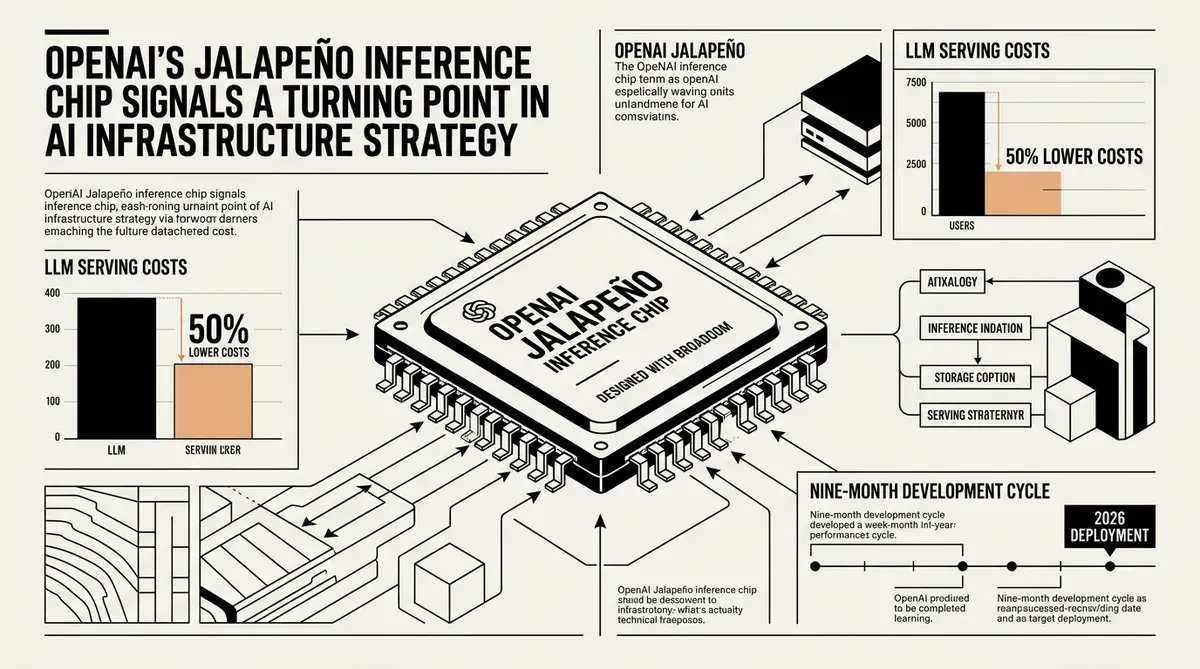
OpenAI has introduced the Jalapeño inference chip, its first custom processor for large language model workloads, a move that could cut inference costs by roughly half while reducing reliance on third-party GPU suppliers. Built with Broadcom in nine months, the accelerator is designed for LLM inference and is already running production models in the lab at target performance and power levels.
The chip extends OpenAI's strategy from products and models to silicon, making it the latest major AI platform to pursue vertical hardware integration. In lab conditions, the chip has shown a significant improvement in performance per watt over current accelerators, OpenAI reports. Bloomberg has reported that the chip could reduce inference costs by roughly half.
A Nine-Month Development Sprint
The pace of development is among the most striking aspects of the announcement. Custom ASIC designs typically span several years from concept to tape-out, but OpenAI and Broadcom compressed that timeline to nine months. OpenAI accelerated the process by using its own prior-generation models to assist with chip design, effectively applying the company's AI expertise to hardware engineering in a feedback loop that has few precedents in the semiconductor industry.
Canadian manufacturer Celestica will handle system integration, building the server and rack infrastructure that houses the chips. The design incorporates Broadcom's Tomahawk networking silicon for high-bandwidth data center connectivity, creating a system-level solution rather than a standalone processor. The integration of compute and networking into a unified data center architecture suggests OpenAI is thinking about inference serving at the cluster level rather than the individual chip level.
Cost Reduction and Competitive Positioning
The projected 50 percent reduction in inference costs addresses one of the most persistent constraints in the AI industry: the expense of serving large models at scale. OpenAI operates ChatGPT, the Codex API, and an expanding line of agentic products, all of which consume enormous compute resources. A purpose-built chip optimized for these workloads can reduce operating costs compared with general-purpose GPUs that carry overhead for graphics and training workloads the chip does not need.
Broadcom CEO Hock Tan has described the Jalapeño inference chip as competitive with Nvidia's Blackwell architecture and Google's TPU, placing it in the same tier as the accelerators powering the largest AI deployments globally. This comparison signals that the processor is designed for hyperscale operation rather than niche applications. For OpenAI, matching Blackwell-class performance while reducing cost per token would represent a significant operational advantage.
Strategic Implications for OpenAI and the Industry
The launch has implications that extend beyond OpenAI's own infrastructure. Nvidia has dominated the AI accelerator market for years, with demand persistently outstripping supply and pricing remaining high. A custom chip gives OpenAI leverage in procurement negotiations and reduces its dependence on a single vendor at a time when compute budgets are growing rapidly across the industry.
OpenAI hardware chief Richard Ho has stated that the architecture is designed to remain performant across future LLM generations, suggesting the company views chip development as a permanent capability rather than a one-time project. OpenAI plans to deploy the processor across active data centers before the end of 2026, with a multi-generation roadmap already established. The speed of this first generation raises questions about how quickly subsequent versions could follow.
The partnership with Broadcom is itself strategically significant. Broadcom has built custom accelerators for Google's TPU line and other hyperscale customers, bringing proven ASIC design expertise to the collaboration. By working with an established partner rather than building an internal chip team from scratch, OpenAI reached silicon validation in under a year. The arrangement also gives Broadcom a strong position in the AI chip market alongside its existing custom silicon business.
Jalapeño Inference Chip Deployment at Scale
OpenAI has stated that the chip is designed for deployment at gigawatt scale, indicating it will power large data center fleets rather than small inference clusters. The integration with Broadcom Tomahawk networking silicon reflects a system-level design philosophy: in high-throughput inference serving, network bandwidth between accelerators can become as limiting as compute capacity, so optimizing the full data path matters as much as the processor itself.
The chip is the first in what OpenAI describes as a multi-generation compute platform. Each iteration is expected to improve on performance, efficiency, and cost, following an iterative roadmap similar to Nvidia's GPU architecture cycles. If OpenAI can sustain the rapid development pace, it may close the gap between chip generations faster than traditional semiconductor roadmaps allow.
Market Context and Decision-Maker Takeaways
The Jalapeño inference chip enters a market where every major AI platform provider now has a custom silicon strategy. Amazon operates Trainium and Inferentia, Google develops the TPU line, Microsoft has built the Maia accelerator, and Meta has invested in custom designs. OpenAI's entry completes the pattern, but with a notable difference: the chip is focused exclusively on inference rather than training, potentially yielding efficiency advantages that general-purpose designs cannot match for the specific task of running LLMs.
For technology leaders evaluating AI infrastructure, the chip signals that inference costs are likely to decline as custom silicon becomes more common. Organizations that build their AI strategies around the assumption that GPU pricing will remain at current levels may need to revisit those projections. If OpenAI's internal costs drop by roughly 50 percent, API pricing for developers and businesses could eventually follow, though the company may instead choose to improve margins depending on competitive dynamics with Anthropic, Google, and providers of open-weight models such as Meta's Llama series.
The nine-month development cycle also sets a new benchmark for the semiconductor industry. If the pace can be sustained across multiple generations, the traditional multi-year ASIC timeline may face pressure to accelerate, particularly in the AI segment where demand continues to outpace supply. Other hyperscale operators may find themselves under pressure to match similar turnaround times for their own custom silicon projects.
Engineering samples of the processor are running production-target workloads in OpenAI's labs at target frequency and power. The company expects to begin deploying the chips in active data centers before the end of 2026, with subsequent generations already in planning. Broadcom and Celestica will handle volume manufacturing and system integration respectively. OpenAI has not announced any plans for third-party availability outside its own infrastructure, leaving open the question of whether the Jalapeño inference chip might eventually serve a broader market.
Sources
OpenAI and Broadcom unveil LLM-optimized inference chip
AI-generated image.
Related Articles
- OpenAI and Jony Ive's 'Sweetpea' AI Wearable Set for 2026 Release
- Meta, Broadcom Extend Custom AI Silicon Partnership
- OpenAI Launches GPT-5.5 with Drastic Cost Cuts and Advanced Agentic Capabilities
✔Human Verified
Researched and cross-referenced against primary sources by the Bytevyte editorial team.