
PlusAI SPAC Deal Backs $800 Million Push Toward 2027 Driverless Trucking
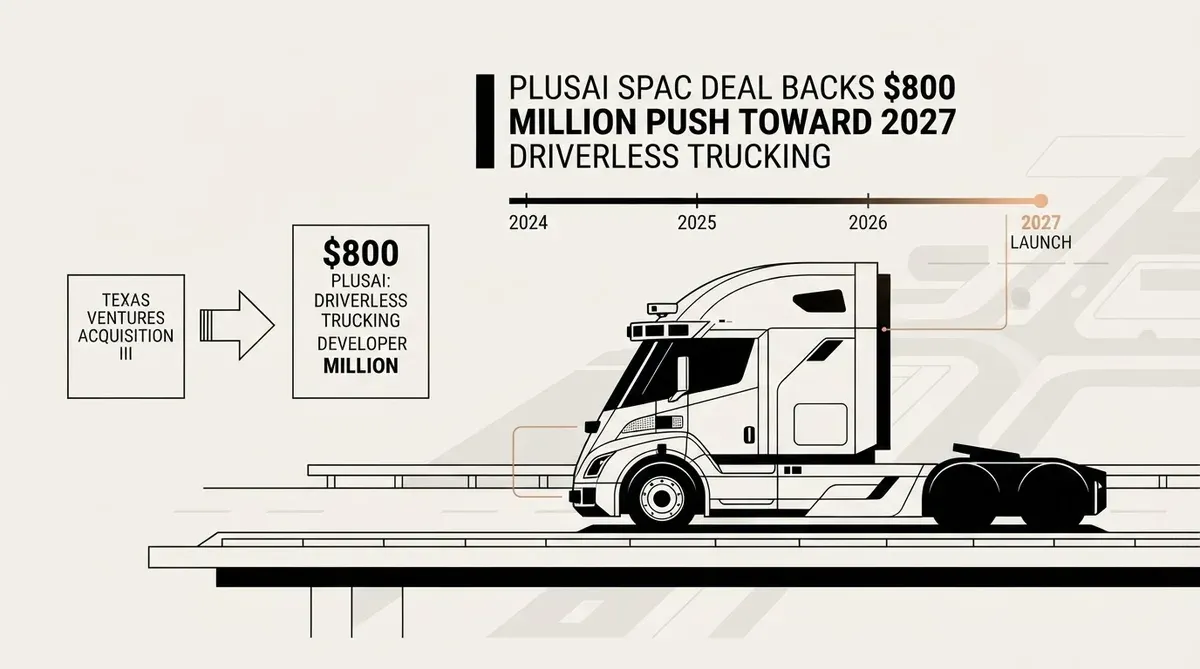
Plus Automation Inc. will reach the public markets by merging with Texas Ventures Acquisition III Corp, a blank-check company that already trades publicly. The two sides announced the agreement on Sept. 3. The transaction values the autonomous trucking developer at $800 million before any new cash arrives and could raise as much as roughly $300 million, which PlusAI intends to spend commercialising driverless trucking. The companies expect to close before the end of 2026, and the combined business will keep the PlusAI name.
The path is a merger rather than an initial public offering. Texas Ventures Acquisition III carries an existing listing, and PlusAI is the operating company that merges into it. That route swaps an IPO's roadshow and price discovery for a negotiated valuation and a faster route to a ticker.
The disclosure came on Sept. 3, and the deal still hinges on customary closing conditions. Blank-check companies typically work to a completion deadline set when they list, which gives both sides a reason to finish the paperwork instead of letting it sit.
The $800 million figure is pre-money equity value, so it leaves out whatever cash the deal eventually produces. That is why the announcement carries two numbers that do not match: a valuation set at signing and proceeds capped at about $300 million. If the raise fills in full, it would add roughly a third of the valuation again.
Redemptions determine how close the raise comes to that cap. SPAC shareholders can pull their money out rather than roll it into the merged company, which is why the announcement describes proceeds as up to $300 million instead of a fixed amount. For PlusAI's 2027 target, the difference between gross proceeds and cash actually in hand is the figure that matters.
Ownership moves with those same decisions. Current PlusAI holders keep the equity captured in the pre-money valuation. The SPAC's public shareholders and sponsors receive a share of the combined company, and its size is not fixed until the vote.
The SPAC supplies more than a trust account. Texas Ventures Acquisition III brings a listed shell, a shareholder base already through its own securities review, and institutional holders who can either stay in the merged company or exit at the vote. Their choice is the deal's real pricing event.
What the PlusAI SPAC Deal Is Meant to Fund
PlusAI has tied the capital to one commercial milestone: driverless trucking at commercial scale in 2027. The company says the funding carries its commercialisation plans through that year, which places the launch at the end of the spending period.
Roughly 15 months separate the announcement from that launch. The money has to cover development, testing and the cost of standing up a commercial service before any driverless freight revenue appears.
Spending order is the binding constraint. Development work, safety validation and the build-out of a commercial operation all fall due before the first driverless mile is billed. The raise's real deadline is the point at which PlusAI would have to slow its programme, which can arrive before the deal closes.
One revenue line is already public. PlusAI cited $25 million in HyperFoundry revenue and a target of $40 million to $50 million. That spread is the company's near-term case for raising public money now: a business aiming to roughly double a revenue line needs working capital, and a listed share price gives it a funding source beyond the SPAC proceeds.
The two parts of the story are separate. HyperFoundry generates the disclosed revenue. Driverless trucking is what the raise is meant to finance. Investors are being asked to back the second with numbers produced by the first.
A listing also changes the reporting duty. A merged PlusAI will file quarterly results, which turns the $40 million to $50 million HyperFoundry target into a figure that can be checked against actuals instead of left as a projection.
A Second Run at the Public Markets
PlusAI reached this agreement after an earlier combination attempt ended in April 2026. Signing a new definitive business combination agreement within about five months suggests another listed vehicle was prepared to underwrite a comparable valuation.
The second attempt also sets a reference point. An $800 million pre-money mark agreed in a signed merger will shape how investors value PlusAI in any later financing, whether or not the transaction closes as planned.
A 2026 close keeps the calendar tight. The 2027 launch window opens almost immediately after the transaction would complete, leaving little room for a delayed vote or a fresh round of negotiation.
Closing depends on customary conditions. In this structure that includes approval from shareholders of both companies. The size of the raise is not settled until that vote, because the redemption choices of Texas Ventures Acquisition III's public holders decide how much of the roughly $300 million stays in the deal.
The disclosed terms:
| Term | Detail |
|---|---|
| Announced | Sept. 3, 2026 |
| SPAC partner | Texas Ventures Acquisition III Corp |
| Pre-money equity value | $800 million |
| Maximum gross proceeds | ~$300 million |
| Expected close | 2026, subject to conditions |
| Driverless launch target | 2027 |
| HyperFoundry revenue cited | $25 million |
| HyperFoundry revenue target | $40 million to $50 million |
| Prior combination attempt | Ended April 2026 |
Where the Risk Sits
The structure fixes the valuation at signing and leaves the cash open. That asymmetry helps PlusAI when redemptions are light and hurts it when they are heavy, because the $800 million mark does not adjust to the size of the cheque that arrives.
For fleet operators weighing autonomous capacity, the practical question is whether the 2027 date is funded or aspirational. A raise well below $300 million would compress the programme, because the same development and testing costs would have to be covered from less cash. Carriers that build plans around driverless capacity carry that slippage risk.
For investors, the pre-money mark is the benchmark rather than the proceeds. Once PlusAI reports quarterly, the $25 million HyperFoundry figure and the $40 million to $50 million target become the test of whether $800 million was a fair entry point.
Autonomy stays a capital-hungry business, which is the context for going public at all. A listing gives PlusAI access to equity markets after the SPAC cash is spent. That matters for a company whose main product is not expected to generate revenue until 2027.
Public shareholders take on that spending profile directly. A private round keeps losses inside a cap table. A listed PlusAI will report its cash position every quarter with the driverless business still pre-revenue, leaving HyperFoundry to carry the reported numbers in the meantime.
What to Watch Before the Close
- The shareholder vote, which both companies must win as a closing condition.
- Redemption levels, which set the final raise against the $300 million ceiling.
- HyperFoundry revenue, the $25 million figure tracked against the $40 million to $50 million target.
- The 2027 launch, the milestone the funding was raised to reach.
Why this matters
PlusAI's listing is a test of whether public markets will still fund driverless trucking before the revenue exists. The $25 million HyperFoundry line against a $40 million to $50 million target is the only hard financial figure in the deal, and the 2027 launch depends on how much of the roughly $300 million survives redemptions. If the raise holds, autonomous freight gains a funded operator with a public balance sheet. If it does not, the 2027 date is the first thing to move, and the shareholder vote is the milestone to watch.
AI-generated image.
Related Articles
- Stord Reaches $3B Valuation to Advance Physical Intelligence in Logistics
- PsiBot Series A: Industrial Capital Funds Embodied AI
- Together AI $800 Million Funding Round Fuels Open-Source AI Cloud Platform Growth
✔Human Verified
Researched and cross-referenced against primary sources by the Bytevyte editorial team. This article was generated with the assistance of artificial intelligence and reviewed by the Bytevyte editorial team.