
Samsung's $80 Billion Quarter Tests Whether the AI Memory Supercycle Holds
Samsung guided to 107.4 trillion won in Q3 operating profit, a ninefold jump, as the AI memory supercycle lifts HBM and DRAM earnings.
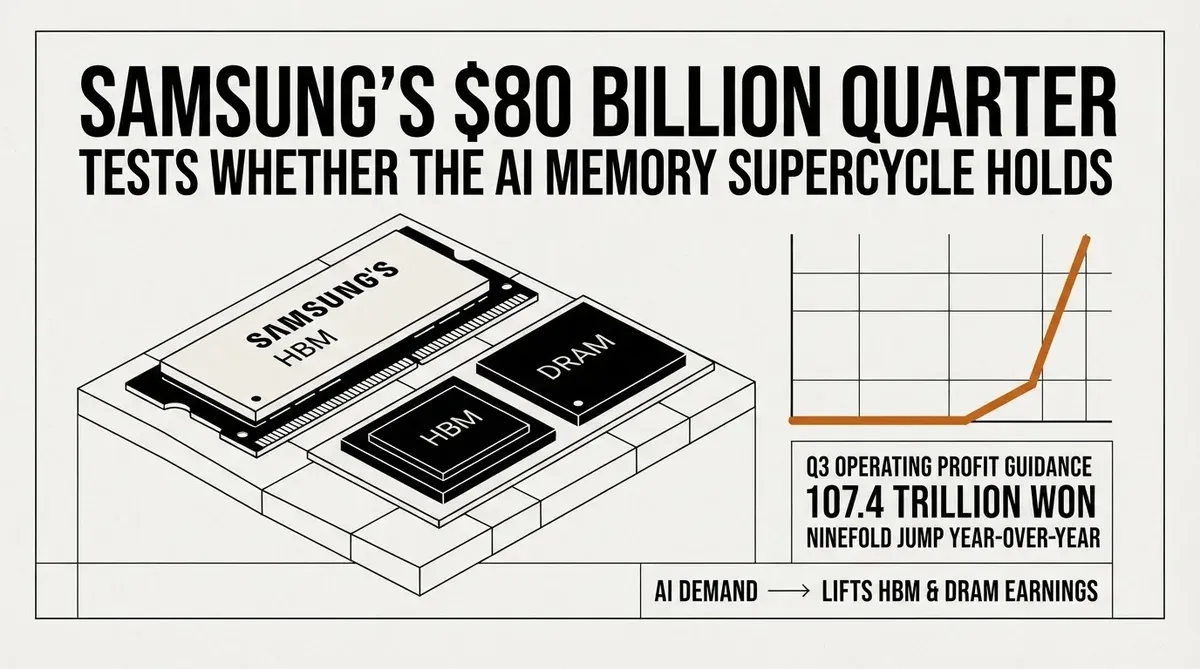
Samsung Electronics has guided to a third-quarter operating profit of about 107.4 trillion won, roughly $80 billion, a nearly ninefold rise from the 12.17 trillion won it booked a year earlier. The preliminary figures, published on October 8, 2026, put consolidated sales at approximately 195 trillion won, up from 86.06 trillion won in the same quarter of 2025. No South Korean company has cleared 100 trillion won in quarterly operating profit before, and this is Samsung's fourth consecutive record. Samsung credits AI-focused memory demand, in both high-bandwidth memory and conventional DRAM, as data-center operators keep building out AI infrastructure. The result makes the AI memory supercycle the largest single profit engine in the company's history, and it raises the harder question of how much of that windfall is durable.
Samsung's guidance format matters for reading the number. Korean disclosure rules bar companies from publishing an earnings estimate as a range, so Samsung discloses the median of its internal band instead. The 107.4 trillion won figure is the midpoint of 107.3 trillion to 107.5 trillion won, and the 195 trillion won sales estimate sits between 194 trillion and 196 trillion won. The apparent precision reflects regulatory convention, not unusual confidence.
Three comparisons set the scale. Year on year, operating profit multiplied almost nine times while sales grew about 127%. Quarter on quarter, profit rose from the 89.49 trillion won recorded in the three months to June, when sales were 171.5 trillion won. Against consensus, an LSEG SmartEstimate of 106.1 trillion won had the market braced for less.
The manufacturing base did not expand ninefold over the same period. Sales roughly doubled; profit rose nearly nine times. That gap places the change on the demand and pricing side of the ledger, not on the volume side.
What Samsung Actually Reported
| Period | Sales (trillion won) | Operating profit (trillion won) |
|---|---|---|
| Q3 2025 (actual) | 86.06 | 12.17 |
| Q2 2026 (actual) | 171.5 | 89.49 |
| Q3 2026 (guidance) | ~195 | ~107.40 |
Trace the four-quarter arc. Operating profit moved from 12.17 trillion won in the third quarter of 2025 to 89.49 trillion won in the second quarter of 2026, and now to a guided 107.40 trillion won. That is a swing of roughly 95 trillion won in twelve months, against a revenue increase of about 127% over the same window.
The milestone carries weight beyond one balance sheet. Samsung is the world's largest memory chipmaker and memory sits at the centre of South Korea's export base, so a quarter of this size moves national trade and currency figures as well as the company's own accounts.
Guidance at this stage covers the consolidated group only. The audited quarterly report, which breaks out the semiconductor division and separates memory from foundry and logic, will show whether other units contributed or whether the chip business carried the result alone. Given the size of the swing, memory is the likely source, but the split will confirm it.
Scarcity Is Doing the Pricing
Samsung's memory business has run into a supply wall for several quarters. Demand from AI infrastructure has grown faster than the industry's ability to add capacity, and the shortage has pushed DRAM pricing to record levels. Suppliers with scarce output allocate it to the customers willing to pay the most, and in 2026 that means hyperscalers and accelerator vendors building training and inference clusters.
Product mix reinforces the effect. Samsung has qualified HBM4 with Nvidia, putting its highest-margin memory into the supply chain for the accelerators that dominate AI data centers. HBM stacks sell at a substantial premium to commodity DRAM and are harder to substitute, which gives a qualified supplier more pricing leverage than it holds on standard modules.
Record pricing also changes the shape of customer contracts. When supply is short, buyers move away from spot purchasing toward long-term agreements that guarantee volume, and the supplier gains discretion over which programmes it serves. That is where durable advantage gets built, because a multi-year supply agreement signed during a shortage outlasts the shortage itself.
That leverage is the mechanism behind the record. When a supplier is capacity-constrained and its output is designed into products customers cannot easily change, the supplier captures the surplus. A ninefold profit jump on roughly double the revenue is what that shift looks like in an income statement.
Is the AI Memory Supercycle Durable?
The analytical split is between two readings of the same numbers. One holds that HBM4 demand is structural: AI training and inference need far more memory bandwidth per accelerator than earlier generations, qualification creates switching costs, and order books stretch into 2027. The other holds that much of the windfall is a conventional DRAM price spike driven by temporary undersupply, one that fades as new wafer capacity comes online and prices revert.
Evidence exists on both sides. Samsung's fourth consecutive record quarter and the widening mix toward HBM suggest demand is not a one-quarter event. The arithmetic cuts the other way: profit grew almost nine times while revenue only doubled, so the result leans heavily on price, and memory prices have a long history of falling fast once supply catches up.
Two complications sit on top. A stronger South Korean won works against reported margins for a company that sells in dollars and books results in won, so the quality of the quarter depends partly on currency. Samsung shares also slipped in Seoul after the guidance landed, which indicates investors had already priced in a result at or above this level and are looking past the record to what comes next.
Who Ends Up Paying
The buyer side of this trade is the hyperscale data-center business. Every accelerator deployed needs HBM stacks, and every rack needs conventional DRAM for host memory and storage tiers. When memory prices rise, the cost lands in the capital budgets of the companies building AI capacity, and it feeds into the economics of running models at scale.
Those buyers have few near-term options. Switching memory suppliers does not help when the shortage is industry-wide, and redesigning an accelerator around a different memory type takes years. The practical choices are to absorb higher memory costs, stretch deployment schedules, or shift spending toward software efficiency. Each one changes how fast AI capacity gets built.
The cost lands in capital budgets rather than operating lines. A data-center build that assumes a given memory price per accelerator can absorb a modest increase; a sustained doubling of DRAM costs changes the payback maths on an entire cluster. Operators respond by phasing builds, renegotiating with accelerator vendors, or pushing more work onto hardware that needs less memory per unit of throughput.
Smaller operators feel it first. A hyperscaler can absorb a memory price increase across a very large balance sheet; a startup renting compute or building a single cluster cannot. Sustained high memory pricing therefore narrows who can afford to train and serve large models, and that has consequences for how concentrated the AI market becomes.
For the memory makers the risk is the mirror image. Capacity added during a shortage tends to arrive after the shortage ends, and the industry has repeated that pattern across several generations. The open question for Samsung is whether HBM's qualification barriers and the difficulty of stacking more layers keep supply growth below demand this time, or whether current pricing sits at the top of a familiar curve.
Why this matters
A 107.4 trillion won quarter shows where the economics of the AI buildout currently sit: with the suppliers of scarce inputs rather than the operators of the data centers. That inverts the usual arrangement, in which compute vendors capture the premium while component makers compete on cost. If HBM4 demand holds, memory stays a bottleneck and hyperscalers keep paying. If it does not, this quarter is the peak. Anyone budgeting for AI infrastructure should track memory pricing as a first-order input.
Sources
Samsung Electronics Announces Earnings Guidance for Third Quarter 2026
AI-generated image.
Related Articles
- Samsung Q2 2026 Earnings: 89.4 Trillion Won on AI Chip Boom
- Samsung Q2 2026 results: Record revenue driven by AI memory
- Samsung Achieves Record Financial Performance as AI Semiconductor Demand Surges
✔Human Verified
Researched and cross-referenced against primary sources by the Bytevyte editorial team. This article was generated with the assistance of artificial intelligence and reviewed by the Bytevyte editorial team.