
SAP Buys TechWolf to Anchor Its Enterprise AI Push in Work Intelligence
SAP will acquire Belgium's TechWolf, folding its AI work intelligence platform into SuccessFactors and Joule. The deal is expected to close in Q4 2026.
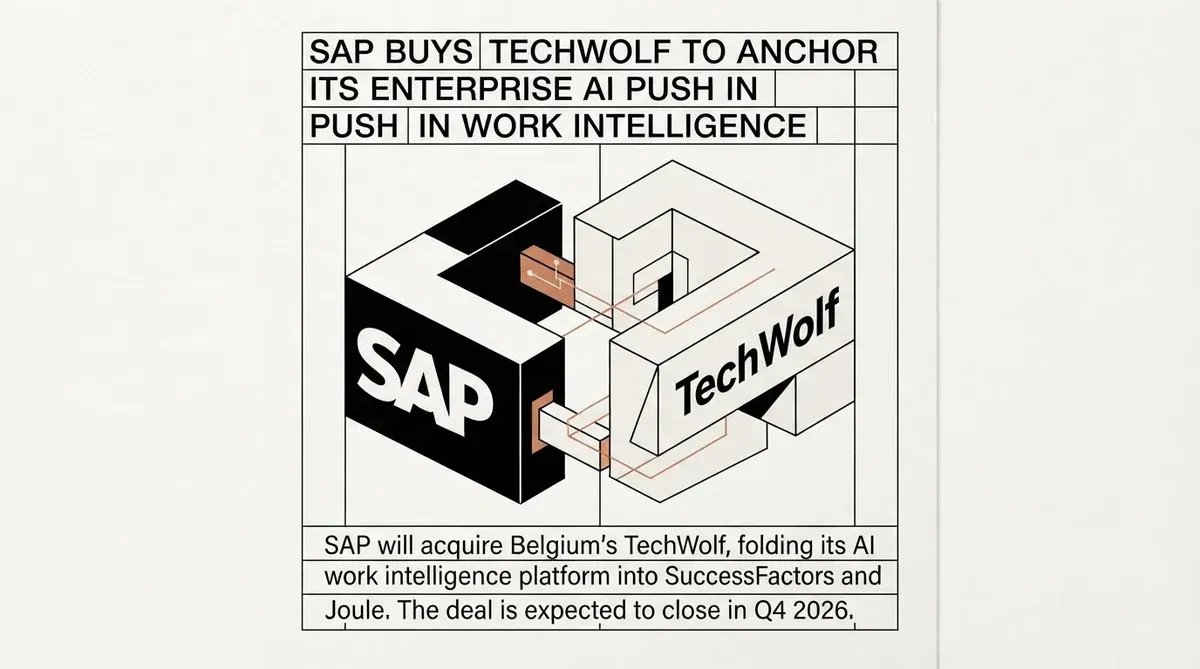
SAP has agreed to acquire TechWolf, a Ghent, Belgium-based provider of an AI work intelligence platform, in a deal that extends the German software group deeper into workforce skills data. The two companies signed the agreement on Oct. 6, 2026, and SAP expects the transaction to close in the fourth quarter of 2026, subject to regulatory approval and customary closing conditions. Financial terms were not disclosed. At the center of the deal is TechWolf's proprietary context graph for work, a real-time model of an enterprise's entire workforce that records which skills employees hold, which tasks they perform, and how both connect to business strategy and the external labor market.
SAP intends to bring that context graph, along with TechWolf's AI models and its applied AI research team, inside the company. Work intelligence will become a strategic SAP asset, integrated with the SuccessFactors human capital management portfolio and used to ground Joule, SAP's AI assistant. TechWolf is expected to keep operating as an independent entity under its current chief executive after the close, with the two companies co-innovating on new AI-powered workforce and skills-optimization products.
The platform answers a question that has become harder as enterprises reorganize around AI: what work actually exists inside the company. Instead of relying on annual self-assessment surveys, the system infers skills continuously from workforce data, producing a live picture that HR and business leaders can plan against. That difference shows up in reskilling budgets and hiring decisions, because a static skills inventory is usually out of date before a planning cycle closes.
SAP framed the move as giving enterprises an evidence-based view of work in the age of AI. The phrasing points at a gap many organizations have hit. AI adoption plans are typically built on job titles and org charts, which describe formal structure rather than the tasks people actually perform. A context graph that updates in real time offers a different starting point for deciding where automation fits.
TechWolf holds ISO/IEC 42001 certification for AI management systems and ISO/IEC 27001 for information security, credentials that carry weight with buyers in regulated industries. J.P. Morgan served as the company's exclusive financial advisor on the transaction.
Why Work Intelligence Is Becoming Infrastructure
The logic behind the purchase runs past HR software. Agentic AI systems need to know which tasks exist, who owns them, and which ones can be handed to software. TechWolf positions its platform as a way to discover what tasks and skills can be automated, which puts it upstream of deployment decisions enterprises are making now. Gartner projects that 40% of enterprise applications will include task-specific AI agents by the end of 2026, up from less than 5% in 2025. If that forecast holds, the workforce data layer becomes the input that determines where those agents get applied.
Skills inference is a comparatively young AI application, and it competes with established testing and assessment tools used for screening and recruiting. TechWolf aims its technology at talent management, workforce planning and AI enablement instead. Pre-built ontologies trained on large data sets cut the taxonomy work that would otherwise consume months, and the Everest Group PEAK Matrix for skills intelligence platforms indicates the category has matured, with improved integration and shorter time-to-value.
Mapping internal skills against the external labor market is what separates a workforce model from a conventional HR record. When planners can see a role shrinking in the wider market before it shrinks internally, the gap between signal and reskilling decision narrows.
The business case turns concrete at that point. Enterprises adapting to AI-driven role changes have to decide which employees to retrain, which roles to redesign and where to hire externally, and those calls need current data rather than an annual snapshot. SAP's stated aim is to turn workforce data into a decision engine for the autonomous enterprise, a framing that puts skills data on the same footing as financial and supply chain data in its portfolio.
The Competitive Stakes in Enterprise HR
SAP's SuccessFactors business competes directly with Workday and Oracle in cloud human capital management, and skills intelligence has turned into a differentiator as all three vendors layer AI into their suites. Buying TechWolf gives SAP an owned work intelligence layer rather than a partnership or reseller arrangement, and it reinforces the autonomous enterprise positioning SAP has built around its Business AI portfolio and Joule agent strategy. SAP chief executive Christian Klein has argued that enterprise AI's value comes from converting a company's own business knowledge into measurable outcomes, and a proprietary context graph is one way to supply that knowledge.
Competitors face a similar calculus. Workday and Oracle both sell skills and talent modules, and either could respond with acquisitions of its own or by expanding an existing skills graph. The category's maturity, as tracked by Everest Group, means buyers already have options, so the competitive question is less about whether skills intelligence works than about whose data model customers trust with workforce records.
The integration roadmap SAP has outlined points to continuous workforce planning, AI-informed role design, and context-aware recommendations for deploying and developing talent. For existing SuccessFactors customers, that means skills data flowing into planning workflows they already run rather than a separate tool to procure and maintain.
Keeping TechWolf independent under its current leadership leaves the research team's operating model intact while its models feed into SuccessFactors. The purchase takes the team as well as the technology, which suggests applied AI research capacity is the scarce input in this category. SAP did not disclose the price, leaving the deal's value against other HR technology transactions impossible to benchmark from the announcement alone.
Deal Terms at a Glance
| Item | Detail |
|---|---|
| Acquirer | SAP SE (NYSE: SAP) |
| Target | TechWolf, Ghent, Belgium |
| Announced | Oct. 6, 2026 |
| Expected close | Q4 2026, subject to regulatory approval |
| Terms | Not disclosed |
| Structure | Independent entity under current CEO |
| Certifications | ISO/IEC 42001, ISO/IEC 27001 |
| Advisor to TechWolf | J.P. Morgan |
For HR and IT leaders weighing the SAP stack, timing matters. The transaction cannot close before the fourth quarter of 2026, and SAP has not attached dates to specific product milestones. Near-term decisions on skills intelligence therefore rest on what SAP, Workday and Oracle ship today, with the TechWolf integration arriving as a later layer. The deal also requires approval before it can close, and SAP has not indicated whether it expects conditions from any jurisdiction.
Why this matters
Enterprise AI competition is moving away from model capability and toward the data layer that tells agents what work exists. SAP is paying to own the map of skills and tasks inside its customers' organizations, and that map gains value as agents take on more execution. For buyers, the practical effect is consolidation of workforce data into the same stack that runs payroll, planning and finance, which cuts integration work while raising switching costs. TechWolf's independence until close, and the undisclosed price, leave the competitive response from Workday and Oracle open.
Sources
AI-generated image.
Related Articles
- SAP Launches Joule Agentic AI for SuccessFactors HR Platform
- SAP Reltio Acquisition Finalized to Power Joule AI Agents with Unified Data
- SAP Transforms Joule Assistant with New Agentic AI Features for 2026
✔Human Verified
Researched and cross-referenced against primary sources by the Bytevyte editorial team. This article was generated with the assistance of artificial intelligence and reviewed by the Bytevyte editorial team.