
SAP Unveils Three Modernization Paths for AI-native SAP Logistics Management
SAP defines three modernization paths for AI-native SAP Logistics Management, offering a 2040 support window for legacy systems while pushing for AI automation.
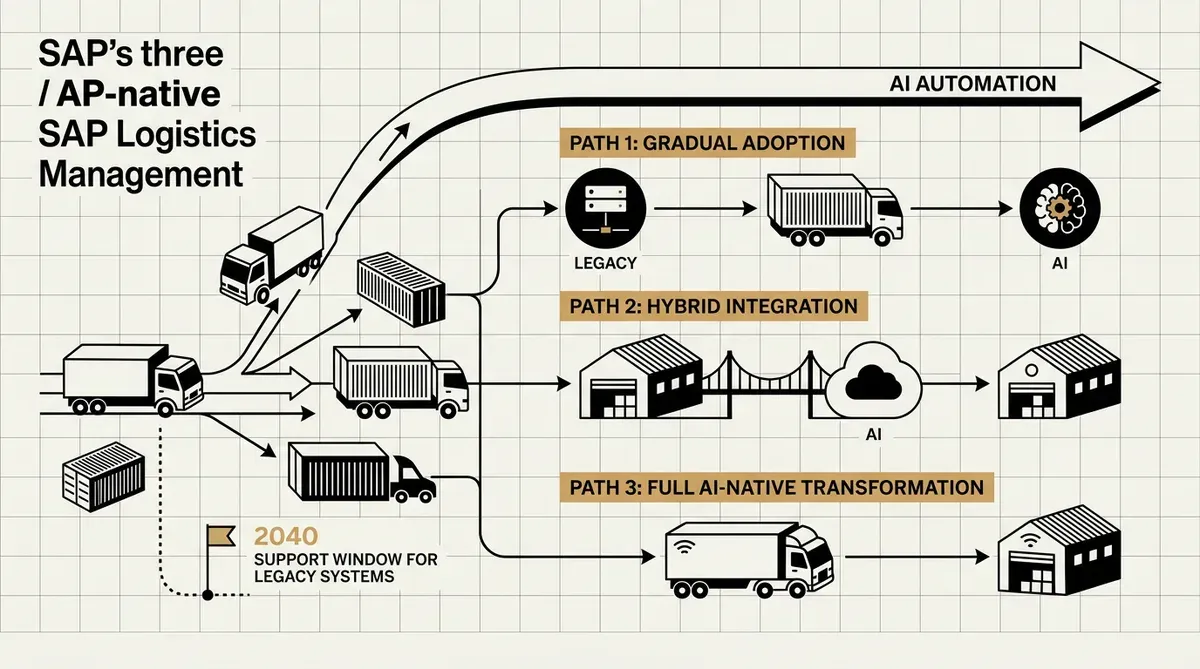
SAP has introduced a new strategic framework for supply chain modernization, defining three distinct migration paths for enterprises to adopt AI-native SAP Logistics Management. This announcement, made on 2026-05-25, addresses the growing need for autonomous orchestration in global trade. By categorizing business needs through a complexity model, the company aims to move organizations away from traditional efficiency metrics toward a more resilient, AI-driven operational structure.
The strategy utilizes the five-level logistics complexity model from Gartner to help companies identify their ideal transition speed. This approach acknowledges that not every business is ready for a full cloud migration immediately. Instead, it offers a tiered system that balances the preservation of existing investments with the necessity of adopting AI-native SAP Logistics Management to handle modern supply chain disruptions. The framework is built to accommodate various operational scales, from localized warehouses to massive global distribution networks.
Three Paths to AI-Native Logistics
The first modernization journey is designed for organizations prioritizing stability. It focuses on moving legacy systems to SAP S/4HANA stockroom management. SAP confirmed that support for the legacy LE-WM and LE-TRA modules will continue until 2040 under this specific path. This provides a long-term safety net for businesses with highly customized on-premise environments that require a slower pace of change. It ensures that critical infrastructure remains functional while the broader market shifts toward cloud-first architectures.
The second journey involves a phased transition to S/4HANA Cloud. This path is intended for companies seeking a balance between innovation and risk. It allows for a gradual adoption of cloud-based features while maintaining core operational continuity. This middle ground is a bridge for enterprises that are moving toward digital transformation but are not yet ready for a complete architectural overhaul. It provides the flexibility to test AI capabilities in specific segments of the supply chain before a full-scale rollout.
The third journey is a direct move to AI-native SAP Logistics Management. This path targets organizations that require rapid standardization and the highest level of automation. By bypassing intermediate steps, these companies can immediately leverage autonomous orchestration and advanced predictive analytics. This journey is optimized for businesses facing extreme market volatility that need the most advanced tools to maintain a competitive edge. It is the most aggressive shift toward a fully automated logistics environment.
This new framework signals a shift in how enterprise software providers handle the transition to artificial intelligence. By offering a 2040 support window for stockroom management while simultaneously pushing for AI-native SAP Logistics Management, SAP is attempting to manage a diverse global customer base with varying levels of digital maturity. The focus on resilience over simple cost-cutting reflects a broader industry trend toward self-healing supply chains. As global trade becomes more unpredictable, the ability to pivot between these three journeys will likely determine the long-term viability of large-scale logistics operations.
The integration of AI into these logistics paths is not just about automation but about creating a system that can anticipate and react to changes without human intervention. SAP is positioning its new platform as the central nervous system for these operations. By 2027, many of the features currently in development for the AI-native path are expected to become standard across the S/4HANA ecosystem, further blurring the lines between traditional management and autonomous systems.
While we strive for accuracy, bytevyte can make mistakes. Users are advised to verify all information independently. We accept no liability for errors or omissions.
Sources
Three Journeys That Redefine Logistics in a Disruptive World
AI-generated image.
Related Articles
- SAP and Microsoft Expand Azure Migration Program to Accelerate Enterprise AI Adoption
- SAP AI Transition to Be as 'Painful' as Cloud Shift
- SAP Launches Business AI Platform to Drive Autonomous Enterprise Vision
✔Human Verified