
SAP's €1B Tabular Foundation Models Bet Reshapes AI
SAP's €1B Prior Labs acquisition bets that tabular foundation models, not general-purpose LLMs, hold the key to enterprise AI. What this means for business leaders.
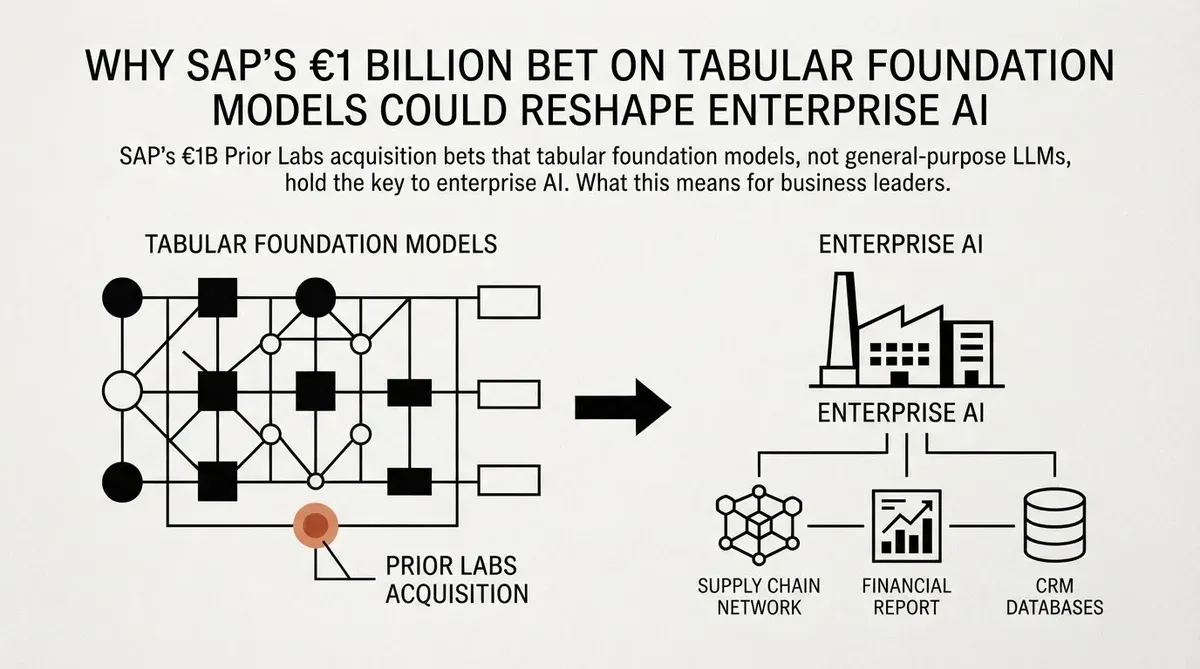
SAP completed its acquisition of Prior Labs on July 17, 2026, and agreed to invest more than €1 billion (roughly $1.16 billion) in a company founded only 18 months earlier. The deal signals that Europe's largest software company sees a significant opportunity in the structured data layer that general-purpose chatbots have consistently overlooked.
The deal, first announced in May 2026, commits SAP to invest over €1 billion across four years to build Prior Labs into a frontier AI research center focused on tabular foundation models. In early 2025, Prior Labs collected €9 million in pre-seed funding. The startup, based in Freiburg, Germany, will continue operating independently under the SAP umbrella. TabPFN-2.6, Prior Labs' flagship model, takes structured data as input and produces predictions. Its accuracy equals what an AutoML pipeline would deliver after four hours of work, but it completes the job in seconds. This speed advantage enables real-time operational decisions that were previously impractical with traditional data-science workflows.
Tabular Foundation Models Address Enterprise AI's Blind Spot
The market has spent the past two years fixated on large language models that generate text, write code, and answer questions. But roughly 80% of enterprise data is tabular: rows and columns in spreadsheets, ERP tables, CRM records, and supply chain databases. This is the data that decides credit limits, predicts equipment failure, forecasts demand, and flags fraudulent transactions. Until now, LLMs have largely ignored this layer because they are designed for sequential text, not structured tables.
SAP manages more tabular data than almost any other organization. Its ERP systems handle procurement, inventory, payroll, and financial reporting for tens of thousands of businesses. Feeding that data into a chat interface misses the point. The real value lies in prediction: which customers will churn, which machines will break, and which inventory levels will fall short, delivered in seconds rather than hours.
That is exactly what Prior Labs' TabPFN-2.6 delivers. The model bypasses the time-consuming AutoML pipeline that data scientists typically run (feature engineering, model selection, hyperparameter tuning) and produces results at speeds that make real-time operational decisions feasible. SAP is betting that this speed advantage, applied to the massive tabular datasets it already manages, creates a category of enterprise AI that deserves its own foundation models rather than a repurposed LLM.
Why Tabular Foundation Models Differ From the LLM Arms Race
The contrast with the broader AI market is striking. OpenAI, Anthropic, Google, and Meta are spending billions on scaling LLMs with larger contexts, multimodal inputs, and agentic capabilities. SAP's bet on tabular foundation models is not an alternative to that race; it is a recognition that the race is being run on a different track entirely. Structured data AI requires fundamentally different architectures: models that understand column relationships, handle missing values natively, and generalize across tables without retraining.
Prior Labs published the original TabPFN paper in 2022, demonstrating that a transformer-based model pre-trained on synthetic tabular data could outperform traditional gradient-boosted trees and AutoML systems on small-to-medium datasets. The TabPFN-2.6 release this year extends that capability to larger datasets and more complex prediction tasks. For SAP, which manages data from industries as varied as manufacturing, retail, and financial services, a model that generalizes across tables without per-dataset training is the key to deploying AI at scale without a proportional increase in data science headcount.
There is a European dimension to this bet as well. Prior Labs is being positioned as the continent's first corporate frontier AI lab focused on tabular data, a deliberate contrast with the US-dominated LLM ecosystem. European policymakers have repeatedly expressed concern about the region falling behind in foundation model development. SAP is effectively building a third path: a foundation model strategy that does not compete head-to-head with GPT or Claude but occupies a domain where European industrial strength in ERP and business software provides a natural advantage.
The €1 billion commitment reflects the scale of that ambition. It is not just an acquisition price. It is a four-year research budget to turn Prior Labs into a frontier AI lab that can compete with DeepMind and FAIR on its own terms. SAP is effectively arguing that the structured data layer is large enough and structurally different enough to justify a dedicated research effort rather than incremental improvements to existing LLM architectures.
What This Means for Enterprise Buyers
For CTOs and technology leaders evaluating AI investments, the SAP Prior Labs acquisition sends a clear signal. The prevailing assumption that LLMs can handle any data type with enough prompting or fine-tuning is being challenged by a company that manages the world's most sensitive business data. If SAP succeeds in turning TabPFN-2.6 into a platform that generates predictions from enterprise tables at conversational speed, the competitive advantage for its customers could be substantial.
Consider the alternative. A procurement manager using a general-purpose LLM to analyze supplier risk would need to export data, structure a prompt, validate the output, and import results back into the ERP system. A tabular foundation model embedded directly in SAP's ecosystem could run the same analysis as a native function, querying the database, running inference, and writing results back without leaving the application. That is the difference between a feature and a platform.
The bet carries risks. Prior Labs is an 18-month-old startup with a single model family and a small team. Scaling a research lab to frontier status in four years with €1 billion is ambitious by any standard, and SAP's track record with large acquisitions has been mixed. The company will also need to handle the competitive response from cloud providers (AWS, Google Cloud, and Microsoft Azure, all of which offer AutoML and tabular AI services) and from specialized AI startups that target the same structured data use cases.
There is also the question of adoption. Tabular foundation models require integration into existing data pipelines and decision workflows. SAP's customer base includes thousands of organizations running legacy ERP systems that were not designed for real-time AI inference. The company will need to bridge that gap with middleware, APIs, and consulting services that add complexity to what is already a multiyear deployment cycle for many enterprises.
Why This Matters
The SAP Prior Labs deal is the moment structured data AI stopped being a niche technical problem and became a boardroom investment thesis. The market has been conditioned to think of AI as chatbots and code generators. The real enterprise value may be invisible, sitting inside models that never write a sentence but quietly predict which invoice will be late, which shipment will be delayed, and which customer will leave. SAP has placed the biggest single bet on that vision, and the next four years will determine whether tabular foundation models become the backbone of enterprise AI or a costly detour from the LLM highway. The deal tests whether specialized AI architectures can outcompete the LLM-centric strategies that dominate today's enterprise AI conversations.
AI-generated image.
Related Articles
- SAP Dremio Acquisition Unifies Data for Agentic AI
- SAP and Microsoft Expand Azure Migration Program to Accelerate Enterprise AI Adoption
- SAP Reltio Acquisition Finalized to Power Joule AI Agents with Unified Data
✔Human Verified
Researched and cross-referenced against primary sources by the Bytevyte editorial team.