
ServiceNow Adopts Consumption-Based Models to Counter AI Seat Cannibalization
ServiceNow shifts to usage-based pricing to monetize agentic AI and protect revenue from seat cannibalization as autonomous workflows transform the enterprise.
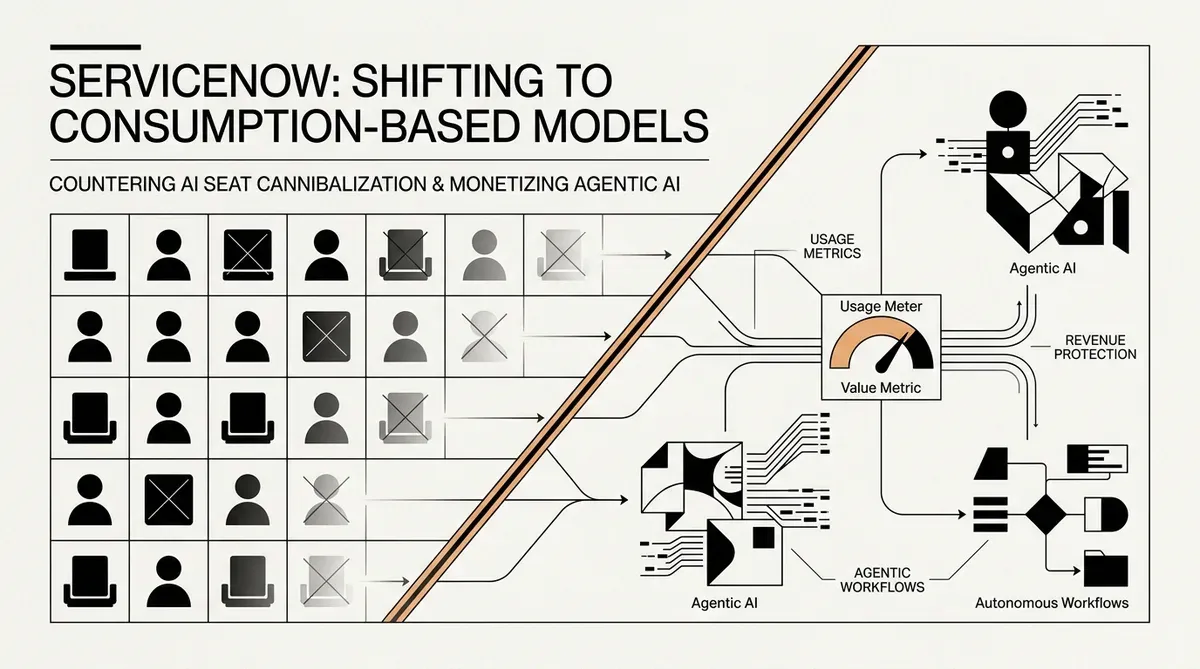
ServiceNow has initiated a significant shift in its enterprise software monetization strategy by moving toward usage-based pricing models. This transition, confirmed during the company's Q1 2026 earnings report, addresses the growing influence of agentic AI and its potential to reduce traditional per-user seat requirements. By decoupling revenue from headcount, the company is positioning itself to capture value from the productivity gains generated by autonomous digital workers.
The company reported that 50% of its new business is now derived from non-seat-based contracts, which include consumption-based or hybrid structures. CFO Gina Mastantuono stated that the organization is successfully deploying Assist packs and token systems to monetize its Now Assist generative AI features. This strategy ensures that as AI agents handle more complex workflows, the resulting efficiency does not lead to a decline in subscription revenue.
Strategic Pivot to Usage-Based Pricing
The move toward usage-based pricing represents a fundamental change in the SaaS industry, where seat-based licensing has been the standard for decades. ServiceNow is utilizing these new models to future-proof its business against the automation of roles that previously required manual software interaction. This shift allows the company to charge based on the volume of work performed by AI rather than the number of human employees logged into the system.
Industry analysts suggest that this pivot moves the enterprise software giant closer to an outcome-as-a-service model. By focusing on tokens and consumption, the platform can scale its revenue in direct proportion to the value delivered by its autonomous workflows. This approach is designed to mitigate the risk of seat cannibalization, where highly efficient AI tools might otherwise lead customers to reduce their total user licenses.
Expanding Agentic AI Capabilities
ServiceNow plans to further demonstrate its commitment to this new era at the Knowledge 2026 conference scheduled for May 4. The event is expected to highlight new innovations in agentic AI that allow for more sophisticated, self-managing workflows across the enterprise. These advancements are central to the company's goal of maintaining its growth trajectory as organizations increasingly rely on AI to manage IT service desks, HR processes, and customer service operations.
The Q1 2026 results showed a significant beat in AI-driven subscription revenue, suggesting that the market is receptive to these new monetization vehicles. As the enterprise landscape evolves, the ability to monetize the output of AI agents rather than just human access will likely become a benchmark for other major software providers navigating the transition to autonomous technology.
While we strive for accuracy, bytevyte can make mistakes. Users are advised to verify all information independently. We accept no liability for errors or omissions.
AI-generated image.
Related Articles
- GitHub Copilot Moves to Usage-Based Billing for Enterprises
- Genpact Report: 92% of Executives Forecast Agentic AI Will Reshape Corporate Workflows
- Salesforce Headless 360 Launches to Power Autonomous AI Agents
✔Human Verified