
SMR Data Center Deals Mount as Rolls-Royce Raises Outlook
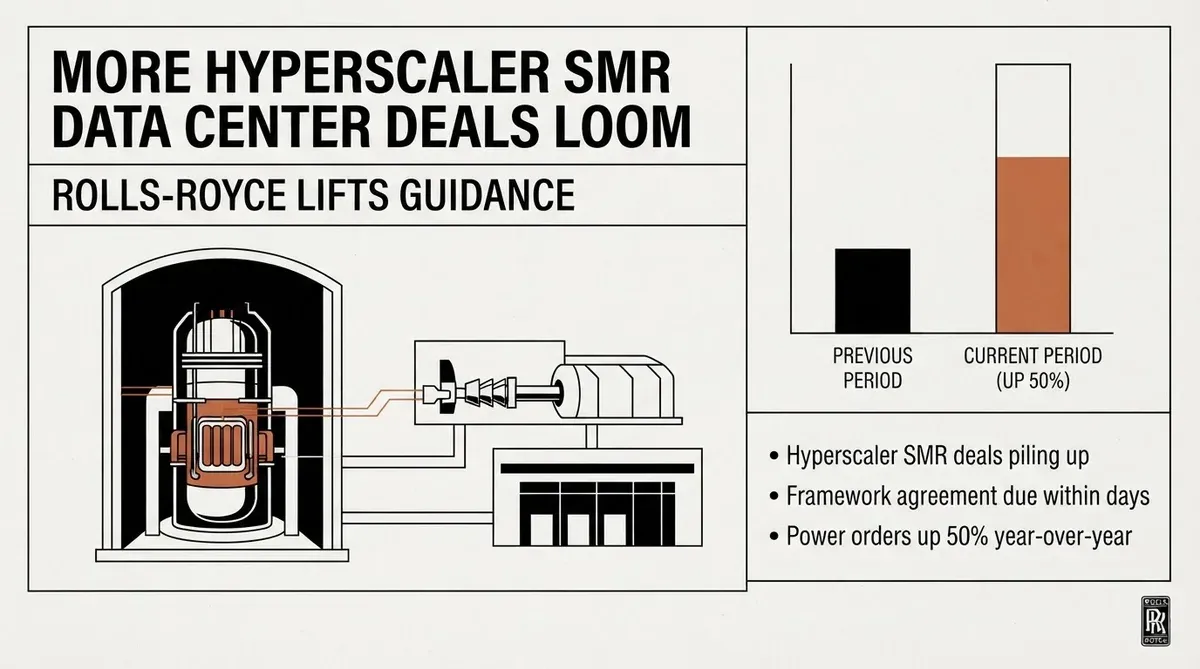
Rolls-Royce expects its investment committee to approve another hyperscaler framework agreement in the coming days, and it is already booking data center power orders for 2028 delivery. The disclosure came with a raised full-year profit outlook and first-half results showing data center orders in its power business up more than 50%. The clearest indication yet: SMR data center deals have moved from pitch to order book.
The engineering group now guides to 2026 underlying operating profit of £4.7 billion to £4.9 billion, up from £4.0 billion to £4.2 billion. First-half operating profit rose 46% to £2.5 billion on revenue of £11.3 billion, a 26% increase. Chief executive Tufan Erginbilgic told analysts that the investment committee will review a major hyperscaler framework deal early next week and that Rolls-Royce is already taking orders for data center deliveries in 2028.
The strategic read is that Rolls-Royce is being re-rated from jet-engine maker to prime-power supplier for AI infrastructure. The constraint holding back data center buildout has shifted from compute supply to grid access, and the Power Systems division sells directly into that gap with backup power, continuous power and the 470 MWe SMR design. The next round of SMR data center deals is the market's test of whether that re-rating holds.
The Numbers Behind SMR Data Center Deals
Helen McCabe, the chief financial officer, said data center power orders rose more than 50% year on year in the first half. She attributed the increase to operators buying backup and continuous power while grid constraints limited new connections. Power Systems order intake rose by a similar magnitude, and Rolls-Royce lifted the division's revenue growth target to 25% a year through 2030, from 20%. The revised target implies the division must add roughly a quarter of its revenue base every year for the rest of the decade, a pace that depends on data center bookings rather than engine replacement cycles.
Rolls-Royce's internal forecast puts continuous power at up to 20% of its power-generation business by 2030. Data centers struggling to secure grid connections are the main driver of that demand. Defence remains the larger profit engine today, with margins of 21% and a £17.5 billion backlog providing three years of revenue visibility, so the earnings base is stable. Data center power is the upside swing factor. The company is already booking deliveries for 2028 while the SMR pipeline develops in parallel as the longer-dated option. Those near-term bookings, not the SMR data center deals themselves, will show up in revenue first.
Why SMR Data Center Deals Keep Landing at Rolls-Royce
The SMR program already holds government selections in the United Kingdom, the Czech Republic and Sweden. Sweden is the third European country to back the design, and the selection is Sweden's most significant nuclear commitment in four decades. The 470 MWe unit is backed by £280 million in UK government funding matched by private investment, and Siemens Energy is the exclusive supplier of steam turbines and generators for the platform. At maturity, Rolls-Royce plans to scale output to eight units a year. Governments and utilities across Europe, North America and Asia are evaluating the technology as a way to decarbonize power systems while keeping supply reliable, which widens the addressable market beyond hyperscalers.
Demand is forming before a single unit is built. ULC-Energy, which intends to use Rolls-Royce SMRs, holds a letter of intent with Equinix to supply power to data centers in the Netherlands. Erginbilgic said the SMR and Power Systems teams now present a joint offering to hyperscalers, which shortens the path from power purchase discussions to the current run of SMR data center deals.
SMR Data Center Deals Become a Standard Procurement Item
Rolls-Royce is one participant in a broader shift. By May 2026, every major hyperscaler had signed at least one nuclear power deal for AI data center capacity, and 13 announced projects have committed more than 9.8 GW of nuclear capacity. The first nuclear-generated power for an AI data center is scheduled to arrive in 2027 from the Crane Clean Energy Center, the Three Mile Island Unit 1 restart, and total AI data center consumption is projected to pass 1,000 TWh in 2026.
Nuclear's appeal for operators is dispatchable, carbon-free baseload output with capacity factors above 90%, which wind and solar cannot match without battery systems that scale poorly beyond a few hundred megawatts. Data centers operate around the clock, a load profile that intermittent generation cannot cover on its own. Hyperscalers are effectively building a parallel energy economy, contracting power directly instead of waiting for utilities to expand the grid. SMR developers including NuScale, X-energy, Kairos Power and TerraPower have collectively raised more than $1 billion in the past 18 months, financing a project pipeline that runs into the early 2030s.
Competing designs sit at different stages of maturity, and the same is true of SMR data center deals: buyers are choosing between established industrial groups and funded start-ups.
| Developer | Design | Output | Status |
|---|---|---|---|
| Rolls-Royce | SMR | 470 MWe | Selected in UK, Czech Republic, Sweden |
| TerraPower | Natrium | 345 MWe | Site at Kemmerer, Wyoming |
| Oklo | Aurora | 75 MWe | 500 MW power agreement with Equinix |
| GE Hitachi | BWRX-300 | ~300 MWe | Darlington project targeted for 2029 |
The Risk and Timing of SMR Data Center Deals
Scale brings open questions even as SMR data center deals multiply. Until spent fuel disposition is resolved, through repository siting or advanced fuel cycle closure, SMR deployment faces the same public acceptance barriers that have constrained large nuclear for decades. There is also a credibility gap between designs that exist on slides and vendors with operational supply chains; investors currently price SMR risk as if all developers were equal, which misprices the difference between an established industrial base and a funded start-up.
Timing compounds the risk. A framework agreement signed now is a booking for 2028 at the earliest, with years of licensing and construction before electrons flow. Rolls-Royce's eight-units-a-year production target at maturity is designed for this market, a fleet approach that lets hyperscalers order standardized units rather than bespoke plants. Hyperscalers are effectively pre-paying for power years ahead of delivery, and that willingness is what fills the order book today.
The Verdict: Power Is the Moat
Rolls-Royce's position differs from most SMR vendors because it sits inside a large industrial group with an order book, a balance sheet and cash returns in progress, which lets it fund the reactor program without depending on the capital markets that several smaller developers rely on. Each additional hyperscaler framework agreement adds evidence that SMR data center deals are becoming a standard procurement category rather than a pilot experiment. The raised guidance and the pace of bookings suggest the market is now pricing Rolls-Royce as an AI infrastructure supplier first and an engine maker second.
For decision-makers, the metric to track is booking cadence, not announcement count. Rolls-Royce is taking orders for 2028 and expects the next round of SMR data center deals within days; the open questions are how quickly follow-on agreements convert into construction commitments and whether the fuel cycle question gets answered in time.
Why This Matters
Rolls-Royce's shift from engine maker to AI power supplier changes the shape of the data center supply chain: grid interconnection queues, not GPU availability, now set the pace of AI buildout. For operators and investors, the raised guidance and the pipeline of SMR data center deals make power procurement a first-order strategic decision rather than a utility afterthought.
AI-generated image.
Related Articles
- Applied Digital Secures $5.2 Billion AI Data Center Lease with Hyperscaler
- NVIDIA and Doosan Group Partner to Drive Physical AI and Energy Solutions for Data Centers
- AI Chip Rally Hits Turbulence as Investors Eye Hyperscaler Spending Slowdown
✔Human Verified
Researched and cross-referenced against primary sources by the Bytevyte editorial team. This article was generated with the assistance of artificial intelligence and reviewed by the Bytevyte editorial team.