
Snap Specs Pre-Orders Open at $2,195 With an Anticipatory AI Assistant
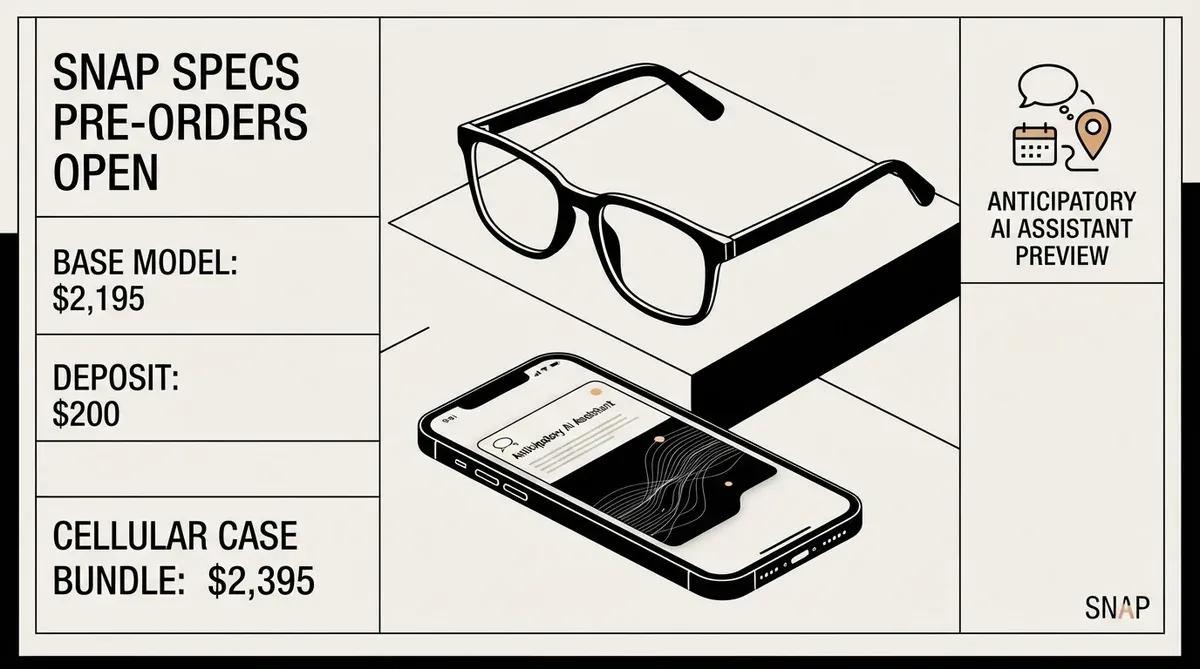
Snap opened Snap Specs pre-orders on September 16, putting a $2,195 price on its untethered augmented-reality glasses and a $200 refundable deposit on the queue. The same Los Angeles event introduced SPECS Intelligence, an anticipatory AI service that Snap will also run on iPhone and Mac.
Snap says the frames carry the computing. Spatial windows, hand tracking and the AI features run without a cable, a paired phone or a separate processing unit. The company lists a full-color display with a 51-degree field of view in immersive mode and a virtual cinema mode that renders the equivalent of a 115-inch screen seen from 10 feet.
SPECS Intelligence is the piece Snap wants buyers to notice. It learns the apps a wearer connects and builds a picture of routines, priorities and relationships, then surfaces information on its own instead of waiting for a typed prompt. Snap demonstrated an airport scenario in which a wearer asks about a flight's status. The assistant also runs on iPhone and Mac, which puts it in front of people who have not bought the glasses.
According to the company's announcement, the service handles what needs attention on a given day while leaving room for longer-term goals. Snap opened a waitlist for Mac access alongside the iOS preview. Because the assistant lives on the phone and the laptop as well as the frames, Snap can reach users who never put the glasses on, an unusual position for a hardware-first company.
What the Snap Specs Pre-Orders Include
The iOS preview opened in the United States on September 16 for anyone 18 or older through the SPECS app, and Mac access runs through an invitation-only waitlist. Software features include real-time translation across 60 languages, immersive navigation, and a multiplayer mode called EyeConnect that starts shared games when two wearers make eye contact. TechCrunch reported that the September event leaned on that entertainment angle, showing hands-on demos of the EyeConnect games after a June debut that underwhelmed. Snap named the NBA, the WNBA, HBO Max with Harry Potter programming, Spotify and Tripadvisor as experience partners.
The SPECS Connected Case addresses the glasses' reliance on Wi-Fi. The accessory holds four additional full charges and carries its own cellular radio, so the glasses stay connected away from home networks. It sells for $200 on its own, or a bundled purchase runs $2,395.
| Item | Price |
|---|---|
| Specs glasses, pre-order | $2,195, with a $200 refundable deposit |
| Specs Connected Case bundle | $2,395 |
| Cellular plan on Verizon (US) | $10 per month |
| Cellular plan on other carriers | $20 per month |
Verizon, Orange in France and EE in the United Kingdom are the carrier partners, according to Snap's investor release. Eligible Verizon customers can spread the hardware cost across 36 monthly payments, and Snap said custom data plans, digital setup and hands-on sessions at selected Verizon stores are part of the arrangement.
The first wave of Snap Specs pre-orders opened on June 16, the day of Snap's AWE keynote, at the same $2,195 price and the same fully refundable deposit. The September event added software detail, partner names and a cellular option rather than a new number, and the deposit reserves a place in the queue while the shipping window firms up.
The carrier line-up maps exactly onto the three launch countries, which means the cellular case pays off only where a local partner exists. Buyers outside the United States, Britain and France get the glasses without the accessory's main advantage.
The Enterprise Pitch Arrives Beside the Consumer One
Snap used the same event to add a workplace pitch that did not exist at the June reveal. Its investor release says the company is targeting retail, manufacturing and field operations with hands-free AR computing, backed by integrations spanning Salesforce, Amazon Web Services, Nvidia, Trifork and Hololight. Salesforce is bringing its Agentforce AI agent platform into Specs so workers can reach company data and automate tasks through the glasses. Nvidia supplies the AI that lets the glasses read a visual environment and retrieve relevant records, while AWS offers a voice assistant for jobs such as checking product availability. A Whiteboard tool for brainstorming and support for Bluetooth peripherals including keyboards complete the work software.
Privacy terms are stated plainly in the announcement. A physical LED lights whenever the glasses capture photo or video, and Snap says personal data is not used to train AI models or to target advertising.
The economics are the real test. At $2,195 the glasses cost more than most flagship smartphones, and a buyer who wants connectivity pays $2,395 up front plus $120 to $240 a year for data. Snap's consumer case rests on the idea that an assistant which acts before it is asked justifies that premium, an argument distinct from the one made by cheaper camera-and-audio eyewear that leans on a paired phone for processing.
Hands-on sessions at the launch pointed to a device closer to a small computer than to a camera accessory, with hand controls and spatial windows drawing the most attention. That is the distinction the price has to carry, since audio-and-camera smart glasses sell for a fraction of $2,195 and depend on a nearby phone.
Availability and the First Run
Consumers can try Specs in person from October 1 at SPECS First Look at Westfield Century City in Los Angeles. Shipping to the United States, the United Kingdom and France begins in late fall 2026, and Snap has capped the first production run at roughly 100,000 units.
Why this matters
Snap's pitch rests on an assistant that reads context and acts first, with the display as the delivery mechanism, and the $2,195 price plus a carrier-billed case is how the company finds out whether that promise survives a monthly bill. The enterprise tier with Salesforce, Nvidia and AWS spreads the cost of the hardware across workplace buyers, which matters for a first run limited to about 100,000 units. For anyone weighing a purchase, the practical question is whether an anticipatory assistant worn on the face is worth flagship-phone money before the software has proven itself in daily use.
AI-generated image.
Related Articles
- Snap Debuts Consumer-Ready Sixth-Generation Specs AR Glasses
- Snap and Qualcomm Partner for AI-Powered AR Glasses Arriving in 2026
- Weekly Tech Roundup: Apple's Big Week and AI's Price Tag
✔Human Verified
Researched and cross-referenced against primary sources by the Bytevyte editorial team. This article was generated with the assistance of artificial intelligence and reviewed by the Bytevyte editorial team.