
Spotify Taste Profile Beta Reaches US Premium Subscribers
Spotify Taste Profile beta reaches US Premium subscribers aged 18 and over, letting listeners view and rewrite the taste data behind their Home feed.
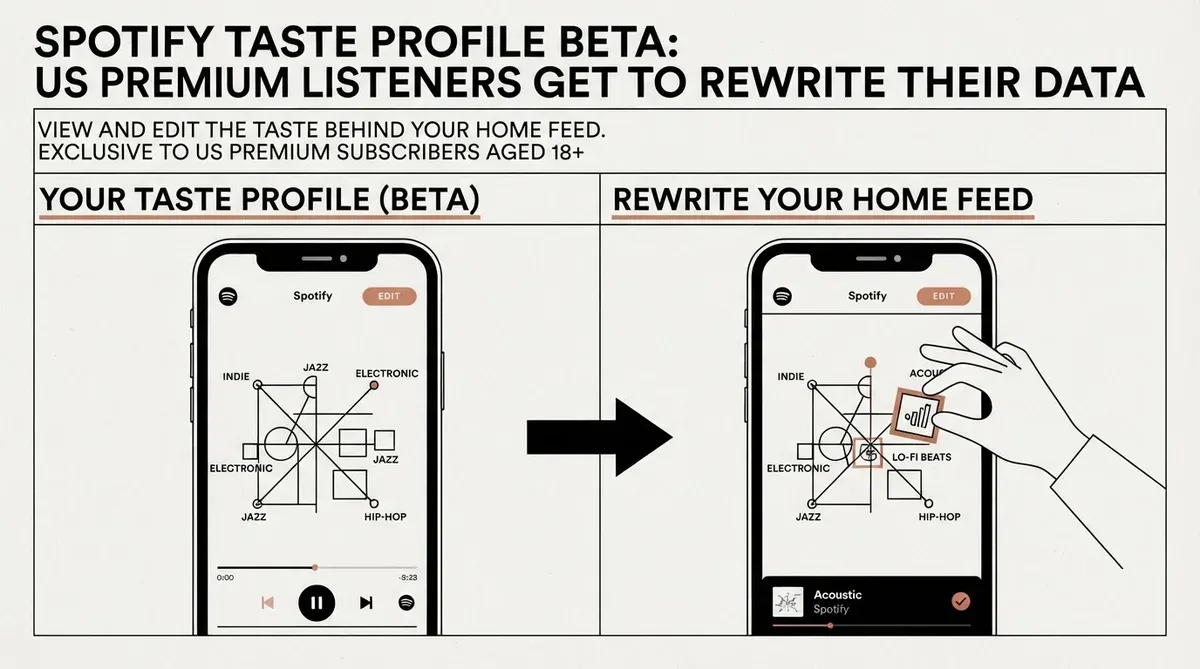
Spotify has begun rolling out the Spotify Taste Profile beta to Premium subscribers in the United States. The feature gives listeners a written summary of how the service reads their taste and a natural-language box for correcting it. The rollout started Wednesday and applies to accounts aged 18 and older. Spotify ran an earlier version of the test in New Zealand.
The feature covers music, podcasts and audiobooks. Spotify says this is the first time listeners can read the company's own description of their preferences inside the app, instead of inferring it from the tracks and shows that keep resurfacing.
How the Spotify Taste Profile works in the app
Access sits one tap deep. Users open the mobile app, tap their profile picture and choose Taste Profile. The page that loads holds Spotify's reading of their listening across the three content types, set out in plain language.
Editing runs on prompts. A listener can ask for more material from a named artist, more of a genre, or tracks that fit a particular mood. They can also flag artists and genres they have moved past. Spotify applies those instructions to the Home feed and to the personalised shelves behind it.
The summary is short by design. Spotify describes it as a brief interpretation of listening history, which keeps the page readable but limits how much of the underlying model a listener can inspect. Users who disagree with the reading can ask for narrow changes, such as more from one artist, or broader ones, such as a new direction for the whole Home feed.
Spotify says Discover Weekly and Made for You draw on the same preference data, so a rewritten profile can shift the weekly playlist as well as the front page. The company has not published how it weights written instructions against behavioural signals such as skips, saves and repeat plays.
| Detail | New Zealand beta | US rollout |
|---|---|---|
| Timing | Earlier in 2026 | Started September 23, 2026 |
| Eligibility | Premium listeners | Premium listeners aged 18 and over |
| Content covered | Music, podcasts, audiobooks | Music, podcasts, audiobooks |
| Access path | Profile picture, then Taste Profile | Profile picture, then Taste Profile |
| Cost | Included with Premium | Included with Premium |
The beta carries no separate charge and no stated end date. Taste Profile is part of an existing Premium subscription, and Spotify has not said when or whether it will move out of testing. The company also has not announced how access will be staggered across US accounts, or whether the feature will reach markets beyond the US and New Zealand.
From a New Zealand test to the biggest market
The New Zealand trial gave Spotify a small English-speaking market in which to watch what listeners do when handed the dials. Moving to the US changes the scale of that experiment. Spotify's American subscriber base is its largest, and the behaviour recorded there shapes how the company pitches itself to advertisers, labels and investors. A beta confined to New Zealand yields a thin signal. One that reaches US Premium accounts produces enough correction data to test whether user-written instructions improve satisfaction or simply add noise.
The timing also puts Taste Profile against a competitor making a similar bet. YouTube announced at its Made On YouTube event that it is adding Ask Music, a conversational tool for requesting music and podcasts, and Your Podcast Lineup, a weekly AI-generated spoken preview of suggested episodes. Both are headed for YouTube Music and YouTube Premium subscribers. The two companies are converging on one premise: typing a request in ordinary language is now a workable way to steer a recommendation engine.
Spotify has tied the shift to large language models. Executives have described systems that handle ordinary English as the change that lets the service take listener instructions directly, where previously it inferred intent from behaviour. The company has returned to that point at investor events this year.
Spotify Wrapped is the other surface worth watching. The year-end recap is assembled from listening history. If written instructions change what the recap reports in December, listeners will get an unusually visible test of how much authority their prompts carry.
Why Spotify is opening the black box
Recommendation systems have long been opaque by design. Spotify's move trades some of that opacity for direct user input, and the trade has a data logic. Every correction a listener types into the Spotify Taste Profile is an explicit label. That label is cleaner than the indirect evidence Spotify normally works from, where a skip might mean dislike, distraction or an interrupted commute.
The strategic target looks like match quality rather than time spent. Spotify frames the feature around whether recommendations fit. For a business that pays rights holders per stream, better targeting supports retention: a subscriber who keeps finding music they like has less reason to cancel.
Open questions remain for the beta to answer. Audiobooks are a comparatively new surface for Spotify, and taste data there is thinner than for music, so the written profile may read more accurately for songs than for books. Vague prompts are another unknown. A request for something calmer or more upbeat can be read in several directions, and Spotify has not detailed how its language model resolves ambiguous instructions or how quickly an edit shows up in the Home feed.
Eligibility is narrower than the headline suggests. The beta covers Premium accounts aged 18 and over in the US and New Zealand, which leaves out free-tier listeners, teen accounts and every other market.
Why this matters
Spotify is testing whether listeners will do part of the ranking work for it, and whether their written corrections beat the behavioural signals the algorithm already collects. The answer will shape how quickly other platforms open their own recommendation systems to plain-language editing, and how much control subscribers can reasonably expect over the feeds they pay for.
AI-generated image.
Related Articles
- Google Preferred Sources puts readers in control
- Meta Expands Instagram Parental Supervision with New Algorithm Transparency Tools
- YouTube Custom Feeds Let Viewers Write Their Own Algorithm With Gemini
✔Human Verified
Researched and cross-referenced against primary sources by the Bytevyte editorial team. This article was generated with the assistance of artificial intelligence and reviewed by the Bytevyte editorial team.