
TeamViewer Integrates AI-Driven Scripting into Tia for Autonomous Endpoint Management
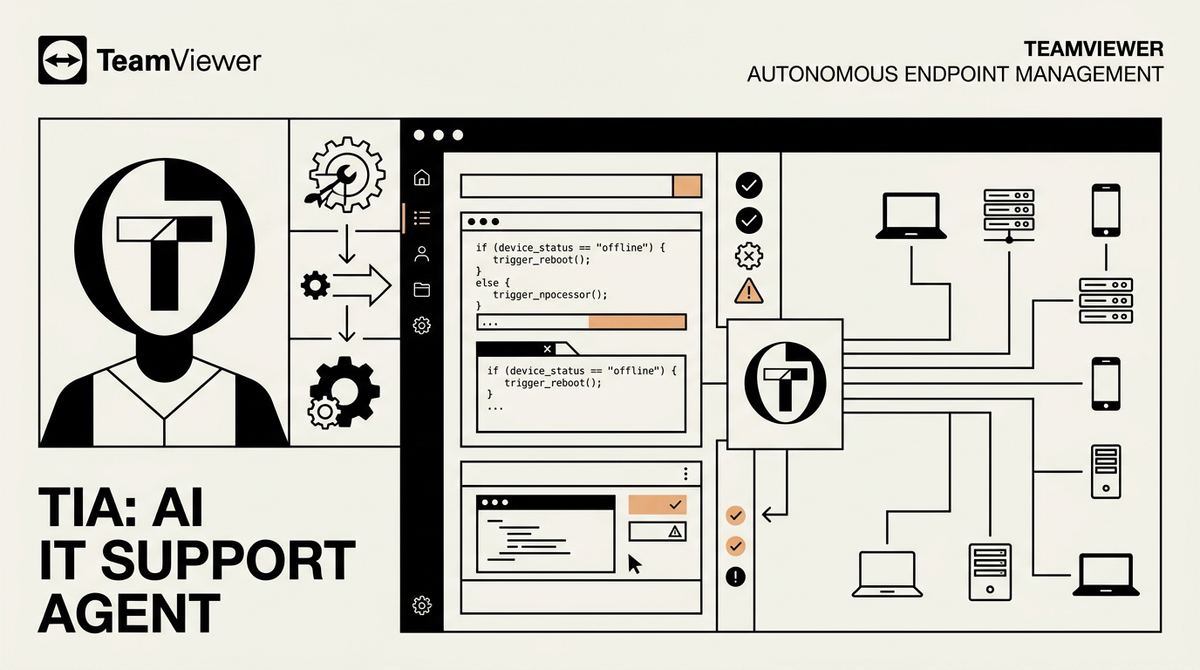
TeamViewer has introduced a new AI-driven scripting capability for its Tia intelligent agent, marking a significant step toward fully autonomous IT operations. Announced this week at the Gartner Digital Workplace Summit in London, the update allows the system to analyze an organization's historical support data and automatically generate executable scripts from previously resolved tickets. This integration of TeamViewer Tia AI scripting aims to streamline endpoint management by converting human-led fixes into standardized, automated workflows.
The new functionality functions by scanning past remote support sessions and documentation to identify successful interventions. Once a proven solution is recognized, the AI transforms the steps taken by technicians into ready-to-run automation scripts. According to TeamViewer, this process enables IT departments to deploy fixes across large device fleets simultaneously, reducing the need for manual repetitive tasks and minimizing the risk of human error in routine maintenance.
Scaling Operations with TeamViewer Tia AI Scripting
This release is a core component of the company's broader Autonomous Endpoint Management (AEM) roadmap. By leveraging TeamViewer Tia AI scripting and a milestone of over one million AI-powered remote support sessions already recorded, the platform utilizes real-world data to refine its automation logic. For enterprise leaders, this shift represents a move from reactive troubleshooting to a proactive, self-healing IT infrastructure where recurring issues are mitigated before they impact end-users.
Standardizing these fixes allows organizations to maintain consistency across diverse hardware environments. As IT teams face increasing complexity in managing distributed workforces, the ability to automate the lifecycle of a support ticket—from initial insight to an actionable script—provides a competitive advantage in operational efficiency. TeamViewer stated that the goal is to prevent the reoccurrence of known issues by ensuring that once a problem is solved, the solution is permanently codified into the system's autonomous library.
The introduction of these capabilities follows a period of rapid development in the remote connectivity space, where AI is increasingly used to bridge the skills gap in technical support. As of April 2026, the focus for many enterprises has shifted toward reducing the "mean time to resolution" (MTTR) through intelligent automation. With the latest updates to the Tia agent, the company positions itself as a primary provider for firms looking to implement high-level automation without requiring extensive manual script writing from their internal staff.
While we strive for accuracy, bytevyte can make mistakes. Users are advised to verify all information independently. We accept no liability for errors or omissions.
AI-generated image.
Related Articles
- Lenovo Launches Early Access for Lenovo Qira AI Assistant
- TCS and Google Cloud Launch Agentic AI Solutions
✔Human Verified