
The AI Infrastructure Pulse Economy Demands Continuous Synthesis
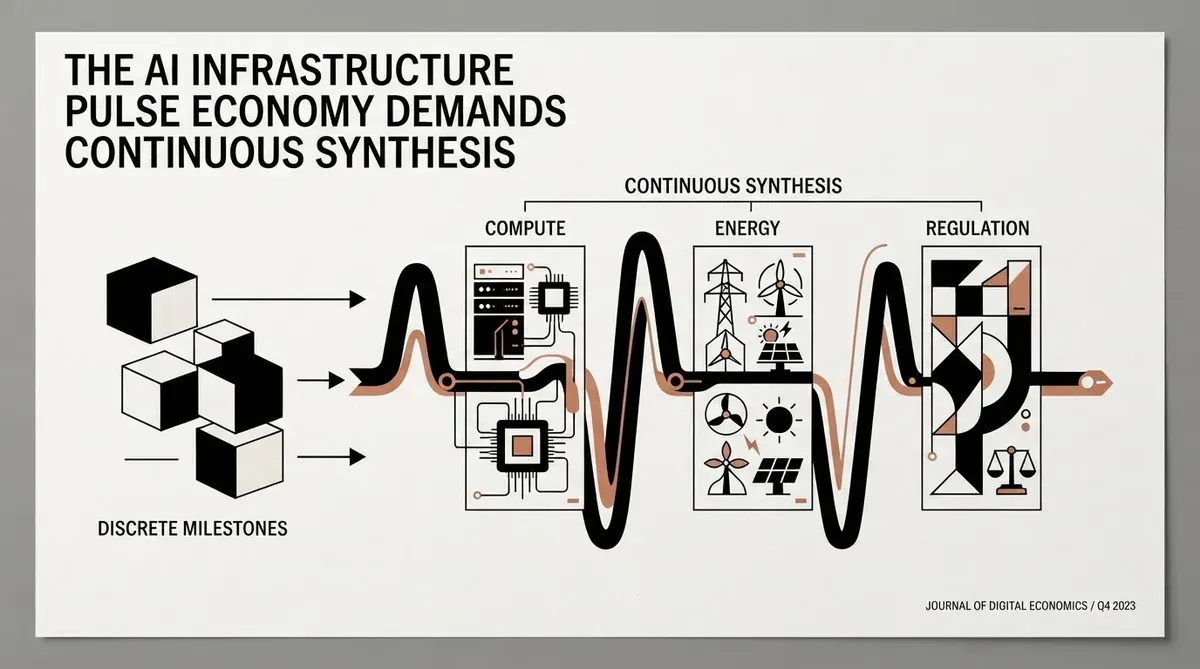
The artificial intelligence industry is changing the rhythm of its own economics. For a decade, progress arrived in discrete milestones: a flagship model launch, a data center commissioning, a new piece of legislation. Research circulating this year, including a May preprint on the arXiv and a July study in medRxiv, argues that this logic is breaking down, and that the AI infrastructure pulse economy now runs on continuous, non-stationary dynamics that reward synthesis over milestone-counting.
The core claim in that preprint is simple to state and hard to operationalize. The industry is moving from managing compute, energy, and capital as separate, staged events toward managing them as one evolving system. The preprint argues that traditional forecasting, which assumes the future mirrors the past, fails when structural conditions are unprecedented. At this scale of expansion, the past is a poor template for what comes next.
From Milestones to Continuous Synthesis
The analytical backbone comes from the PULSE project, a research effort that treats AI demand as a non-stationary time series and describes the shift as generative phase evolution. Its proposed mechanism, the Generative Phase Router, synthesizes the operator that governs how the system evolves, mapping arbitrary current conditions onto future trajectories instead of extrapolating from historical patterns. That is a direct challenge to the frequency-matched growth models that guided capacity planning through the earlier years of the boom.
The same logic appears at the hardware level. Research on trapped-ion platforms for quantum simulation finds that the most efficient route bypasses discrete gate representations entirely. Engineers apply numerical optimal control to compile whole algorithmic blocks into continuous, hardware-specific pulse gadgets, collapsing the distance between algorithmic theory and physical execution. The direction of travel is consistent across both layers: fluidity is winning over modularity, and the hardware-software boundary is dissolving.
The AI Infrastructure Pulse Economy
In the AI infrastructure pulse economy, the economics of chips and the energy needed to run them can no longer be treated as a linear progression. Demand arrives as a pulse with variable amplitude and timing. Organizations that plan for steady growth will misallocate capital when the next surge or lull lands, and energy providers that price power against constant baselines will miss the peaks.
The capital implication follows directly from the non-stationarity claim. If demand pulses rather than climbs, the correct response is not a single large bet at one point in the cycle but a portfolio of options that can be exercised as the phase changes. That discipline differs from the linear build-out that defined the first wave of AI infrastructure spending.
Enterprise evidence for the pulse view is concrete, if narrow. A pulse-diagnosis-inspired deep network for short-term electricity load forecasting removes redundant features and uses a serial multi-timescale framework to balance trend stability against fluctuation accuracy; the study reports a significant reduction in root mean square error compared with traditional control groups. Financial markets already work this way. The Trend Pulse indicator family, used by traders, reads market structure, price expansion, and trend aging to judge whether a move is maturing or exhausting, rather than leaning on fixed moving averages or momentum oscillators.
The four-stage model popularized by Trend Pulse maps directly onto the current AI cycle:
- Acceleration, where infrastructure and model capabilities expand rapidly and investment is aggressive.
- Distribution, a sideways phase where hype settles and efficiency-driven strategies take over.
- Deceleration, when model limitations or regulatory hurdles slow growth and positions turn conservative.
- Accumulation, the quiet consolidation where the next generation of technology is built before the next acceleration.
The preprint's assessment is that the market is leaving acceleration and entering distribution: the emphasis shifts from building larger models to synthesizing more efficient ones. That matches the drift in enterprise tooling toward deep momentum networks that unify position sizing with trend learning, giving operators finer control in volatile conditions.
Regulation and the Case for Stochastic Timing
The regulatory argument borrows from medicine. Deep brain stimulation is an established therapy for neurologic and psychiatric disorders, and its conventional form delivers highly regular pulses that suppress pathological activity while narrowing the usable therapeutic window. That rigid timing produces side effects such as paresthesias and speech impediments. A medRxiv study published in July tests stochastic pulse timing, which introduces controlled temporal variability while preserving the therapeutic benefit, and finds it widens the tolerable stimulation range.
Translated to AI policy, the lesson is that fixed-interval compliance checks and static frameworks create their own side effects: innovation fatigue, capital flight, and monitoring systems that cannot keep pace with a fast-moving technology. A structured but flexible regulatory cadence could keep oversight meaningful without assuming the industry's pace stays constant. What remains unresolved is operational. No regulator has yet built a compliance rhythm of this kind, and the distance between the metaphor and a working regime is large. The preprint also flags a concrete monitoring problem, sample imbalance and recognition accuracy in current AI oversight tools, which it compares to isolating pulsar signals from radio frequency interference.
Labor and the Third Path
On employment, the pulse framework offers a third option beyond replacement and augmentation, which it calls rhythmic integration. AI produces a continuous stream of processed data, and the human worker supplies interpretation, judgment, and strategy. The preprint even borrows its name from Synthesis Pulse, a progressive house mix that developers play for focus during long sessions: the music provides the steady background rhythm while the programmer provides the creative overlay.
The mechanical analogue is the adjustable speed drive, whose parallel linkages run on cranks set out of phase so the output stays steady even as individual components fluctuate. A workforce organized along those lines would treat different AI systems as phase-shifted collaborators rather than isolated tools, and the skill that matters becomes reading the synthesis of those pulses across the whole operation. The preprint frames that skill as the move beyond discrete task management toward a holistic understanding of how an industry evolves over time.
What the Pulse Framing Gets Right and Wrong
The strongest part of the synthesis is its convergence. Quantum control, medical device programming, electricity forecasting, and technical analysis reached the same conclusion independently: fixed, frequency-matched structures underperform adaptive, temporally structured ones. That alignment across domains that rarely speak to each other is the most persuasive evidence in the paper.
The weakness is the asymmetry of that evidence. The concrete wins are narrow and measurable: an error reduction in load forecasting, a wider therapeutic window in stimulation. The grander claims, that the global economy now runs on pulses that institutions must learn to ride, are framing devices rather than demonstrated findings. Trend Pulse is a trading heuristic without a predictive track record, and the four-stage market model is a descriptive tool with no demonstrated predictive power. Adopting the pulse language uncritically would be as costly as ignoring the non-stationarity it describes. The same pattern holds across the AI infrastructure pulse economy: the useful outputs are diagnostic signals that prompt human confirmation rather than autonomous verdicts.
Maturity cuts in both directions. On the demand side, the framework is young: it comes from preprint research rather than from a record of forecasts that came true. On the supply side, the underlying phenomena are already visible in the boom-and-settle rhythm of model releases, in power constraints that cap data center growth, and in enterprise budgets shifting from experimental scale-ups to efficiency work. The framework reads best as a warning about the shape of the cycle, not as a precise instrument for timing it.
The timing question is also a live policy question. The European Union and other global bodies are still writing comprehensive AI rules, which means the choice between a fixed compliance cadence and a flexible one is being made now, not at some distant review date. The practical verdict for capital allocators, capacity planners, and regulators is the same. Stop projecting linear demand. Build review processes with variable cadence. Use AI as a diagnostic layer that flags anomalies for human confirmation rather than a system that automates whole decisions. Organizations that treat the current distribution phase as a moment to consolidate efficiency will enter the next acceleration stronger than those still extrapolating from the last one.
Why This Matters
The stakes are measured in chips, energy, and the capital committed to both, the largest costs of the current expansion, and much of that money is being planned on assumptions of steady growth. If demand arrives as a non-stationary pulse, fixed multi-year plans and static rules will misallocate resources at scale. The open question posed by the preprint is whether economic and regulatory institutions can adapt their own rhythm before the technology changes it again.
AI-generated image.
Related Articles
- The Pulsed Synthesis Paradigm and the End of Continuous Output
- Great Rationalization AI: Beyond the GPU Land Grab Toward Resource Sovereignty
- AI Business Roundup: Infrastructure Billions, Market Jitters, and a New Regulatory Era
✔Human Verified
Researched and cross-referenced against primary sources by the Bytevyte editorial team. This article was generated with the assistance of artificial intelligence and reviewed by the Bytevyte editorial team.