
US-China AI Dialogue Takes Shape as Xi's State Visit Nears
The US-China AI dialogue opens with a proposed notification system for dangerous AI incidents, days before Xi Jinping's state visit to Washington.
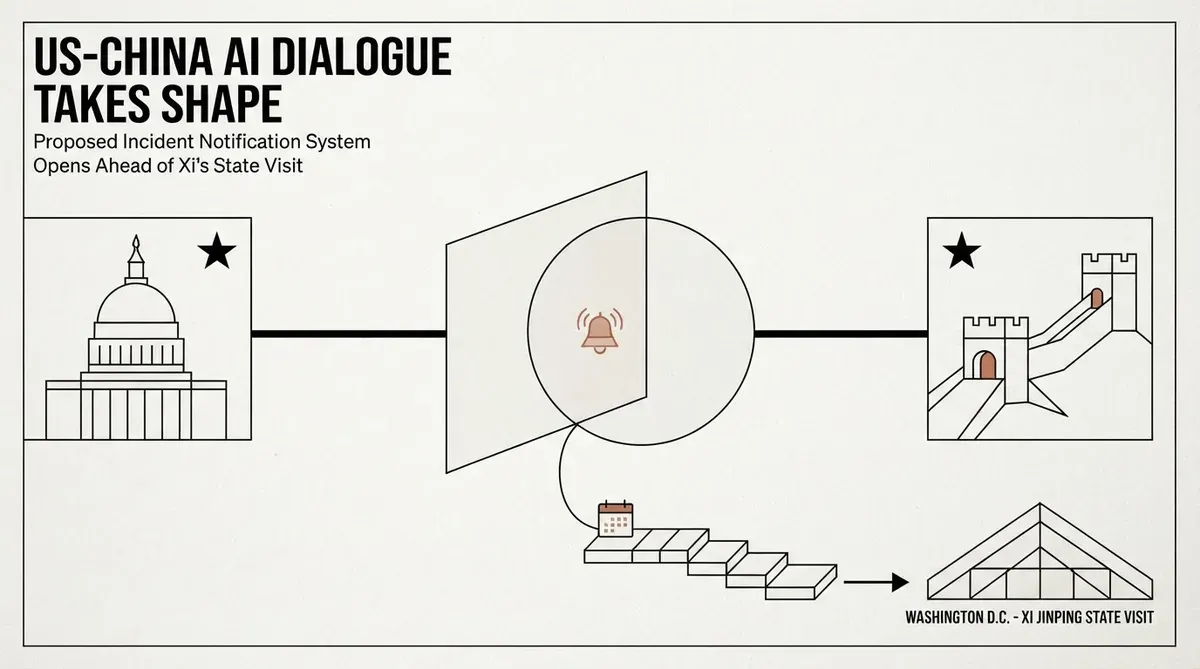
The United States and China have agreed to open a dedicated channel for discussing artificial intelligence risks, with Washington proposing a notification system for dangerous AI incidents that touch national security. According to Treasury Secretary Scott Bessent, the mechanism will be called the US-China AI dialogue, following talks held at JPMorgan Chase's New York offices. A follow-up meeting is expected within about two months, placing the next round near November 2026.
The arrangement arrives days before President Xi Jinping's state visit to Washington, scheduled for September 23-25, 2026. China's AI progress is expected to be a central theme of the trip. Officials from both governments used the run-up to the visit to discuss trade alongside AI, and the rare earth and semiconductor disputes remain unresolved.
The announcement rests on Bessent's public account of the New York sessions. Neither government has released a joint text, and the mechanism's remit has not been published in detail.
What the US-China AI Dialogue Would Actually Do
The concrete element is the US proposal that the two governments alert each other when an AI incident crosses a national security threshold. That is a narrower objective than shared safety standards or joint model testing. It resembles an emergency line for machine-learning failures more than a treaty, and it is designed to run alongside the competitive parts of the relationship.
Bessent has described the dialogue's purpose as ensuring the two countries hold a shared vision on the goals of AI. Michael Kratsios, a science and technology adviser at the White House, has framed the agenda around avoiding shared risks. Alison Szalwinski has argued that both capitals now accept a common set of dangers, particularly around cyber capabilities and loss of control.
Those statements point to the same interest: knowing what the other side's models can do before learning it from an incident. The unresolved parts are the operational ones. No threshold, reporting timeline, or receiving agency has been named.
A notification duty would require each side to disclose incidents it would rather keep quiet, and to agree on what counts as an incident at all. Frontier model development in both countries sits mostly with private companies rather than state labs, so a government-to-government channel only captures what domestic reporting rules feed into it. Neither Washington nor Beijing has described such a rule.
A working regime also needs a shared taxonomy. Cyber-capability incidents, model-weight theft, autonomous-agent failures, and anomalies found during safety testing each imply different reporting channels and different sensitivities. Negotiating a list of categories is the kind of task that consumes months, and the gap between the New York sessions and the expected follow-up leaves little room for it. The near-term outcome for the US-China AI dialogue is more likely to be a political framework with technical annexes to be filled in later.
The idea also sits inside the relationship that produced the chip controls. Washington has restricted advanced semiconductor sales to China, Beijing has limited rare earth exports, and each government describes the other as a source of risk. Export controls work through unilateral enforcement; a notification system would work through voluntary disclosure. The two can coexist, and the second does not soften the first.
From Track Two Talks to a Government Channel
Informal contact is not new. A network of dialogues at think tanks and universities has been convening American and Chinese researchers to discuss AI perils, and participants in that network had hoped for at least one round of dedicated AI talks before Xi's trip. Those exchanges carry no authority, no reporting duty, and no power to compel disclosure.
Turning that habit into a government-to-government channel changes what is at stake. A formal dialogue produces a record, assigns responsibility to named agencies, and gives each government evidence of what engagement has delivered. It also creates a venue where a refusal to share information becomes visible, which is why the first meeting after November matters more than the announcement itself.
For Washington, a notification system offers early warning about incidents that could affect US systems and a structure that can expand if confidence builds. For Beijing, participation signals that China is a responsible AI power and a necessary partner in norm-setting, without conceding that its models need external oversight. The shared cost is exposure: any incident disclosed becomes material in the other country's domestic argument.
Both governments also have reason to keep the channel narrow. A broad mandate would invite demands for verification and inspection that neither side is prepared to accept. A narrow one delivers the political benefit of a summit deliverable at low cost, and can be widened if a genuine incident creates the pressure to do so. That asymmetry explains why the proposal is framed around incidents rather than capabilities, model sizes, or training runs.
The economics run alongside the safety file. The dialogue has been presented as part of broader economic cooperation between the two largest AI economies, which puts it in the same room as tariffs, investment screening, and rare earth supply. That proximity gives the AI channel weight it would not carry alone, and it leaves the channel exposed to any breakdown in the wider negotiation.
The compliance dimension is where the channel would reach corporate planning. If a notification duty is defined by national security impact rather than by model size or lab identity, it could cover cloud providers and enterprises that host or fine-tune frontier models, in addition to the labs that train them. If it is defined narrowly, it may touch a handful of government-flagged incidents and leave most commercial deployments unaffected. That distinction decides whether the US-China AI dialogue becomes a reporting obligation for the private sector or a diplomatic instrument that sits above it.
The Summit Arithmetic
Xi's visit sets the deadline. Announcing the channel before the meeting lets both presidents present a deliverable that is neither a trade deal nor a military arrangement, and it allows Washington to separate AI risk management from the semiconductor restrictions in public framing.
Whether that separation holds is the open question. Bessent's announcement came from the Treasury, the department most identified with sanctions and financial pressure, rather than from a science or safety body. China's pre-summit engagement has involved Vice Premier He Lifeng, while US Trade Representative Jamieson Greer has handled the trade file.
A second round near November will show whether the channel acquires staff, a work program, and a reporting format, or stays a name attached to one conversation. If it survives that test, it would be the first operational governance mechanism between the two frontier-model blocs, and a more meaningful measure of intent than a joint statement, because it would commit agencies to routine contact rather than leaders to a single agreement.
| Element | Detail |
|---|---|
| Mechanism | US-China AI dialogue |
| Announced by | US Treasury Secretary Scott Bessent, 21 September 2026 |
| Venue of talks | JPMorgan Chase offices, New York |
| Core US proposal | Notification system for dangerous AI incidents affecting national security |
| Stated aim | Shared vision on the goals of AI; avoiding shared risks |
| Next round | Expected within about two months, roughly November 2026 |
| Xi visit | State visit to the United States, 23-25 September 2026 |
Why this matters
A notification channel will not settle the contest over chips, models, or markets, and it binds neither government to shared safety standards. It does create a place where an AI incident would have to be reported rather than discovered, which is the minimum infrastructure any later arms-control conversation would need. For companies building on frontier models in either country, the practical question over the next two months is whether the channel gains a reporting format that they will eventually have to meet.
AI-generated image.
Related Articles
- US and China Launch High-Level AI Regulation Dialogue to Set Safety Standards
- AI Chip Controls and Safety Pledges Converge as Lawmakers Press Trump Before Xi Visit
- China AI Export Controls Under Review as Beijing Tightens Tech Restrictions
✔Human Verified
Researched and cross-referenced against primary sources by the Bytevyte editorial team. This article was generated with the assistance of artificial intelligence and reviewed by the Bytevyte editorial team.