
US and China Launch High-Level AI Regulation Dialogue to Set Safety Standards
US and China agree to a high-level AI regulation dialogue on safety standards as the Trump administration pushes the America’s AI Action Plan for dominance.
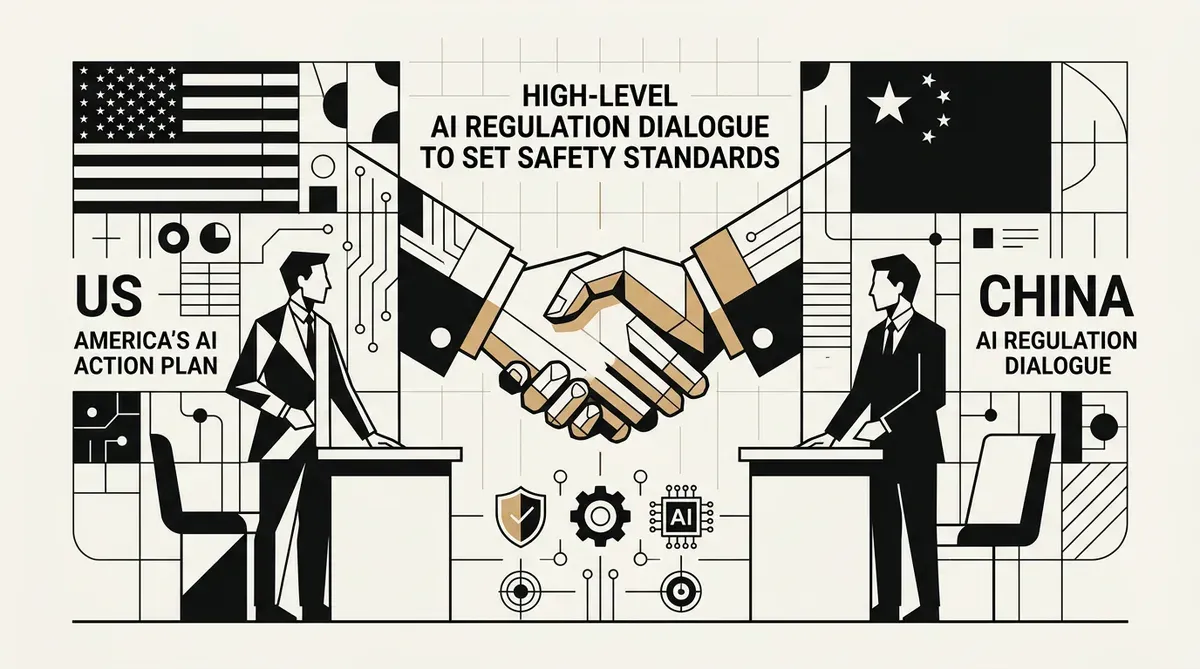
Donald Trump and Xi Jinping have established a new high-level AI regulation dialogue following a direct call between the two leaders. This agreement, confirmed by China’s Foreign Ministry Spokesperson Guo Jiakun, is a significant diplomatic shift as both nations seek to establish common ground on safety standards for artificial intelligence. The move comes at a critical juncture as the United States pivots toward a more aggressive, deregulation-focused strategy to maintain its technological edge.
The discussions between the presidents centered on the necessity of international cooperation regarding AI safety. While the two superpowers remain in fierce competition for technical supremacy, this dialogue suggests a mutual recognition that unmanaged AI risks could have global consequences. The framework for these talks will focus on technical guardrails and the prevention of catastrophic failures in autonomous systems, even as broader trade tensions persist.
The America’s AI Action Plan and Strategic Deregulation
This diplomatic engagement coincides with the active implementation of the America’s AI Action Plan. This policy blueprint, which moved into its active phase in early 2026, is a departure from previous cautious approaches. The plan is built on three primary pillars: innovation, infrastructure, and leadership. By removing what the administration describes as ideological bias and regulatory hurdles, the U.S. aims to accelerate domestic development and achieve global AI dominance.
The shift toward a deregulation-first approach is intended to lower the barrier to entry for American firms and encourage massive infrastructure investment. Under this new AI regulation dialogue, the U.S. delegation will likely push for safety standards that do not stifle the rapid deployment of new models. This creates a complex balancing act for decision-makers who must handle a domestic environment of rapid innovation while participating in international safety discussions.
Global Regulatory Divergence
While the U.S. and China begin their bilateral talks, the European Union is moving in a different direction. The EU recently finalized its Digital Omnibus deal, which adjusts the timelines for the AI Act. Although this deal delays some high-risk compliance requirements, it also introduces specific bans on certain AI applications. This highlights a growing divergence in how major economic blocs handle AI regulation dialogue and enforcement.
For global enterprises, these developments signal a fragmented regulatory environment. Companies must now track the deregulatory push in the U.S., the safety-focused bilateral talks between Washington and Beijing, and the evolving compliance rules in Europe. The outcome of the U.S.-China dialogue will be a key indicator of whether global safety standards can be harmonized or if the industry will face a bifurcated set of rules based on geopolitical alignment.
The first meetings under this new agreement are expected to take place in the coming months. These sessions will provide the first concrete evidence of whether the two nations can move beyond high-level agreements to establish functional safety protocols. As of May 20, 2026, the focus remains on setting the agenda for these technical exchanges. The administration has indicated that these talks will not delay the rollout of domestic infrastructure projects, ensuring that safety discussions run parallel to rapid industrial expansion.
The U.S. Department of Commerce is expected to play a central role in these negotiations, coordinating with private sector leaders to ensure that any agreed-upon standards are technically feasible. This involvement of industry stakeholders is a core component of the current administration's strategy to keep American companies at the forefront of the global market. The dialogue will likely address specific concerns such as the use of AI in critical infrastructure and the potential for algorithmic bias in cross-border financial systems.
While we strive for accuracy, bytevyte can make mistakes. Users are advised to verify all information independently. We accept no liability for errors or omissions.
AI-generated image.
Related Articles
- U.S. Commerce Department Secures AI Safety Agreements with Google, Microsoft, and xAI
- China Blocks Meta's Manus Acquisition Over National Security Concerns
- US Defense Department Partners with Tech Giants to Establish AI-First Military Force
✔Human Verified