
Visa and FPT AI Factory Launch Payment Rails for the B2AI Economy
Visa and FPT AI Factory launch a platform for the B2AI economy, enabling AI agents to autonomously research and pay for business services with secure protocols.
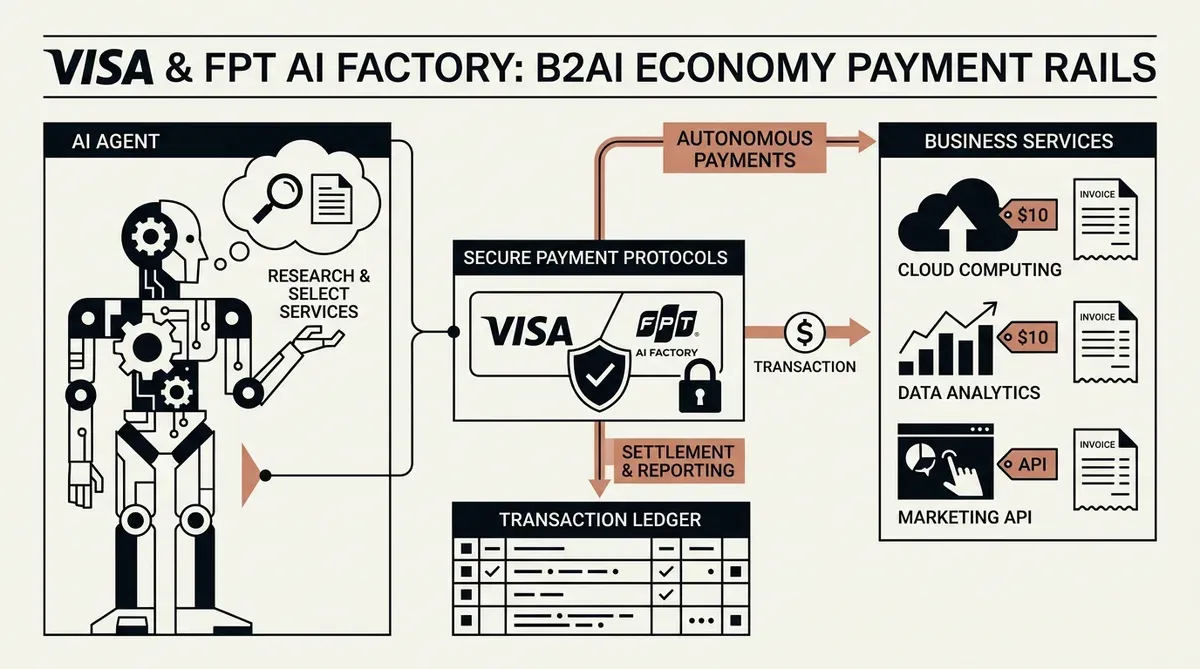
Visa and FPT AI Factory have launched an agent-native commerce platform designed to facilitate the emerging B2AI economy, where autonomous AI agents act as independent economic participants. Announced this week, the collaboration introduces a framework that allows AI agents to research, negotiate, and execute financial transactions without direct human intervention. The initiative aims to address a significant barrier in the agentic AI era: the secure and authenticated movement of funds by non-human entities.
The platform integrates Visa Intelligent Commerce payment rails with FPT AI Factory's production inference layer, which utilizes NVIDIA-accelerated GPU infrastructure. By providing the necessary "spend controls" and tokenized credentials, the system enables enterprise AI agents to manage procurement and business services autonomously. Industry projections suggest the B2AI economy could reach a market value between $3 trillion and $5 trillion by 2030, driven by the shift from human-led to agent-led commercial interactions.
Securing the B2AI Economy with Trusted Protocols
Central to the new platform is Visa's Trusted Agent Protocol (TAP), a security framework that ensures every transaction initiated by an agent is authenticated and auditable. This protocol is designed to be agnostic, supporting various industry standards such as Google's AP2 and Stripe's MPP through the Visa Acceptance Platform. By establishing these standards, Visa and FPT aim to provide a reliable environment for AI-to-AI negotiations, a concept that over 50% of business leaders are currently open to exploring.
The infrastructure provided by FPT AI Factory supports frontier AI models that power the decision-making capabilities of these agents. This setup allows agents to function as a new class of customers, capable of navigating complex business environments to find and pay for services. The integration of AI-ready tokenized credentials ensures that while agents have the autonomy to spend, they remain within the strict budgetary and operational boundaries set by their human or corporate overseers.
Strategic Implications for Enterprise Procurement
For decision-makers, the launch of an agent-native commerce platform signifies a shift in how enterprise resources are managed. Traditional procurement processes often involve manual approvals and human-led negotiations that can slow down operations. By transitioning to a B2AI economy model, companies can automate the discovery and acquisition of services, potentially reducing overhead and increasing the speed of business execution.
The partnership between a global payments leader and a major AI infrastructure provider highlights the growing need for specialized financial services tailored for autonomous systems. As AI agents become more sophisticated, the demand for "spendable" AI will likely increase, requiring more durable frameworks for identity and payment verification. The current rollout provides a foundation for businesses to begin testing autonomous procurement strategies within a secured and regulated ecosystem.
While we strive for accuracy, bytevyte can make mistakes. Users are advised to verify all information independently. We accept no liability for errors or omissions.
AI-generated image.
Related Articles
- EBANX Global Payments Expansion Integrates AI in Asia
- AiPrise Unveils Website Agent 2.0 to Streamline Merchant Risk Assessment
- Databricks and Stripe Launch Payment Infrastructure for Autonomous AI Agents
✔Human Verified