
Wayve and Uber Switch On the UK's First Autonomous Rides in London
Wayve and Uber have launched the UK's first autonomous rides in London, with a TfL-licensed safety driver still onboard during the supervised phase.
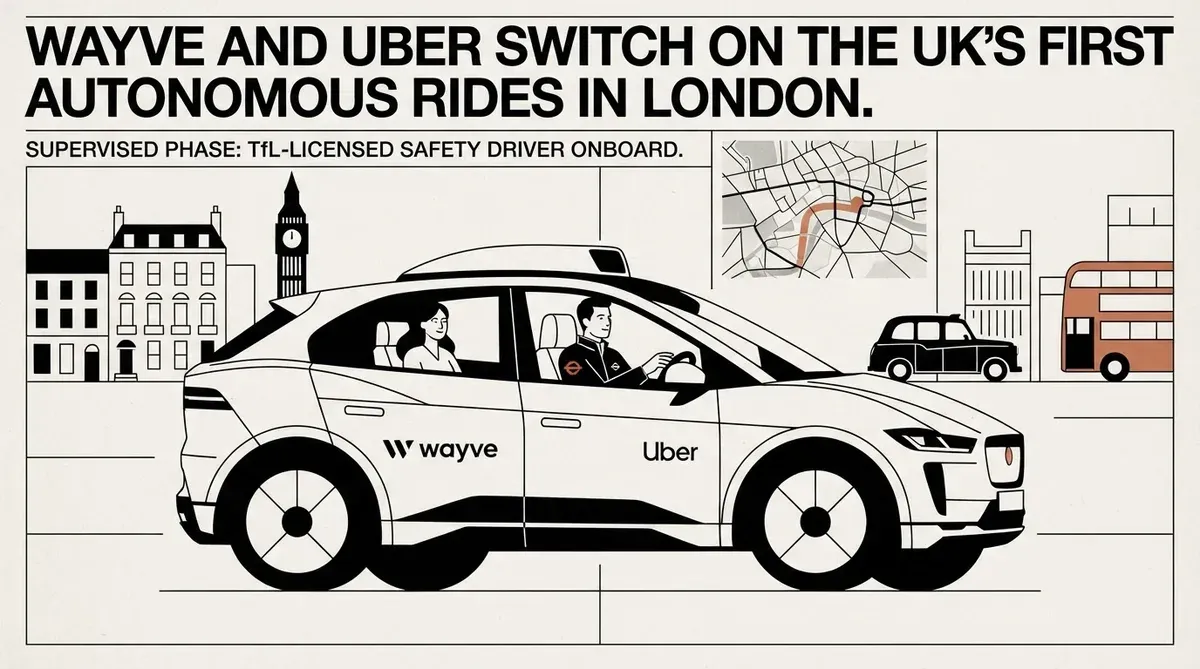
Wayve and Uber have put the UK's first autonomous rides on London streets, opening a supervised public service in which passengers are matched with self-driving, all-electric Ford Mustang Mach-E vehicles through the standard Uber app. The service went live on September 3, 2026, with a Transport for London-licensed safety driver behind the wheel of every car during this initial phase.
Riders who book an UberX, Uber Electric, or Uber Comfort journey can be paired with a Wayve car without paying any surcharge, and the price is shown upfront before the trip is confirmed. The operating area covers London excluding its airports, and the screens inside the cars that explain each ride to passengers support 64 languages. More than 140,000 Londoners had already opted in to the feature ahead of the launch.
Under the hood is Wayve's AI Driver, an end-to-end system the company labels "AV 2.0" and describes as improving through experience rather than leaning on high-definition maps. Wayve positions that mapless design as the route to scale: instead of commissioning detailed maps for each new operating area, the AI Driver keeps learning from the miles it logs.
The supervised format is deliberate rather than a temporary workaround. A trained private-hire driver licensed by Transport for London monitors every trip and can take control at any moment, and the service operates under the government's Code of Practice for automated vehicle trials. Reaching fully driverless operation is a separate milestone. Wayve has said it will move to manufacturer-produced robotaxis on a new Nissan LEAF platform, validate safety on that vehicle, and clear a national approval process before the human leaves the cab.
Beyond the UK's First Autonomous Rides
The London switch-on is the opening move in a partnership the two companies plan to run across 12 markets. Tokyo is next on the roadmap: later in 2026, the pair expects to deploy Nissan LEAF vehicles running Wayve software on the NVIDIA DRIVE Hyperion platform. Uber's stated target is autonomous trips in 15 cities worldwide by the end of 2026.
Why This Matters
The UK's first autonomous rides are as much a regulatory experiment as a commercial launch, demonstrating how a supervised service fits under the existing Code of Practice while the country builds a national approval route for driverless operation. For Wayve and Uber, every supervised mile strengthens the safety case that will decide when the driver seat can be empty, the point at which robotaxi unit economics improve. Londoners, for their part, get an early read on whether they trust a machine with the capital's traffic.
AI-generated image.
Related Articles
- London Robotaxi Delay Deepens as TfL's Unwritten Rulebook Keeps Driverless Taxis Grounded
- Stellantis, Wayve, and Uber Form Global Robotaxi Alliance for Level 4 Autonomy
- Waymo Launches Reference Driver Model to Benchmark Autonomous Safety Against Human Behavior
✔Human Verified
Researched and cross-referenced against primary sources by the Bytevyte editorial team. This article was generated with the assistance of artificial intelligence and reviewed by the Bytevyte editorial team.