
Stellantis, Wayve, and Uber Form Global Robotaxi Alliance for Level 4 Autonomy
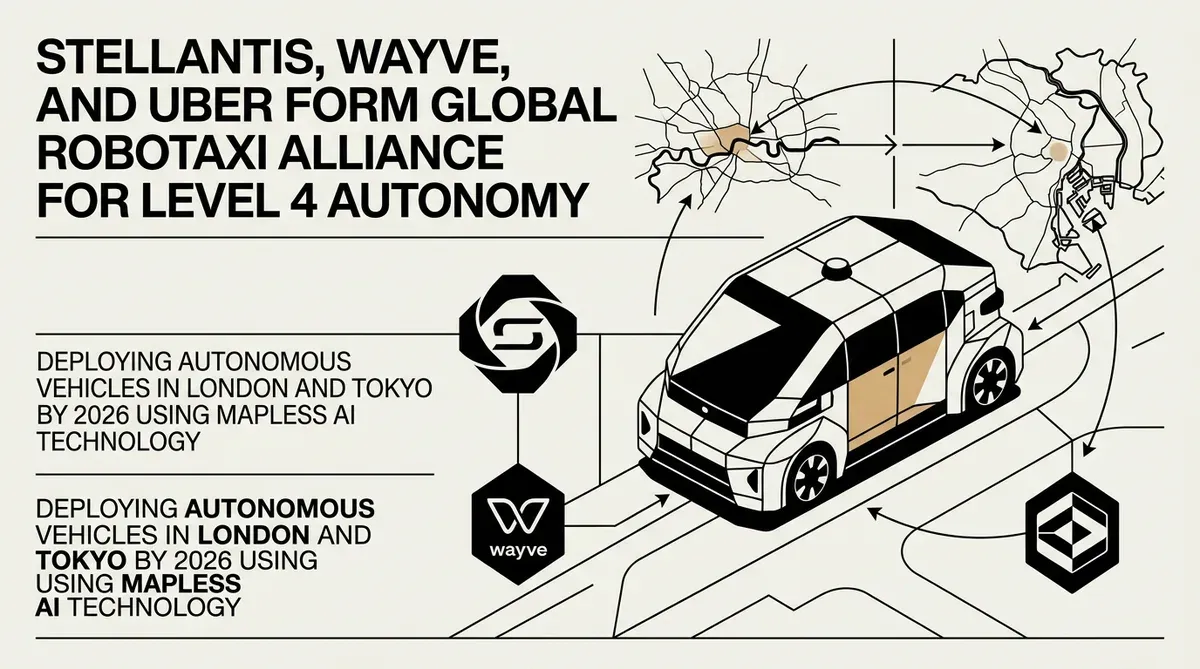
Stellantis, Wayve, and Uber established a global robotaxi alliance on June 17, 2026, to develop and deploy Level 4 autonomous vehicles. The collaboration combines vehicle manufacturing, adaptive AI software, and a ride-hailing network to commercialize driverless mobility services. The partners aim to launch autonomous rides in London and Tokyo starting in 2026.
The agreement is a non-binding Memorandum of Understanding (MoU) for technology licensing and vehicle procurement. According to the terms, Stellantis will mass-produce vehicle platforms for driverless operations. These vehicles use Wayve's mapless Embodied AI software, which allows autonomous systems to operate in urban environments without pre-mapped data. Uber will incorporate these Level 4 robotaxis into its marketplace to provide the consumer-facing infrastructure.
Strategic Impact of the Global Robotaxi Alliance
This partnership addresses bottlenecks in hardware production, software adaptability, and market access. By using Stellantis' manufacturing capacity, the global robotaxi alliance avoids scaling issues common among smaller startups. Wayve's mapless technology reduces operational costs in new markets because it removes the requirement for high-definition maps. This approach allows for faster expansion into diverse geographic regions.
The collaboration follows a previous technical relationship between Stellantis and Wayve regarding Level 2++ driver assistance. The move to Level 4 autonomy indicates a commitment to driverless commercial applications. For Uber, the deal provides purpose-built autonomous vehicles and reduces reliance on third-party fleet operators. The global robotaxi alliance intends to expand to 10 additional cities as the platform matures.
Operational and Market Implications
The integration of Wayve's AI into Stellantis platforms creates a hardware-software stack for different vehicle models. This modularity allows Uber to maintain a consistent user experience across regulatory environments in North America and Europe. The initial rollout focuses on high-density urban areas with high ride-hailing demand. Removing the human driver in these areas provides the strongest economic case for the service.
The global robotaxi alliance competes with established autonomous vehicle companies. Mass-producing L4-ready vehicles provides Stellantis a competitive position in the OEM market. Wayve receives real-world driving data through Uber's network to refine its AI models. This data loop improves performance in edge-case scenarios. Production-ready units will begin testing in metropolitan areas in 2027.
AI-generated image.
Related Articles
- Stellantis and Microsoft Launch Five-Year Strategic AI Alliance to Overhaul Automotive Infrastructure
- Pony.ai Unveils L4 Autonomous Compute Platform with NVIDIA
- SoftBank, Sony, and Honda Form ¥1 Trillion Alliance to Build Sovereign Physical AI
✔Human Verified