
Zoox Robotaxi Exemption: Landmark U.S. Approval for Steering-Wheel-Free Rides
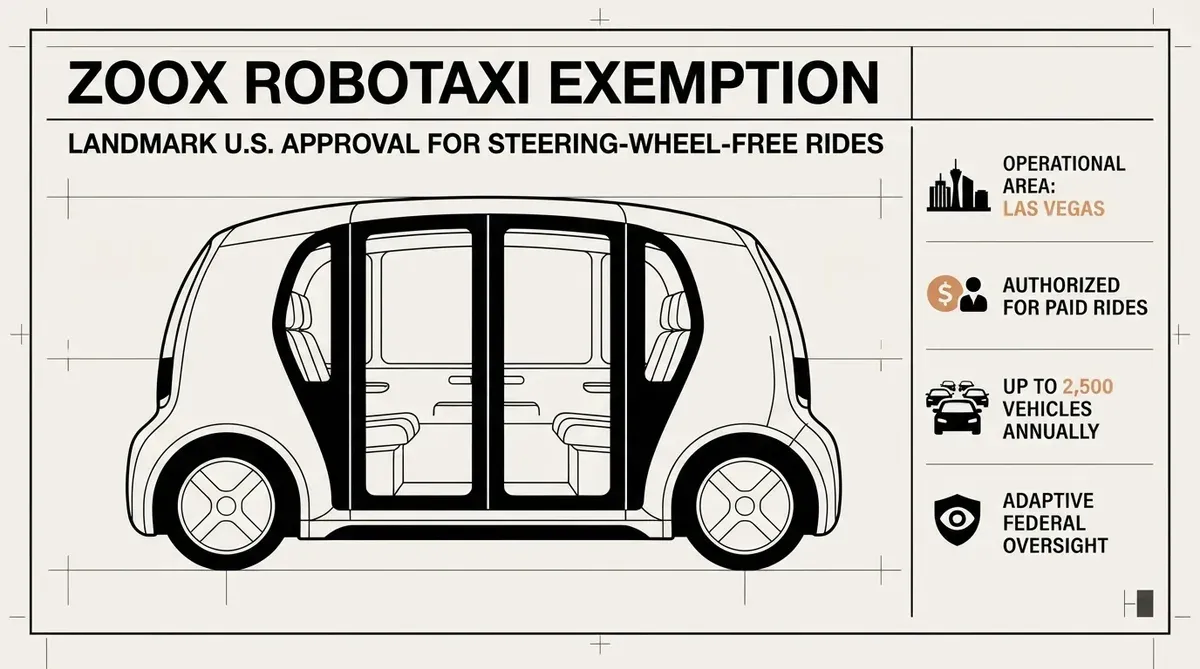
NHTSA has granted Amazon's Zoox the first commercial exemption for a purpose-built robotaxi, clearing the way for a vehicle with no steering wheel, brake pedals, or side mirrors to charge for rides in the United States. The two-year approval, announced July 30, 2026, permits up to 2,500 Zoox vehicles a year into commercial service. The Zoox robotaxi exemption covers Las Vegas first, with additional markets to follow once state and local requirements are met.
The difference shows up at the curb. The carriage-style pod seats four passengers on two rows of inward-facing seats, reaches 75 mph, and drives itself with no one in front of a wheel. Zoox says more than 500,000 people have already ridden in its autonomous vehicles during development and testing.
The exemption is one piece of a wider regulatory reset announced alongside it. NHTSA launched A2SCEND, a $5 million, three-year project with SAE Industry Technologies Consortia to develop national performance standards for automated vehicles, and issued an interim final rule that lets vehicles built before an exemption grant enter commercial deployment. The agency is also updating its 2017 technical guidance for autonomous vehicles, adding sections on emergency responder interaction, remote assistance, and post-crash behavior. NHTSA framed the package as an effort to cut red tape without lowering the safety bar, pairing faster approvals with new performance standards.
The guidance updates address questions that only exist when no human sits behind the wheel: who speaks to a police officer at a traffic stop, who calls for help or files a report after a crash, and who takes control when remote assistance is engaged. For a purpose-built robotaxi, none of those roles has a default answer. The revised guidance is NHTSA's attempt to supply one before driverless fleets scale.
The approval also shows how far the federal rulebook lags the technology it now regulates. Safety standards dictate steering wheel placement, mirror requirements, and pedal design, assumptions that do not apply to a vehicle that drives itself. Zoox's exemption works around those rules for a single company, while A2SCEND is NHTSA's longer-term answer: performance benchmarks that replace assumptions about human drivers with measurable behavior on the road.
What the Exemption Covers
The order relieves Zoox of eight federal motor vehicle safety standards and sets a deployment envelope of 2,500 vehicles annually over the two-year period, or up to 5,000 robotaxis in total. NHTSA structured the oversight to adapt as Zoox's technology changes rather than locking in a fixed compliance regime for the life of the exemption.
The pathway behind the approval is as important as the approval itself. NHTSA opened a route for domestic manufacturers building next-generation autonomous vehicles in 2025, and the interim final rule extends that logic to cars already in production: vehicles built before an exemption grant can now be deployed commercially rather than waiting for paperwork to catch up. That change removes a timing problem that could otherwise leave finished robotaxis parked while regulators reviewed them.
The interim final rule is not limited to Zoox. Any manufacturer with vehicles already built when an exemption is granted can now deploy them commercially, which shortens the distance between production line and revenue for every AV developer in the pipeline. The rule is a structural change with wider reach than the Zoox order itself.
Standards work points the same direction. A2SCEND is meant to produce national AV performance benchmarks that manufacturers can design against, with the goal of replacing the sector's reliance on case-by-case exemptions. NHTSA is separately reviewing a request from Robomart to exempt low-speed driverless delivery vehicles, a sign that the new pathway is intended to cover more than passenger robotaxis.
The two-year term makes the approval a supervised experiment rather than a permanent license, and what happens at the end of that term will be the next test of the fast-track approach. For the industry, the near-term regulatory path is now clear: prove the safety case in commercial service, then standardize it.
What the Exemption Means for the Robotaxi Race
The approval lands in a three-way race to scale autonomous ride-hailing. Waymo, owned by Alphabet, and Tesla are both racing to expand their driverless networks, but Zoox's vehicle is structurally different: it was designed as a driverless machine from the start, while competitors adapt conventional cars to regulations written before self-driving technology existed.
The design difference is the commercial core of the approval. A purpose-built pod has no steering wheel to remove and no driver-oriented cabin to retrofit, which is exactly why it needed an exemption in the first place. Jonathan Morrison, NHTSA's administrator, framed the decision as the beginning of a broader shift, with the agency clearing the way for robotaxis to operate without steering wheels and eventually without brake pedals.
The exemption is also a revenue event. Zoox has tested its pods for years, but charging for trips is what turns the program into a business. With the Zoox robotaxi exemption in hand, the company holds the first federally sanctioned revenue path for a purpose-built robotaxi in the United States. The 2,500-vehicle annual ceiling is modest next to conventional ride-hailing fleets, but it is large enough to turn the Las Vegas service into a real test of the business model.
Regulatory standing now differs as much as vehicle design. The exemption belongs to Zoox alone, and neither Waymo nor Tesla holds a comparable federal approval for a purpose-built vehicle without controls. That gap is one of the few in this race that software updates cannot close.
For Amazon, which owns Zoox outright, the approval converts years of investment into a commercial service and produces a regulatory precedent no other ride-hailing operator holds. The precedent extends beyond passenger trips: the same exemption pathway NHTSA opened is already being tested by driverless delivery vehicles, so the framework Zoox just passed through is available to other autonomous vehicle programs.
The remaining gates are local. Zoox can begin charging for rides in Las Vegas, and every additional market will require its own state and local approvals that the federal exemption does not preempt. That division of authority, with Washington setting vehicle safety standards and cities controlling operations, is the same structure Waymo and Tesla work within, so the pace of Zoox's rollout will be decided locally as much as federally.
Why the Zoox Robotaxi Exemption Matters
For the industry, the Zoox robotaxi exemption settles the question that has blocked purpose-built autonomous vehicles for years: a car without a steering wheel can legally carry paying passengers in the United States. For Amazon, it validates a long-running investment and hands the company the only federal exemption of its kind, a position neither Waymo nor Tesla holds. The two-year window, with its adaptive oversight, will show whether this fast-track becomes the permanent shape of the AV rulebook or a one-off approval.
AI-generated image.
Related Articles
- AV Emergency Response Coordination Act: Robotaxi Safety Bill
- Pony.ai Reports Nearly 400% Growth in Robotaxi Revenue for Q1 2026
- Stellantis, Wayve, and Uber Form Global Robotaxi Alliance for Level 4 Autonomy
✔Human Verified
Researched and cross-referenced against primary sources by the Bytevyte editorial team. This article was generated with the assistance of artificial intelligence and reviewed by the Bytevyte editorial team.