
Xiaomi Tieda humanoid robot hits 98% factory accuracy after auto-plant trial
The Xiaomi Tieda humanoid robot hit 98% factory accuracy after four months of auto-plant training, debuting at the 2026 World Robot Conference in Beijing.
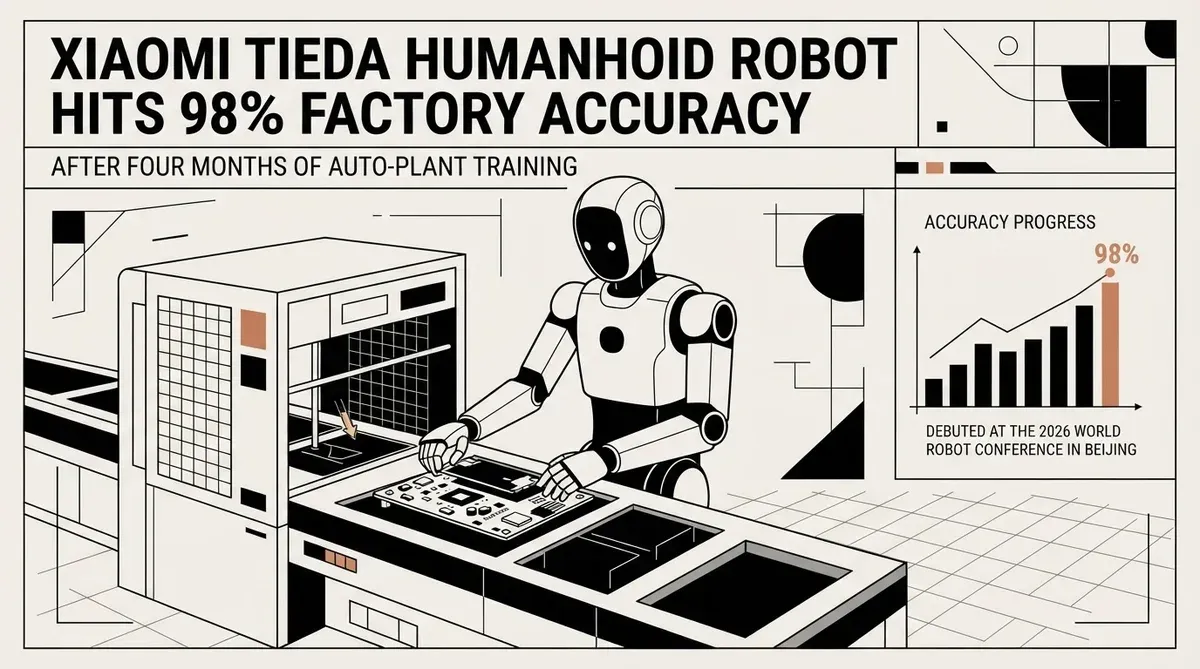
The Xiaomi Tieda humanoid robot hit a 98% success rate on an assembly-line nut installation task after four months of training inside one of the company's own auto plants, a result Xiaomi presented when it publicly unveiled the machine at the 2026 World Robot Conference in Beijing on August 19. The conference runs through August 23, and the Beijing showing is the robot's first public appearance since that extended factory trial.
The accuracy figure anchors the announcement because it is a real-workplace number rather than a staged demo. The machine spent roughly four months inside a Xiaomi automobile factory, and the company released before-and-after performance data from that stint alongside the hardware details.
Specs: a human-scale frame with 66 degrees of freedom
Standing 1.70 meters tall and weighing 66 kilograms, the new-generation robot carries 66 degrees of freedom, 33 of them in the hands. That hand dexterity is what allows it to handle flexible parts and sort components, and it continues the CyberOne line that Xiaomi has developed under the Tieda code name. An earlier iteration, CyberOne V2, appeared at the company's investor day in April 2026 with hands shrunk by 60% to near-human scale, 22 to 27 degrees of freedom in the hands, and a liquid-cooling system built around bionic sweat glands. The new machine's 33 hand degrees of freedom sit above the 22 to 27 CyberOne V2 carried, a sign of the same design direction toward heavier manipulation work.
The progression from CyberOne V2 to this generation shows where Xiaomi has concentrated its engineering effort: the hands grew more capable, and the control software replaced fixed routines with a decision model trained on real work. The result is a machine built around the specific conditions of a production line.
Four months on a real assembly line
Xiaomi's test site was its own car plant, and the clearest result came at a self-tapping nut installation station that required work on two sides of the assembly, forcing the robot to reposition itself and the part between operations. Initial runs there returned a 90.2% success rate; software adjustments over the four-month trial lifted the figure to 98%, one percentage point below human workers on the same job. After mastering that station, the machines moved into new roles in the final assembly workshop, where tasks such as folding boxes ran at a 90% success rate.
| Factory task | Measured result |
|---|---|
| Dual-sided self-tapping nut installation | 98% success, up from 90.2% at the start of the trial |
| Box folding in the final assembly workshop | 90% success |
| Continuous pilot run at a 76-second takt | 90.2% task success over three hours |
Xiaomi frames the plant floor work as pilots rather than deployment, and company president Lu Weibing has likened the robots' role to that of interns learning on the job. The distinction sets expectations: the machine is being measured for what it can learn in a working environment, not sold as a finished production tool.
The software behind the accuracy
The accuracy gains did not come from re-writing task steps. The Xiaomi Tieda humanoid robot runs its decisions through the Xiaomi-Robotics-0 open-source model, which handles autonomous decision-making instead of executing pre-programmed scripts. On the perception side, Mi-Sense depth vision feeds a brain-plus-cerebellum hybrid architecture, with the high-level model selecting the task behavior while lower-level routines manage movement control.
That architecture is what makes the nut-installation improvement possible. Flexible parts shift shape as they are handled, and components can arrive misaligned; a fixed script fails on those variations, while a model that re-evaluates the scene can adjust mid-task. Box folding tests a different skill set, since deformable materials change shape as they are worked. The same architecture later handled box folding in a different workshop, an early sign that the decision model transfers across stations rather than memorizing a single task. Xiaomi has attributed the jump from 90.2% to 98% specifically to software refinements made during the factory trial, which is what separates factory-trained robots from lab demonstrations.
The open-source status of Xiaomi-Robotics-0 is itself a strategic signal. By publishing the decision model rather than keeping it internal, Xiaomi lowers the barrier for research groups and other manufacturers to build on the same stack, the same way open-weight language models have spread through the AI industry. That approach turns the robot from a standalone product into a carrier for Xiaomi's AI software, and it gives other manufacturers a path to reuse the same decision-making stack in their own lines.
Research spending and product strategy
The robotics program sits inside a larger R&D ramp at Xiaomi. The company spent 9.23 billion yuan on research and development in the second quarter of 2026, with a significant portion allocated to AI and robotics, and it has scheduled the robot for exhibition in Europe after the Beijing show.
Commercial ambition is deliberately narrow for now. Lu Weibing has said Xiaomi does not plan to develop the robot as a standalone product, which keeps the machine inside the factory automation strategy rather than the consumer lineup. The car plants that trained the robot double as the testbed for that strategy, tying the robotics push to Xiaomi's wider bets across consumer electronics and electric vehicles. For investors, the R&D line is the more direct signal: the 9.23 billion yuan quarterly spend keeps Xiaomi's AI and robotics ambitions funded even though the robot generates no direct revenue, since it is not for sale. The measurable return sits in manufacturing efficiency inside Xiaomi's own plants, which is why the factory trial data matters more than the stage demo. If the accuracy curve holds across more stations, the first payoff would land inside Xiaomi's own factories, where the robots have already shown they can hold a station.
A crowded stage in Beijing
Xiaomi's Tieda humanoid robot is one accuracy story on a crowded stage. The Beijing event hosts more than 2,000 exhibits and over 150 product debuts, with rivals such as Unitree demonstrating machines that can play table tennis and X Square showing a WALL-B model that identified, picked, and reoriented 1,816 parcels an hour with over 98% accuracy in a livestreamed test. The floor spans robot dogs and humanoids pitched for emotional support alongside the factory machines, a reminder that the commercial case is still being settled across very different categories.
Accuracy claims have become the competitive currency at the show, but the gap with human workers remains the industry's central problem. For all the improvement in nut installation and box folding, humans still outperform humanoids across most factory tasks, and Xiaomi's one-point gap on a single station is a measure of how far the category still has to travel. The industry spent two years demonstrating machines that can breakdance, throw punches, and set marathon records; this year's conference is the test of whether those machines can generate economic value on a shift schedule.
Why the Xiaomi Tieda humanoid robot matters
The significance lies in the method as much as the result. Xiaomi is one of the first large hardware companies to train a humanoid inside its own production line and publish the before-and-after accuracy curve. That puts the discussion on repeatable factory metrics rather than capability demos. For manufacturers, a 98% rate on a dual-sided nut-installation task is the kind of figure that decides pilot programs. For Xiaomi, the robot remains an R&D cost until those numbers hold across more stations and longer shifts.
AI-generated image.
Related Articles
- Humanoid Robot Shipments Jump 272% as AgiBot Overtakes Unitree in China-Dominated Market
- Unitree IPO Draws 5,526x Retail Demand in Shanghai's First Humanoid Robot Listing
- BYD humanoid robot debut puts showrooms before factories
✔Human Verified
Researched and cross-referenced against primary sources by the Bytevyte editorial team. This article was generated with the assistance of artificial intelligence and reviewed by the Bytevyte editorial team.