
Xiaomi Xring O3 chip: 3nm silicon arrives in the 18 Fold this September
The Xiaomi Xring O3 chip brings 3nm silicon, LPDDR6 support, and a 5.22M AnTuTu score to the 18 Fold this September.
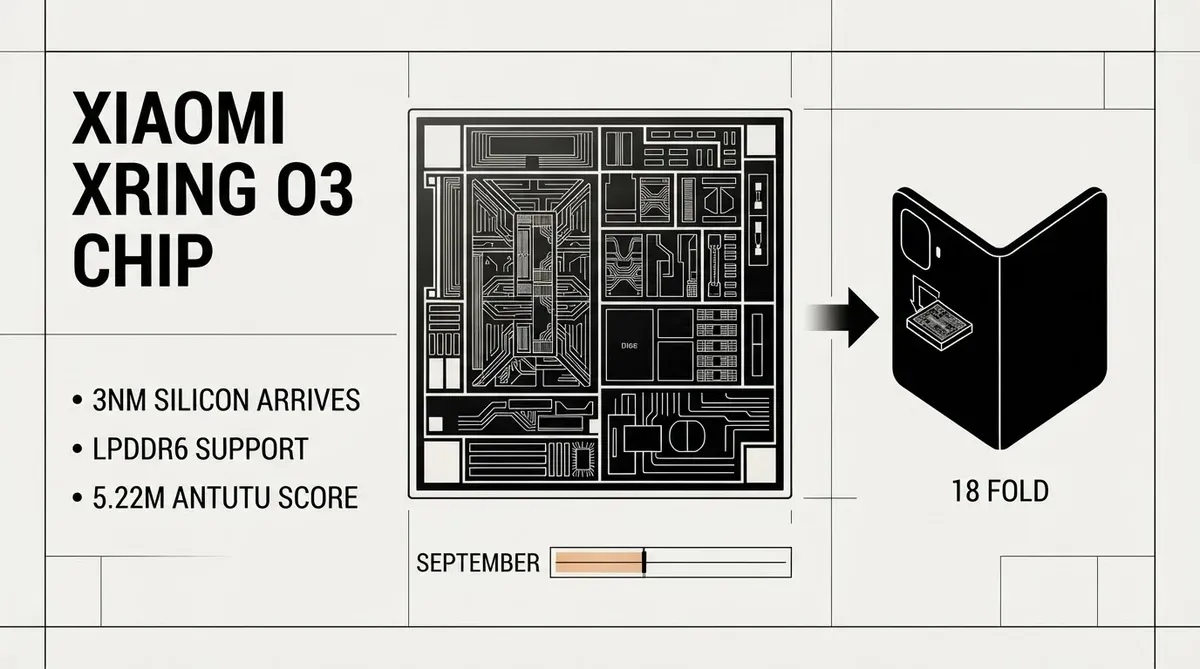
Xiaomi has unveiled the Xring O3, a 3nm in-house processor fabricated by TSMC that will debut inside the Xiaomi 18 Fold when the foldable launches in China in September. Revealed at a chip briefing on August 24, the Xiaomi Xring O3 chip is the company's second flagship SoC in as many years, following the Xring O1, and it lands as Xiaomi steps up its challenge to Qualcomm in Android's high end.
The O3 packs 24 billion transistors, a 26% increase over the previous generation, on a 133mm² die. It combines a 10-core CPU with peak clocks around 4.35GHz, a 16-core Arm G2-Ultra NX GPU, and a redesigned 200 TOPS neural engine aimed at on-device AI. Xiaomi also positions the chip as the first mobile processor with LPDDR6 support, reaching 10,667Mbps memory speeds and 113.8GB/s of bandwidth, roughly 48% more than the Xring O1.
Benchmark claims are aggressive. Xiaomi reports an AnTuTu score of 5.22 million, the first flagship SoC past the 5 million mark, and a multi-core Geekbench result of 15,221. The company says the O3 beats Qualcomm's Snapdragon 8 Elite Gen 5, a claim that will face its first real test when the phones ship next month.
Xiaomi Xring O3 chip and the custom silicon race
The Xiaomi Xring O3 chip reaches buyers first in the Xiaomi 18 Fold and the Xiaomi Pad 9 Pro Max, both launching in China in September with preorders already open. The foldable uses a short, wide form factor similar to the Galaxy Z Fold 8, and Xiaomi is targeting initial shipments of 200,000 to 300,000 O3 units.
Two sibling chips were announced alongside the O3. The Xring O100 is a 6nm AI accelerator built with 3D wafer-on-wafer stacking and 1.22TB/s of near-memory bandwidth, designed to run Xiaomi's MiMo language model on consumer devices. The Xring D100 is a 3nm autonomous driving processor. Both are slated for commercial deployment next year.
The launch is part of a broader industry shift. Xiaomi joins Apple, Samsung, and Huawei in building custom silicon, a strategy aimed at cutting dependence on Qualcomm and MediaTek, strengthening negotiating leverage, and protecting margins at a time of slowing demand. In the foldable segment, the O3 also puts Xiaomi in direct competition with Huawei, which has led that category in China.
Why this matters
For consumers, the near-term payoff is a September foldable and tablet running Xiaomi's own silicon, with LPDDR6 memory and AI features tuned to the company's software. Longer term, a credible in-house chip gives Xiaomi more control over cost and performance, and it adds another serious player to the custom silicon race that Qualcomm and MediaTek have long dominated.
AI-generated image.
Related Articles
- Apple's iPhone 18 Pro and Foldable Ultra Lineup Arrives in September With Major Hardware Overhaul
- Xiaomi 17 Max Teaser Reveals Massive 8,000mAh Battery and 6.9-Inch Display
- Huawei MateBook Fold 2026 Arrives Aug 5 With Stylus, HarmonyOS
✔Human Verified
Researched and cross-referenced against primary sources by the Bytevyte editorial team. This article was generated with the assistance of artificial intelligence and reviewed by the Bytevyte editorial team.