
Yotta's Vera Rubin GPUs: India's $12 Billion Compute Bet
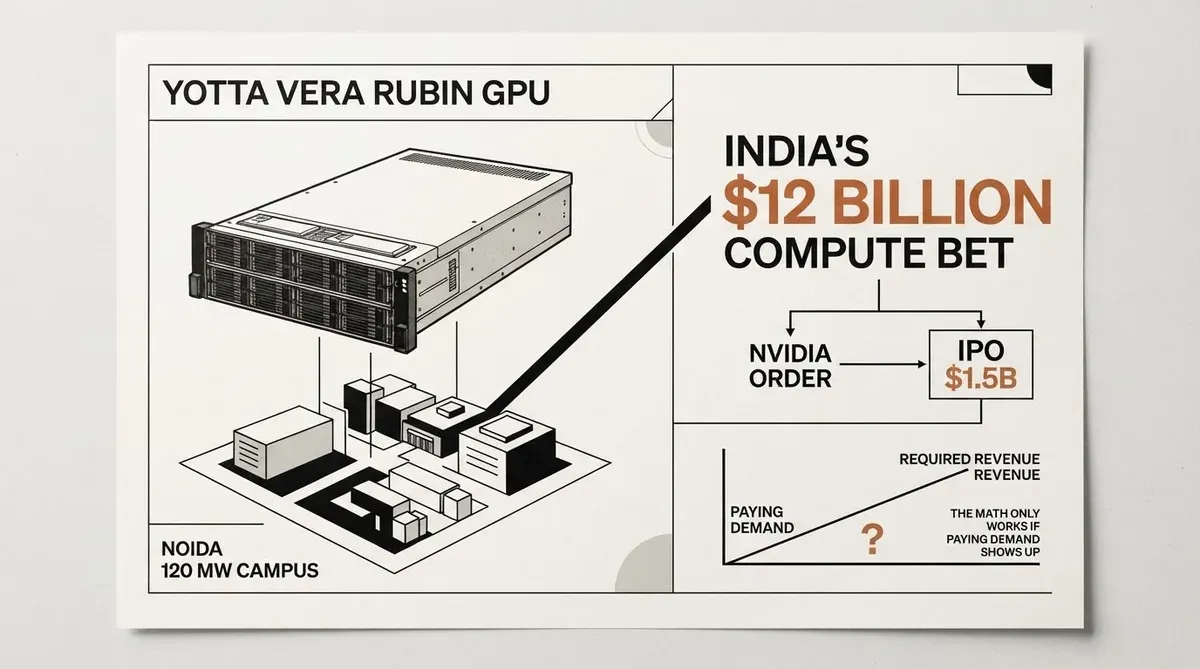
Yotta Data Services is preparing a purchase order worth roughly $12 billion for Nvidia Vera Rubin and Grace Blackwell accelerators, and the first tranche of Yotta's Vera Rubin GPUs is earmarked for a 120 MW campus in Greater Noida. Chief executive Sunil Gupta has framed the commitment as pre-listing infrastructure for the Hiranandani Group company, which expects to sell shares within the next year. The stated value is close to Rs 1 lakh crore.
The order stacks on top of an existing buildout. Yotta committed more than $2 billion to an Nvidia-powered AI hub in February, then added a roughly $3 billion deal covering more than 20,000 Blackwell Ultra GPUs. Nvidia has said Vera Rubin shipments begin this fall, which puts an Indian operator among the earliest buyers of the platform in Asia.
What the Yotta Vera Rubin GPUs Order Actually Covers
The numbers disclosed for Yotta's Vera Rubin GPUs do not agree with one another, and the gaps matter to anyone trying to price the deal. The company has been linked to 40,000 Vera Rubin GPUs for Noida, to 80,000 units across two Indian campuses, and to a mix of 50,000 Vera Rubin chips alongside 45,000 GB300 parts. The Vera Rubin portion alone has been estimated at about $7.5 billion once networking is included.
Each version implies a different power envelope, a different site count and a different financing requirement. Greater Noida, at 120 MW, is the company's flagship hyperscale campus. The second campus referenced in the larger figures has not been identified, and Yotta has not said whether the GB300 allocation belongs to the same capital programme or a separate purchase.
Yotta has published no binding delivery schedule, no per-site allocation and no customer list against the order, which leaves the $12 billion as an intention rather than contracted revenue. Funding shows a similar gap. The company has targeted a pre-IPO round of $1.2 billion to $1.5 billion and a listing sized at roughly $1.5 billion, with a 2027 window. Equity of that size covers a fraction of a $12 billion hardware bill, so the remainder has to come from debt, leasing structures or vendor financing. A dollar-denominated obligation set against rupee revenue also carries currency exposure that Indian infrastructure operators have historically hedged only partially.
The $40 Billion-per-Gigawatt Test
Nvidia's own platform economics supply the yardstick. The company puts Grace Blackwell at about $25 billion per gigawatt of data centre capacity and the Vera Rubin platform at roughly $40 billion per gigawatt, with GPUs taking about 70% of an AI supercomputer's cost.
| Nvidia platform | Cost per gigawatt | GPU share of system cost |
|---|---|---|
| Grace Blackwell (GB200/GB300) | ~$25 billion | ~70% |
| Vera Rubin | ~$40 billion | ~70% |
The arithmetic exposes the scale problem. A $12 billion GPU order implies roughly $17 billion of total platform spend once the non-GPU share is added, which at Vera Rubin rates supports about 425 MW. Greater Noida offers 120 MW. Even the lower $7.5 billion Vera Rubin figure points to something near 270 MW. Either way, the order has to stretch across several campuses and several budget years.
The platform choice carries its own cost. On Grace Blackwell economics, the same $12 billion would underwrite roughly 685 MW, about 60% more capacity than Vera Rubin delivers for the money. Yotta is trading megawatts for newer silicon, faster memory and a longer service life, a bet that only pays off if customers pay a premium for frontier performance.
Power procurement is the other constraint. A buildout of 400 MW or more requires firm, long-duration supply, and the Greater Noida campus alone accounts for 120 MW. Sourcing that capacity, plus the land and cooling to match, runs on a slower clock than signing a GPU order.
Prices are also moving against the buyer. Nvidia has told large customers that servers containing its AI chips will cost more than 15% more in many cases, driven by soaring memory costs, with the increases landing on systems shipped early next year, including Vera Rubin configurations. The pressure applies across Nvidia's customer base, so India's other frontier orders face the same uplift.
Who Actually Pays for the Compute
Sovereign AI is the sales pitch: domestic capacity that keeps Indian government and enterprise workloads inside the country. The nearest benchmark sits in Hyderabad, where AM Intelligence has placed a firm order for 9,000 Vera Rubin NVL72 systems for a 30 MW AI factory due online in the first quarter of 2027, running on Greenko's carbon-free power.
| Operator | Disclosed order | Site | Power | Timeline |
|---|---|---|---|---|
| Yotta Data Services | 40,000-80,000 Vera Rubin GPUs | Greater Noida | 120 MW | Not disclosed |
| AM Intelligence | 9,000 Vera Rubin NVL72 systems | Hyderabad | 30 MW | Q1 2027 |
On paper, Yotta's Vera Rubin GPUs order dwarfs the Hyderabad cluster. The smaller project rests on a fixed site, a fixed power source and a fixed start date. Yotta's advantage is scale, and its exposure is utilisation. A $40 billion-per-gigawatt platform only works when enterprises, government agencies and model developers sign contracts at rates that cover hardware, power and financing cost.
Allocation scarcity shapes the timing. Vera Rubin capacity is limited during the platform's first production cycle, and buyers who wait for signed demand before ordering risk losing delivery slots. That is the logic behind announcing a large order before customers are locked in: the commitment secures supply, and the supply becomes the asset the listing is priced on.
Demand composition is where the plan holds or slips. Sovereign AI buyers in India cluster in government departments, regulated finance and healthcare, segments that pay for data residency and predictable capacity rather than for peak benchmark scores. Those contracts are typically smaller and slower to sign than hyperscaler leases, which makes the fill rate on a 120 MW campus the number that matters most.
Export controls on advanced US accelerators sit outside the company's control, as does the depreciation clock. Each accelerator generation loses value as successors ship, and Yotta has now stacked commitments across Blackwell, GB300 and Vera Rubin. Customers who delay signing shift that depreciation onto the operator's balance sheet.
Trust is a further constraint. Data on a Reliance server that Yotta hosts was exposed in a breach attributed to the ransomware operation World Leaks. That incident sits awkwardly beside a pitch built on sovereign custody of sensitive workloads. For an operator asking public investors to fund frontier infrastructure, a customer-data breach is a diligence item rather than a footnote.
Financing scrutiny is rising at the same time. Nvidia's Rubin launch arrives into a market increasingly focused on how AI data centres are funded, a question that feeds directly into the cost of the debt Yotta will need. A vendor order announced ahead of signed customers is the structure investors have started to interrogate.
The listing is the mechanism that makes the build financeable. Public equity gives Yotta a permanent capital base for assets that take years to fill, and it offers early backers an exit. Comparable AI infrastructure and chip businesses have been well received, with Cerebras targeting a $26.6 billion valuation in a planned US listing as demand for AI compute surges. Public markets also import quarterly scrutiny of utilisation, a metric Indian AI infrastructure firms have been slow to publish.
Three things to watch over the next two quarters:
- Whether Yotta's pre-IPO round closes at the $1.2 billion to $1.5 billion it has targeted.
- How much of the Vera Rubin order converts into binding contracts with named customers.
- Whether Vera Rubin shipments, scheduled to start this fall, reach Indian sites on time and at quoted prices.
Why this matters
India can now buy frontier accelerators; what it cannot yet buy is the paying demand that makes them profitable. Yotta's $12 billion commitment turns a national ambition into a balance-sheet obligation that public investors will soon be able to audit. The question the IPO will answer is whether contracted customers are waiting when the GPUs arrive.
AI-generated image.
Related Articles
- Anthropic Nscale compute deal: $7.5B a year before its IPO
- Anthropic Volta Compute Deal: $10 Billion, a Week-Old Startup and a Bitcoin Miner
- Nvidia SSI Investment: $5B for Safe Superintelligence
✔Human Verified
Researched and cross-referenced against primary sources by the Bytevyte editorial team. This article was generated with the assistance of artificial intelligence and reviewed by the Bytevyte editorial team.