
Zuckerberg's superintelligence manifesto: the economics
Zuckerberg's superintelligence manifesto decoded: Meta's open-weight pivot, free AI tiers, compute auctions, and what AI for everyone really means.
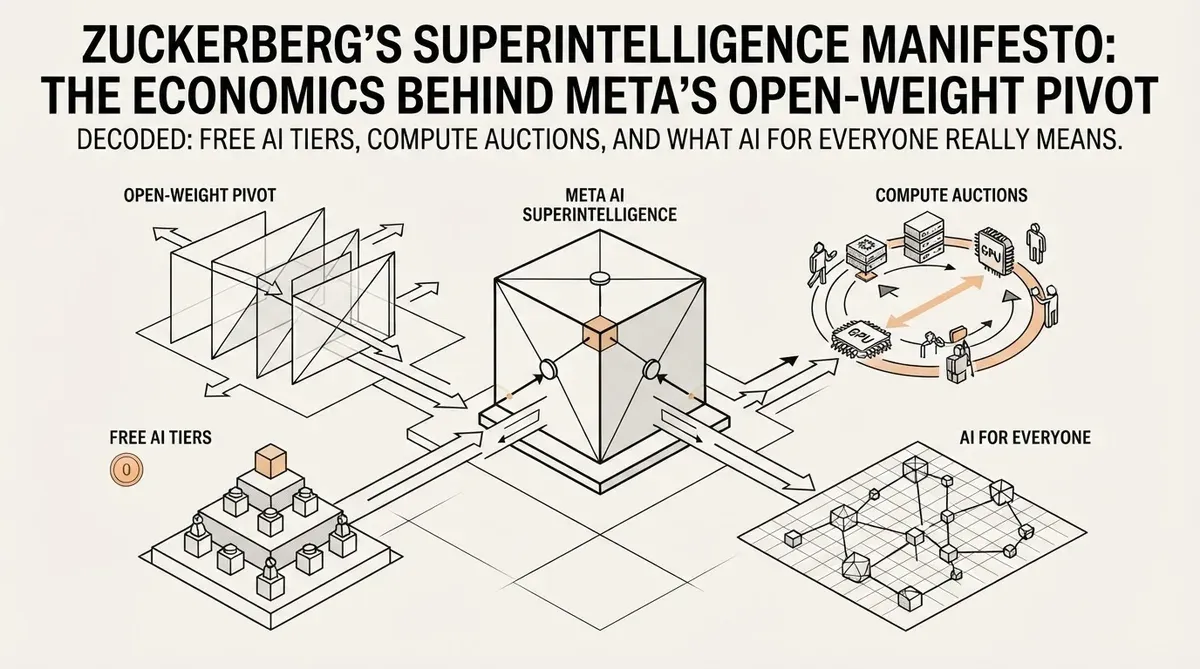
Meta has answered the central question of the AI race with a bet most of its rivals have avoided: the most capable models should be open weight, not locked behind APIs. Mark Zuckerberg made the case in a roughly 6,500-word essay titled The Future is for Everyone, published on Meta's site on Aug 10, the same day the company shipped an open-weight model and said the weights of its flagship Muse Spark 1.2 would follow. Read as a strategy document, Zuckerberg's superintelligence manifesto frames Meta as the decentralized alternative to centralized frontier labs, paired with the economic machinery needed to make wide distribution affordable.
The essay's commitments are unusually specific for a corporate vision statement, and Meta presents them as the default path rather than one option among several: AI tools should reach as many people and businesses as possible. Concretely, Meta says its most advanced AI services will be free for billions of users, and its always-on personal agents will manage health, career and everyday tasks behind end-to-end encryption. Safety oversight would move to an independent board that approves release criteria for models before they ship, a concession aimed at the standard objection that a single company should not set its own safety bar.
What Zuckerberg's superintelligence manifesto promises
With the word superintelligence used about 60 times, the manifesto exceeds 6,000 words and ranges across data centers, regulation, cybersecurity, bioweapon risks, labor-market disruption and surveillance. The core claim in Zuckerberg's superintelligence manifesto is that concentrated control of advanced AI, whether by a few companies, governments, or an uncontrolled system itself, produces worse outcomes for everyone else, and that broad access to open-weight models, personal agents and expanded infrastructure is the safer path. The essay engages the industry's darkest scenarios, including bioweapon creation and surveillance powers, without endorsing the regulatory responses that usually follow such warnings.
That claim carries a labor-market argument. Zuckerberg presents personal superintelligence as a capability multiplier for individuals and small businesses rather than a force that automates people out of work, and argues that open access generates economic growth and creates jobs. The framing is the mirror image of the centralized-automation narrative: instead of systems that replace workers, he promises agents that extend them. It also doubles as a case against restrictive regulation, since rules that confine capable models to licensed vendors would reinforce the concentration the essay warns about.
The essay does not name Meta's rivals, but the contrast is direct. Competitors keep frontier capability behind proprietary APIs and subscription tiers; Zuckerberg's position is that wide distribution of open weights evens the playing field. For developers the stakes are concrete: open weights mean self-hosting, fine-tuning and no API lock-in, while the closed route offers managed safety and support. The most concrete illustration in the text is deliberately domestic, an agent that generates personalized recipes for a father and daughter to bake together, and the gap between that example and the scale of the superintelligence claims is where the skepticism gathers.
Open weights: the reversal behind the rhetoric
The open-weight turn is a reversal, and its recent history explains the careful wording of Zuckerberg's superintelligence manifesto. Meta's Llama 4 stumbled in April 2025. By July of that year the company had retreated from open source over architectural exposure concerns, in part because China's DeepSeek had reportedly built on Llama's open weights. Zuckerberg said then that Meta would keep its strongest, superintelligence-tier models closed. The follow-up flagship missed its release date, and Muse Spark, which arrived in April 2026, was API-only with no open weights.
Now the direction has flipped. Meta Superintelligence Labs is resuming open-weight releases, the model shipped alongside the manifesto is open weight, and as of mid-August the weights of Muse Spark 1.2 are promised to follow. The reversal is not framed as a correction; the essay presents it as the logical endpoint of the same philosophy. What changed between July 2025 and now is not spelled out, and the essay's account of its own history is selective on the same axis: the reader is left to square the manifesto with a flagship that shipped proprietary less than four months earlier. The economics in the text offer one explanation, namely that distribution only works as a strategy if the cost of serving billions can be engineered down.
The economics of AI for everyone
That is where the essay turns from philosophy to machinery. Meta plans free tiers aimed at billions of users, a dynamic auction mechanism for high-compute customers intended to guarantee the lowest possible prices, and community-facing programs, the Future Is For Everyone Fund and America's Workforce Academy, to support skilled trades in regions where data centers are built. An environmental pledge rounds out the package: water-positive operations by 2030, restoring 200% of water in high-stress areas. The combination reads as a full-stack answer to the two things that usually kill open-weight projects: unaffordable serving costs and community resistance to data centers.
Each piece does double duty. The free tier seeds the ecosystem and makes the open-weight promise tangible; the auction monetizes the heaviest users without publishing a price list; the community funds and the water commitment smooth the political and permitting path for the data-center buildout the strategy depends on. The independent board answers the safety critique that shadowed the Llama era. There is a competitive edge too: every user who relies on a free Meta agent is a user who is not paying a closed lab for the same capability. The result is an operating plan as much as a philosophy, and the operating plan is the part that can be checked against reality.
The trade-offs
The trade-offs are visible on both sides. Open weights make post-release control impossible: a released model can be fine-tuned by anyone, and the board's approval governs the decision to release, not what happens afterward. The free tier and the auction imply that cost structure, not ideology, will decide how much distribution is real, since free access caps out at smaller models if inference costs stay high. The auction also targets the high-compute segment that proprietary labs monetize most aggressively, which makes it a pricing weapon as much as a pricing mechanism. The water-positive pledge is a 2030 target set against a buildout happening now, the same tension that runs through every data-center expansion in the industry.
Critics have split along the same lines. Matt Lane, senior policy counsel at Fight for the Future, has argued that open access to AI matters for security-sensitive infrastructure such as voting systems and benefits networks, while noting that only Meta would gain if the world standardized on Meta-designed systems. That is the sharper version of the question the manifesto raises: whether distributing superintelligence widely is the same thing as distributing Meta's stack widely. In the week since publication, the essay has functioned as a Rorschach test for the industry, with each camp reading its own priorities into the text.
The verdict
Read as business strategy, Zuckerberg's superintelligence manifesto is coherent. The open-weight release shipped with the essay and the promised Muse Spark 1.2 weights give the vision a concrete first step; the free tiers, the auction and the community funds give it a funding model; the governance board and the environmental pledges give it defenses against the objections that slowed earlier releases. The essay stops short of a timeline for the most capable weights, which leaves room for the same slippage that marked the Llama era. Whether superintelligence for everyone turns out to be distribution or marketing will be settled by three numbers: the price of inference at scale, the capability gap between free and paid tiers, and whether the most advanced weights actually ship on schedule.
The near-term markers to watch are the release of the Muse Spark 1.2 weights, the first auction results, and the composition of the independent safety board. Each is named in the essay, and each can be verified against what Meta actually does in the coming months.
Why this matters
For enterprises and developers choosing a foundation model, Meta is now competing explicitly on distribution: open weights and low-cost compute against the control and safety guarantees of proprietary vendors. Zuckerberg's superintelligence manifesto will succeed or fail on its business machinery, and that is what will determine whether Meta becomes the default open-weight platform of the next model cycle.
Sources
The Future is for Everyone - About Meta
AI-generated image.
Related Articles
- Beyond Bigger Models: The Sovereign Efficiency Pivot Reshaping AI's Future
- OpenAI 1 billion users: a milestone bought with price cuts
- Meta AI Cloud Business Turns Capex Surplus Into Revenue as 2026 Spending Nears $145B
✔Human Verified
Researched and cross-referenced against primary sources by the Bytevyte editorial team. This article was generated with the assistance of artificial intelligence and reviewed by the Bytevyte editorial team.