
A Month-Old Startup, a $3.7B Valuation: Inside the Emulate Seed Round
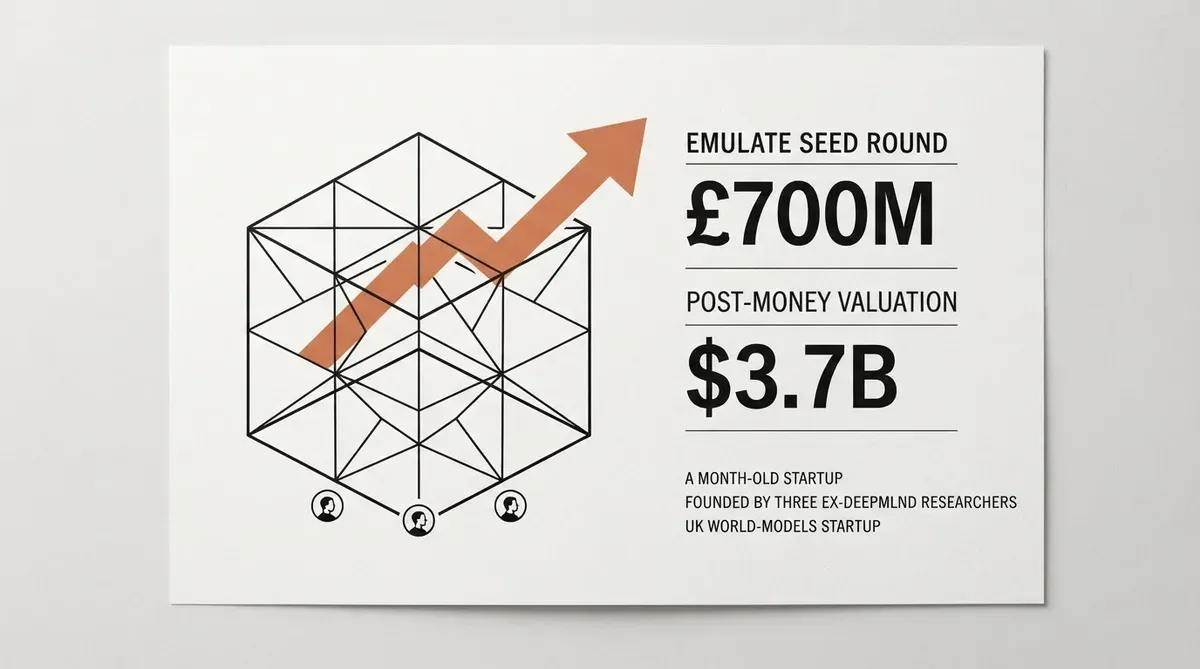
Emulate, a British artificial intelligence startup founded only weeks ago, is in advanced talks to raise as much as $700 million, a first financing that would value the company at roughly $3.7 billion after the new money. The Emulate seed round is co-led by Index Ventures and Lightspeed Venture Partners, with Creandum also participating, and has not yet closed or been signed.
The company was set up in August by three former Google DeepMind researchers: Jack Parker-Holder, Matthew McGill and Philip Ball. All three previously worked on Genie, DeepMind's world-model research line, and the new venture is built around the same technical territory.
World models train a system to build an internal simulation of an environment from video and other sensor data. An agent can then predict what happens next and rehearse behaviour inside that simulation instead of the physical world.
The approach matters most for robotics, where real-world data is slow and expensive to gather. A model that can generate realistic, interactive environments offers a cheaper route to training manipulation and navigation policies, and a way to test them before hardware reaches a factory floor or a warehouse.
Emulate's commercial case rests on buyers in robotics, autonomous systems and industrial simulation, where testing in software costs far less than testing in the field. Whether those buyers eventually pay for a model, a simulation platform or both is a question the company has not answered publicly.
The three founders come out of a lab that has published research on generating interactive environments from video. That background, rather than a product roadmap, is the asset the financing is pricing.
The Emulate seed round, by the numbers
| Item | Detail |
|---|---|
| Company | Emulate, UK-based AI startup |
| Founded | August 2026, roughly one month before the reported round |
| Founders | Jack Parker-Holder, Matthew McGill, Philip Ball (ex-Google DeepMind, Genie world models) |
| Focus | World models for robotics and simulation |
| Round size | Up to $700 million |
| Pre-money valuation | About $3 billion |
| Post-money valuation | About $3.7 billion |
| Lead investors | Index Ventures and Lightspeed Venture Partners co-lead; Creandum also participating |
| Status | Advanced talks; not closed, terms unsigned |
The $3.7 billion headline is a post-money figure. About $3 billion of it is the value assigned to the business before the new capital arrives, and the remaining $700 million is the cash being raised. Investors are therefore pricing roughly $3 billion of enterprise value into a company that has not publicly released a product, named a customer or reported revenue.
Dilution follows directly from those numbers. New backers putting in $700 million against a $3 billion pre-money valuation would take roughly 19% of the company, leaving the three founders and any earlier supporters with the remainder. At formation, that is a large slice of equity to hand over before a product exists, and it limits how much room stays available for later hiring pools and option grants.
What is being purchased is a founding team, a research direction and a wager that world models become a foundational layer for robotics and simulation. Index Ventures and Lightspeed are backing people rather than metrics, and the size of the cheque reflects how few engineers have hands-on experience building world models at frontier scale.
The financing carries the seed label, which usually denotes a company's first institutional capital. Applied to a $700 million raise, the term stretches well past its conventional meaning, and it signals that the round is priced on team and thesis rather than on traction.
Where a $700 million first cheque goes
Most seed capital buys a team, a prototype and a few quarters of runway. A round of this size at a world-model company is closer to a compute budget. Training video-based generative models, and the simulation engines built on top of them, consumes GPU time at a volume that conventional early-stage financing cannot cover.
Hiring is the second call on the money. Frontier researchers at the largest AI labs command compensation that requires substantial capital behind it, and a company valued at $3.7 billion has to recruit against employers with deeper balance sheets and established compute allocations.
World models are also being pursued inside the big labs themselves. That puts Emulate in the position of competing for talent and compute against the organisations its founders left, a contest in which the incumbents hold the advantage in hardware and data.
The wider funding environment supports the scale of the bet. AI chip startup Etched doubled its valuation to $21 billion in a round disclosed in August, and Emerald AI, which builds power-flexible data centres, raised $150 million at a $1.05 billion valuation the same month. Capital is concentrating in the infrastructure and foundation layers of AI, and Emulate sits at the research end of that stack.
The risk inside a formation-stage valuation
The first risk is that the round is not finished. Advanced talks can stall, and terms can shift before signature. Emulate has not confirmed the financing, and none of the reported structure is binding until documents are executed.
The arithmetic sets a second constraint. A $3.7 billion post-money valuation at seed means the next financing has to clear a much higher bar for Index Ventures and Lightspeed to earn the returns their funds promise. That narrows the field of companies large enough to acquire Emulate and pushes the business toward a very large private round or an eventual listing.
Execution risk sits underneath both. World models remain a research frontier rather than a shipping product category, and the distance between a convincing demonstration and a system that factories and robotics firms pay for is where the commercial question sits.
Concentration of a different kind runs through the deal. Three founders carry the technical thesis, and the valuation rests on their continued presence. A company with a month of history has little else on its balance sheet to support the number.
What it means for the UK and European market
Emulate is a British company, and the geography of the deal carries weight. London has produced frontier AI talent for a decade, yet that talent has often moved to US labs or to startups incorporated in California. A first cheque of up to $700 million, raised in London from US and European funds, changes the calculation for researchers deciding where to build.
The Emulate seed round also resets seed-stage comparables. Founders raising in Europe can now point to a month-old company priced at $3.7 billion, which lifts expectations across the earliest stages of the market. For investors, the corollary is that entry prices at formation have risen far faster than the evidence base behind them.
The precedent reaches past Emulate. The largest first cheques in AI have gone to teams organised around researchers from a small number of labs, and investors have accepted formation-stage prices that would have been hard to justify for a software startup a decade ago. Each deal of that shape raises the benchmark the next founding team cites in its own fundraising.
What follows is easy to track. Confirmation that the round has closed, the names of any further participants and the first public evidence of what Emulate is building will each test the price. Until then, the $3.7 billion figure is a negotiation rather than a transaction.
Why this matters
If the round closes at the reported terms, it will confirm that AI capital concentrates on a small group of researchers with frontier experience, and that a multi-billion-dollar valuation can attach to a company weeks old. For robotics and simulation, world models now draw funding at a scale previously reserved for large language models. For the UK, the deal keeps a frontier AI company and its founding team on home soil, and it raises the entry price for the next team that attempts the same thing.
AI-generated image.
Related Articles
- Callosum $100M seed round targets AI's model-to-chip routing bottleneck
- Kevin Weil's AI Science Startup Seeks $150M Round
- Google DeepMind Accelerator: Robotics Launches to Scale European Physical AI
✔Human Verified
Researched and cross-referenced against primary sources by the Bytevyte editorial team. This article was generated with the assistance of artificial intelligence and reviewed by the Bytevyte editorial team.