
Overlap Rules for the EU AI Act and GDPR Slip to 2027, Leaving Firms Exposed
EU AI Act and GDPR joint guidance slips to early 2027. Which AI Act duties already bind firms and where dual-compliance risk sits.
Listen
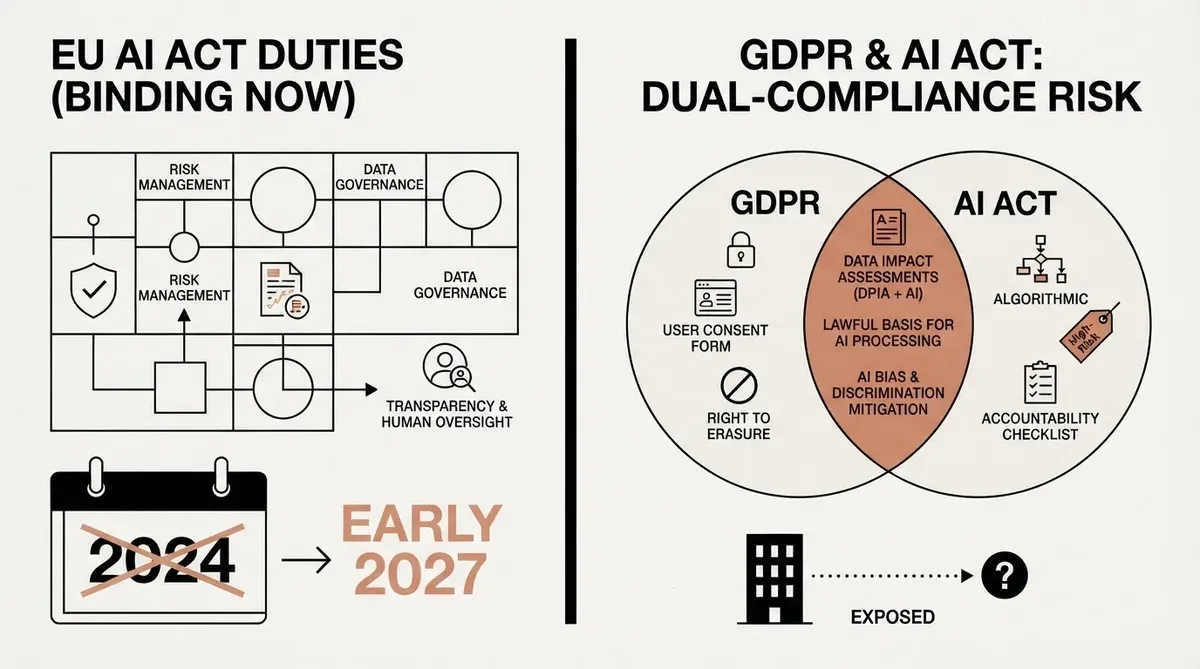
The EDPB and the European Commission have pushed their joint text on how the AI Act and GDPR fit together into early 2027. The head of the EDPB secretariat said on 19 November 2026 that the document, originally planned for finalisation later in 2026, will slip into next year. US firms running EU-facing AI systems that process personal data must therefore work out the overlap between the two regimes without official guidance. Our reading of the sources: several AI Act duties already bind these firms, while the heaviest high-risk obligations fall in 2027 and 2028.
What already binds companies today
The ban list covers emotion recognition in workplaces and schools, which could reach HR, sales-coaching or productivity tools.
Providers of general-purpose AI models have been bound by duties since 2 August 2025, which cover transparency and copyright, and models with systemic risk must also undergo added risk assessment. From 2 August 2026, the AI Office at the Commission and national authorities may test models, require corrective steps and impose penalties. Transparency duties under Article 50, such as disclosing that people are dealing with a machine and labelling deepfakes, also apply from August 2026. Fines for banned practices reach EUR 35 million or 7% of worldwide turnover.
Most firms deploy these models rather than provide them. For them, the practical exposure runs through vendor contracts, which should reflect what model providers now owe under the Act.
Where the dual-compliance risk sits
The GDPR side remains fully in force. Data protection authorities keep jurisdiction over the personal-data side of AI systems, working in parallel with the market surveillance authorities that enforce the AI Act. A GDPR compliance guide published in August 2026, which predates the delay and the Omnibus date changes, describes penalties under the two regimes as capable of stacking. We use that guide only for the overlap logic, not for dates.
The missing joint text matters because it was designed to separate two questions: where work done for one law can be reused for the other, and where the two laws impose distinct duties. Without it, a firm must decide on its own which impact assessments, documentation or risk controls satisfy both regimes.
The timing gap is concrete. High-risk duties for standalone Annex III uses start on 2 December 2027, and those for AI in regulated products on 2 August 2028. Our calculation: if the guidance lands in February or March 2027, firms have roughly nine to ten months to fold its overlap rules into high-risk compliance programmes. Meanwhile, the next new deadline arrives on 2 December 2026, when the ninth ban takes effect, covering systems that produce intimate imagery without consent or child sexual abuse material.
Trade-offs and open questions
Waiting for the guidance before acting carries a rework risk. Acting now on the duties that already apply, such as the bans, the literacy measures and the vendor contract terms, carries little regret, because none of them depends on the joint text. The harder choice concerns high-risk systems, where a firm can either build a single assessment file early or hold separate GDPR and AI Act workstreams until the EDPB and Commission publish their position.
We would treat the early 2027 guidance as a checkpoint for refining compliance work, not as the trigger for starting it. The date to plan against is 2 December 2027, when the first high-risk obligations take effect, and the first check is whether the published text names specific overlaps in the areas where a firm's systems process personal data.
While we strive for accuracy and rigor, ByteVyte can make mistakes. Readers are advised to verify all information independently and conduct due diligence before making decisions based on this reporting. We accept no liability for errors, omissions, or decisions made in reliance on this content.
AI-generated image.
Earlier coverage
- Jul 27, 2026: EU AI Act Article 50 Compliance: Six-Day Countdown to August 2 Transparency Rules
- Jul 16, 2026: EU AI Act Article 50 Compliance: 17 Days Until Transparency and Labeling Rules Take Effect
Related Articles
- EU AI Act Simplification: Deadlines Extended to 2027-2028
- New Deadlines for EU AI Act Compliance: High-Risk System Requirements Delayed to 2027
- EU AI Act Deadlines Shifted for High-Risk Systems and New Prohibitions
✔Human Verified
Researched and cross-referenced against primary sources by the bytevyte editorial team. This article was generated with the assistance of artificial intelligence and reviewed by the bytevyte editorial team.
