
New Deadlines for EU AI Act Compliance: High-Risk System Requirements Delayed to 2027
The EU has delayed EU AI Act compliance deadlines for high-risk systems to 2027. Learn how this 16-month extension impacts your AI strategy and governance.
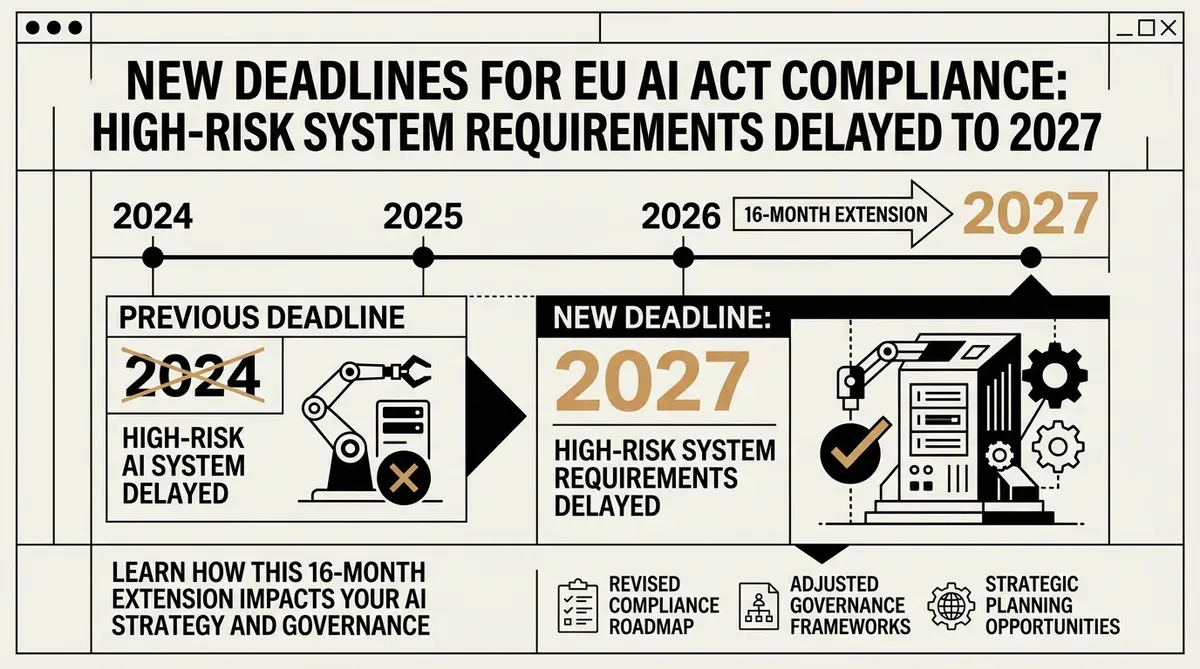
The European Union has revised the implementation timeline for its landmark AI legislation, granting organizations additional time to meet EU AI Act compliance requirements for high-risk systems. Under a new provisional agreement for the Digital Omnibus on AI, the deadline for Annex III High-Risk AI Systems (HRAIS) has been deferred from August 2, 2026, to December 2, 2027. This 16-month extension provides a significant window for businesses to align their internal governance with the new regulatory framework.
This adjustment specifically targets use-based high-risk systems, which include AI applications in critical sectors such as education, employment, and law enforcement. While the delay offers immediate relief, other components of the regulation remain on a faster track. New prohibitions regarding AI-generated non-consensual imagery and child sexual abuse material are scheduled to take effect in December 2026. The deadline for Annex I high-risk systems is now set for August 2, 2028.
Strategic Impact of the EU AI Act Compliance Delay
The postponement of the EU AI Act compliance deadline for Annex III systems reflects the technical and administrative complexity of the original schedule. For enterprise leaders, this shift allows for a more structured approach to auditing existing AI portfolios. The European AI Office has also clarified its role, assuming exclusive supervisory competence over General-Purpose AI (GPAI) models that are integrated into Very Large Online Platforms. This centralization aims to streamline oversight for the largest digital entities operating within the union.
Despite the extended timeline for high-risk systems, transparency obligations are still approaching quickly. Organizations must prepare for these requirements to become effective on December 2, 2026. These rules mandate clear disclosure when users interact with AI systems, ensuring that the origin of synthetic content is identifiable. Failure to meet these milestones carries heavy financial risks, as fines for non-compliance can reach 3% of a company's total worldwide annual turnover.
Decision-makers should view this 16-month extension as an opportunity to refine data lineage and risk assessment protocols rather than a reason to pause development. The EU AI Act compliance journey requires deep integration of safety standards into the product lifecycle. As of June 2026, the focus for many firms shifts toward the transparency rules arriving later this year, while the deferred HRAIS deadline provides the necessary space to handle more complex technical documentation and conformity assessments.
While we strive for accuracy, bytevyte can make mistakes. Users are advised to verify all information independently. We accept no liability for errors or omissions.
AI-generated image.
Related Articles
- EU Digital Omnibus Updates Timelines for AI Act Compliance
- U.S. Commerce Department Secures AI Safety Agreements with Google, Microsoft, and xAI
- WalledProtect Sovereign AI Governance Platform Debuts for Enterprise Security
✔Human Verified