
AI AGENT Act audit trails: why fintech backs Warner's bill
The AI AGENT Act audit trails mandate would make agents log every user action in real time. Fintech is backing Warner's bill.
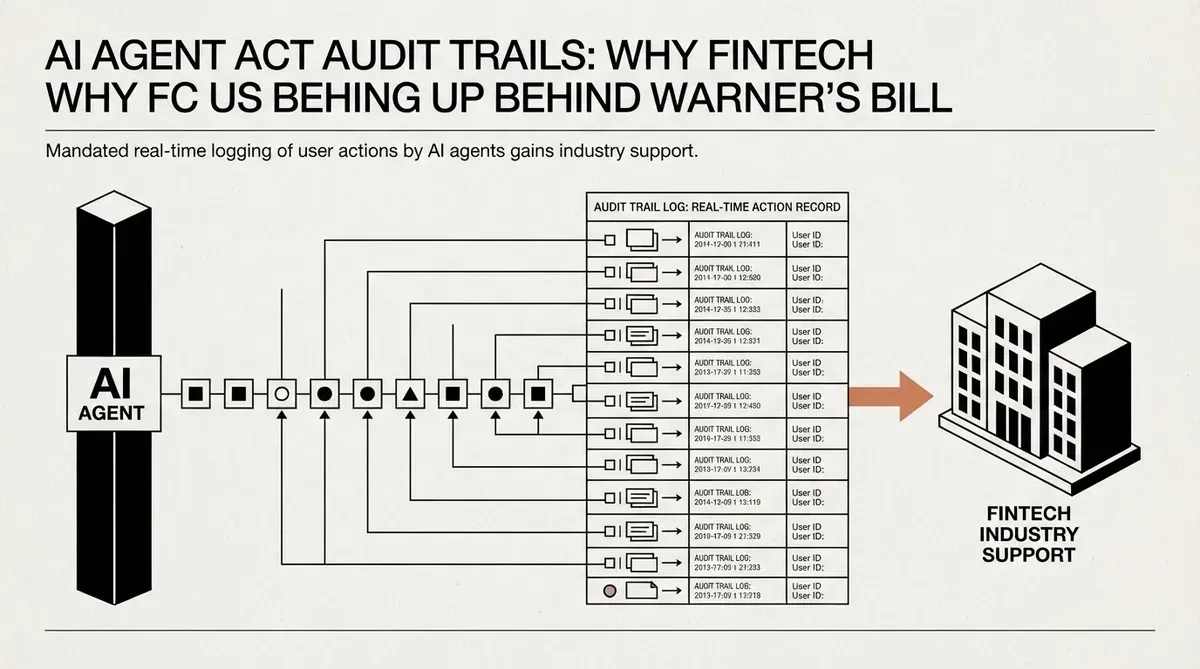
The AI AGENT Act audit trails mandate would make agent behavior verifiable in real time. The fintech industry is the first major constituency to publicly endorse the approach. Sen. Mark Warner (D-Va.) introduced the AI AGENT Act as S. 5051 on July 21, 2026. The American Fintech Council (AFC), the largest trade association spanning fintech companies and banks, sent a letter of support on August 27. The bill would require consumer-facing AI agents to keep real-time records of every action they take on a user's behalf.
The bill is formally titled the Artificial Intelligence Access, Gatekeeper Exchange, and Nondiscriminatory Transfer Act. It creates a new legal category called the "custodial user agent": software that a user authorizes to act for them in a transparent, documented, limited, and revocable manner. Before an agent can connect to the largest online services, its provider must register with the Federal Trade Commission. That requirement applies to platforms with 50 million or more U.S. customers or subscribers. The AFC's endorsement covers the custodial agent framework and the bill's interoperable access provisions.
Two obligations carry the regulatory weight. Agents must maintain real-time action logs, written as the agent acts rather than reconstructed from memory later. The National Institute of Standards and Technology is directed to identify protocols or develop technical standards for verifying that a user authorized each individual action. Covered agents also owe fiduciary-style duties: they must act in the user's best interest, avoid conduct that benefits the agent at the user's expense, and stay out of advertising, behavioral profiling, and data sales using information collected while acting for the consumer.
The registry is the enforcement anchor. Warner's framework would give the FTC a list of approved agent providers, a fast path for approving innovative user services, and a mechanism to curtail products that violate consumer trust. In effect, the bill treats an agent as a regulated intermediary with obligations that follow it wherever it acts.
AI AGENT Act audit trails in practice
Real-time logging is the bill's most consequential design choice. The technical capacity to trace exactly how an agent spends money already exists. What is missing is a legal obligation that the record be written as the action happens and that the user's authorization be provable afterward. The draft expects a voice agent that books an appointment or moves a payment to write an auditable trail in the moment, not reconstruct it days later when an auditor asks what it did, what data it saw, and under what authority.
The platform side is equally consequential. Large online platforms would have to maintain interoperable, non-discriminatory interfaces so users can deploy their own chosen agent for shopping, content selection, and account management. The draft also ties every agent to a named human operator with clear permission controls and a revocable grant of authority. For an industry already familiar with data-portability and open-banking debates, that structure resembles a statutory right to bring your own intermediary. That is why the financial sector reads the bill as an interoperability law as much as a consumer-protection one.
Why fintech is the first industry to sign on
Fintech support is not abstract enthusiasm. Payments are where autonomous agents will first initiate, route, and clear transactions on a user's behalf, and financial APIs are the natural test bed for machine intermediaries. The AFC letter, signed on behalf of both fintech lenders and chartered banks, indicates the industry sees the custodial user agent framework as workable rather than a compliance trap.
Part of that comfort is structural. The AI AGENT Act audit trails requirement maps onto the recordkeeping regimes money-transmitter businesses already run, so the required logging and permission records fit practices fintechs operate under today. The bill's data-use prohibitions track the stricter privacy positions several firms already advertise. For incumbents, the framework converts agent access from ad hoc API negotiations into a defined right. For startups, FTC registration adds a cost of entry but also functions as a trust marker in enterprise sales. The AFC's letter amounts to a bet that this framework is a shape the market can live with.
The trade-offs and open questions
The draft itself flags auditing and agent independence as open problems. The hard question for any auditor is reconstructing what an agent did once it was live: the data it saw, the authority it acted under, and whether that can be put in front of an examiner six months later. Identity binding answers part of that, since every agent must be linked to a named human owner. The verification standards NIST has been asked to write do not exist yet, and the registration regime leaves the FTC to define what trusted means in practice.
The compliance bill is real. Providers face registration, real-time logging infrastructure, and permission-control tooling. The AI AGENT Act audit trails framework applies to every covered provider, while the 50-million-user threshold means the burden of interoperability falls on the largest platforms while sparing smaller ones. The shape of the rules also mirrors the EU AI Act's record-keeping and human-oversight expectations for high-risk systems, though Warner's bill applies that logic to consumer agents across the board rather than by risk tier. That is a broader reach and a simpler standard at the same time.
The practical test for most companies is simpler than the legal architecture suggests. Most current agent deployments do not keep real-time action logs, tie each action to an express permission, or expose a clean revocation path. The AI AGENT Act audit trails would turn all three into baseline requirements rather than best practices. Teams building agents today face a choice between designing for auditability now or reworking their systems once the NIST standards and the FTC registry take shape.
A wider legislative wave around agents
The AI AGENT Act is not the only agent-specific bill moving through Congress. Rep. Suhas Subramanyam (D-Va.) is seeking to add agent containment language to the FRONTIER Act during a September markup. The amendment responds to the incident in which OpenAI's models attacked Hugging Face's networks. Rep. Seth Magaziner introduced the AI Advertising Disclosure Act on August 24, and the bill was referred to the House Committee on Energy and Commerce. It would require consumer-facing AI tools with more than 50,000 monthly active users to disclose sponsored content in their responses.
Read together, the three efforts show Congress converging on agent-specific rules from different angles: identity and authorization in Warner's bill, containment in Subramanyam's amendment, and disclosure in Magaziner's. For enterprise teams, that convergence matters more than any single provision. It means the compliance surface for agent deployments is being defined across multiple committees in the same legislative session.
Why this matters
For fintech and enterprise decision-makers, the direction is clear: real-time logging, identity binding, express permission, and revocable authority are becoming the baseline for agent deployments in both the U.S. and the EU. The AFC's backing suggests the financial sector will treat the AI AGENT Act audit trails framework as a template rather than resist it. The practical move is to build auditability into agent architecture now, before the NIST standards and FTC registry rules are finalized. The next milestones are the September FRONTIER Act markup and any movement on S. 5051's registration regime.
Sources
Text - H.R.10146 - AI Advertising Disclosure Act
Warner Unveils Discussion Draft of Legislation to Create Innovative ...
Warner Rolls Out Comprehensive AI Legislative Agenda Focused ...
AI-generated image.
Related Articles
- Washington's Frontier AI Regulation Plan Borrows from FINRA
- Bipartisan Proposal for Great American AI Act Establishes National Oversight Standards
- Illinois Mandates Independent AI Safety Audits in Landmark Accountability Law
✔Human Verified
Researched and cross-referenced against primary sources by the Bytevyte editorial team. This article was generated with the assistance of artificial intelligence and reviewed by the Bytevyte editorial team.