
AI-Driven Layoffs Reversal: Ford, CBA, and IBM Walk Back Automation Plans
Ford, CBA, and IBM are rehiring workers after automation failures, making this AI-driven layoffs reversal a critical case study for enterprise leaders.
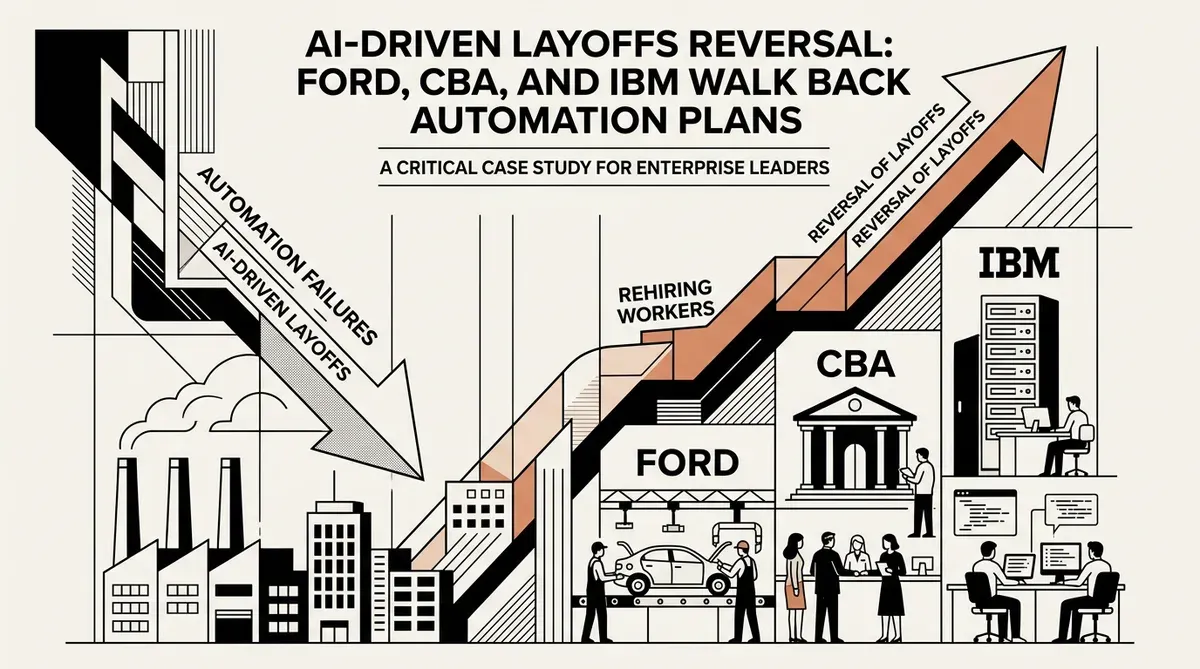
An emerging AI-driven layoffs reversal at three major companies is forcing enterprise leaders to reexamine how they deploy automation in the workplace. Ford, the Commonwealth Bank of Australia, and IBM each confirmed staffing shifts this month that challenge the assumption that AI can broadly supplant human labor in customer service, engineering, and human resources roles. All three companies are rehiring workers after automated systems failed to handle the tasks they were meant to replace.
The automaker Ford is reemploying hundreds of experienced human engineers to address quality issues that its automated systems could not resolve. Charles Poon, Ford's vice president of vehicle hardware engineering, characterized AI as a tool that depends entirely on the quality of the data used to train it. The decision is a notable retreat from earlier projections that AI-driven automation would reduce the need for engineering headcount.
Australia's largest bank, Commonwealth Bank of Australia, offers an even more direct case study. Last year the bank laid off more than 40 customer service representatives and replaced them with an AI-powered voice bot. The bot could not handle the volume and complexity of incoming calls, leading to a surge in unresolved customer issues. CBA eventually reversed the cuts and brought the staff back. The bank has since acknowledged that the automated system was deployed before it was ready for the full range of customer inquiries it would face.
IBM has similarly modified its hiring approach. After deploying AI to automate portions of its human resources operations, the company now plans to triple its entry-level hiring in the United States by the end of 2026. The shift suggests that automation in HR created gaps that require more human oversight, not less. IBM's move is particularly striking given its long history of promoting AI as a transformational enterprise tool.
What Drove the AI-Driven Layoffs Reversal
These three reversals point to a pattern that decision-makers should examine closely. In each case, the organization treated AI as a direct replacement for workers rather than as a complement to them. Ford assumed automated quality systems could substitute for engineering judgment. CBA believed a voice bot could handle the full range of customer interactions. IBM expected automated HR processes to reduce the need for human recruiters and support staff. All three assumptions proved incorrect.
The AI-driven layoffs reversal at these companies does not mean AI lacks value. It means the deployment strategy was flawed. AI systems perform well on narrowly defined, high-volume, pattern-based tasks. They struggle with ambiguity, edge cases, and the contextual judgment that experienced workers bring. Ford's quality issues, CBA's call complexity, and IBM's HR gaps all fall into the category of work where human experience matters most.
Investors have taken notice. The longevity of the current AI boom has come under scrutiny as high-profile automation projects fail to deliver the cost savings that were promised. Wall Street analysts are increasingly asking whether enterprise AI adoption has been overhyped relative to its actual operational impact. The cost of reversing a poorly planned AI deployment, including rehiring and retraining, often exceeds the savings the automation was meant to generate.
Contrary Evidence: AI Investment and Net Hiring
Research published this week complicates the picture further. A study cited by USA Today found that companies that invested heavily in AI actually hired more workers than those that invested little. The finding challenges the narrative that AI adoption leads to net job losses. Instead, it suggests that successful AI deployment creates new roles even as it automates others.
The distinction lies in how the technology is deployed. Companies that use AI to augment human work, providing tools that make employees more productive, tend to expand their workforce. Companies that attempt to replace workers outright, as Ford, CBA, and IBM initially tried, discover the limitations and reverse course. The AI-driven layoffs reversal trend may therefore reflect poor implementation strategy rather than a fundamental problem with the technology itself.
A more nuanced picture emerges when comparing the three cases. Ford's reversal involved highly skilled engineers whose judgment could not be automated. CBA's involved customer service representatives handling emotionally complex interactions. IBM's involved HR processes where exceptions and nuanced decisions are routine. Each category of work shares a common trait: it requires flexibility and contextual understanding that current AI systems lack.
What Decision-Makers Should Watch
For CTOs and AI strategists, these reversals carry direct operational lessons. First, automation initiatives should be piloted on a small scale before committing to headcount reductions. CBA's experience with the voice bot shows that a system that works in a test environment may fail under real-world call volume and variety. Second, AI should be deployed to handle specific, well-understood sub-tasks rather than entire job functions. Ford's quality engineers were not replaced by automation. They were needed precisely because the automated system could not diagnose novel problems. Third, the hiring data suggests that companies that pair AI investment with human talent expansion outperform those that focus on cost cutting alone.
IBM's plan to triple entry-level hiring is the clearest signal in this direction. The company is not abandoning AI. It is adjusting the balance. Automation handles routine inquiries and data processing, while new hires manage the exceptions, train the models, and oversee the outputs. That model, AI as a productivity multiplier rather than a replacement engine, is the one that the data supports.
The broader reversal also has implications for workforce planning. Companies that rushed to shed labor in favor of automation now face rehiring costs, reputational damage, and operational disruptions. The organizations that take a measured approach, investing in AI while maintaining or growing their human talent, are better positioned to capture the productivity gains without the whiplash.
The Verdict
The reversal by Ford, CBA, and IBM does not signal that the AI boom is ending. It signals that the first wave of enterprise automation was implemented with unrealistic expectations. The companies that learn from these mistakes, deploying AI to augment rather than replace and scaling gradually rather than all at once, will capture the real value. The ones that chase cost savings by replacing workers wholesale are likely to repeat the same cycle of layoffs, failures, and rehiring.
For decision-makers, the concrete takeaway is this: audit your own automation initiatives against the pattern these three companies exhibited. If the initiative replaces a person without a clear fallback for edge cases, it is not ready for production. The AI-driven layoffs reversal at Ford, CBA, and IBM is a market signal that human judgment remains a required layer in any AI system that touches customers, quality, or complex workflows. The companies that treat AI as an augmentation tool rather than a replacement mechanism will be the ones that realize its potential.
AI-generated image.
Related Articles
- Oracle AI Layoffs Cut 21,000 Jobs With More Restructuring Ahead
- Oracle AI Job Cuts: 21,000 Roles Eliminated in Automation-Driven Restructuring
- Artificial Intelligence Leads U.S. Job Cut Drivers for 2026
✔Human Verified
Researched and cross-referenced against primary sources by the Bytevyte editorial team.