
AI Model Fatigue Grips Buyers as Four Frontier Labs Ship in One Week
AI model fatigue spreads as Anthropic, OpenAI, Meta and Google ship four frontier models in one week at matching prices. What buyers should do next.
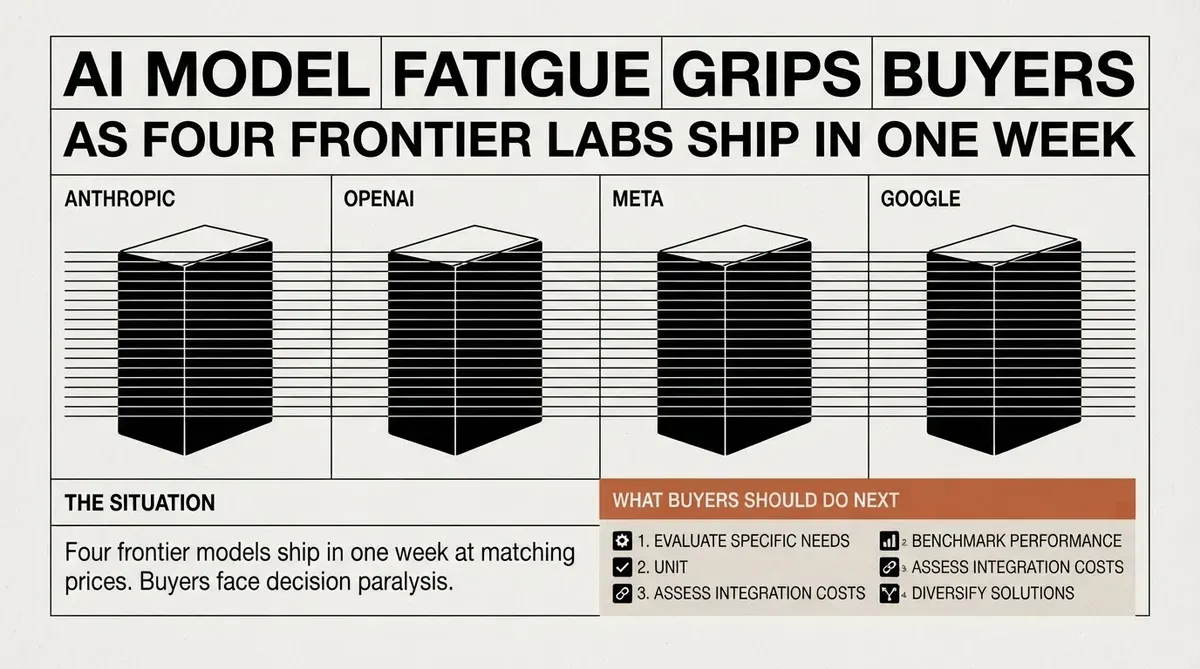
Four of the world's leading AI laboratories each shipped a major model inside roughly 72 hours in early September 2026, compressing what used to be a quarterly event into a single workweek and handing enterprise buyers four upgrade decisions at once. The pileup has given the industry a new complaint to name, AI model fatigue, and it now sits at the center of procurement conversations. Anthropic, Meta, Google and OpenAI all landed releases between September 1 and September 3.
Anthropic opened the sequence on September 1 with Claude Fable 5.1 and Claude Mythos 5.1, describing the pair as its most advanced offerings for coding and knowledge work. Meta followed on September 2 with Muse Spark 1.3, a version number that shows the company running its own steady iteration cycle instead of saving everything for a single annual flagship event. Google moved Gemini 3.8 Flash out in the same window. OpenAI capped the run on September 3 with GPT-6 Astra, a system with a 1,050,000-token context window that is reaching customers in stages, beginning with selected organizations rather than a release to everyone on day one.
The more telling detail sits on the rate cards. Anthropic lists Fable 5.1 at $10 per million input tokens and $50 per million output tokens; OpenAI prices Astra at identical figures. The two diverge underneath those headline numbers. Anthropic cut cached input reads to $0.25 per million tokens, a steep discount for workloads that repeatedly reuse the same context. OpenAI instead applies higher long-context rates above 272,000 tokens, effectively selling its oversized window as the premium feature.
A Release Calendar Under Strain
This is not a one-off pileup. The median interval between major model launches has fallen from 37.5 days in 2023 to roughly 11 days through 2026, and some weeks now carry five frontier or near-frontier systems at once. A similar cluster arrived in mid-August, when four labs again shipped frontier models within days of one another, which makes compressed calendars look like the operating norm rather than an anomaly. Every drop arrives with its own benchmark claims, pricing sheet and rollout plan, so the calendar itself consumes attention that used to go to the models.
Strain shows inside the labs as well. More than 1,100 employees at the major developers have signed a "Pacing the Frontier" letter asking governments to slow development if risks become unmanageable, a public sign that the tempo is contested even among the people building the systems. On the buying side, Runpod chief executive Zhen Lu has described IT teams spending outsized hours comparing costs and capabilities before committing to any model at all. The exhaustion behind AI model fatigue has settled on procurement rather than research.
Why the Tempo Is Not Slowing
Ahmed Abbasi, a professor at Notre Dame's Mendoza School of Business with about 25 years in AI, reads the frenzy as a share-of-wallet contest rather than a technology inflection. Each lab wants developers to keep spending with it, and none is willing to sit out a quarter while a rival claims a new benchmark. Shipping quickly is the cheapest way to remind the market that it is innovating at least as fast as everyone else.
The financial calendar intensifies that logic. Anthropic and OpenAI are each valued at close to $1 trillion by private investors and are heading for public markets. Anthropic is reportedly preparing for an IPO at a potential valuation near $2 trillion, while OpenAI is targeting a fourth-quarter 2026 listing at roughly $852 billion. OpenAI's advertising business reached a $1 billion revenue run rate within 200 days of launch, a measure of how far the labs have extended beyond API access to build the revenue those figures require. With so much valuation riding on perceived momentum, a quiet quarter reads as weakness to the investors underwriting the next round. The pattern echoes the cloud wars of the 2010s, when providers competed on release velocity while unit prices fell every year.
Release tactics have therefore become part of the product. Anthropic doubled up with two simultaneous models rather than one. OpenAI chose a staged rollout, a signal that controlled availability matters to it more than a same-day splash. Google and Meta completed the set mid-week, leaving the week's narrative running order to Anthropic and OpenAI. Buyers now have to interpret what each model does and why each lab chose to ship it when it did.
What AI Model Fatigue Means for Buyers
For enterprises, AI model fatigue carries a concrete cost: evaluation has become a recurring expense instead of a one-time project. When suppliers refresh their flagships every few weeks, benchmark results age quickly, and a decision made at the start of a quarter can rest on a model superseded before the quarter ends. Applications that inherit tool-use and reasoning behavior from a specific model version also carry regression risk each time the flagship changes underneath them, which pushes application teams to maintain their own testing harnesses against every release.
Lock-in is tightening through a quieter channel: cache pricing. Anthropic's $0.25 rate for cached reads makes it far cheaper to keep traffic inside its API than to resend full context at $10 per million tokens. The arithmetic is stark: a workload that repeatedly resends the same context pays 40 times as much at full input rates as it would through a cached read. Switching models therefore forfeits more than integration work; it throws away a warm cache and restarts the cost curve. Cache economics now works as a retention mechanism, and procurement teams should price it explicitly before committing to one supplier.
The convergence of list prices points the same direction. With input and output rates matching at $10 and $50, the labs differentiate on secondary levers: context length, cache discounts, availability timing and positioning claims such as Anthropic's coding-and-knowledge-work focus for Fable 5.1. Google's Flash line has long been the speed-and-cost tier within its Gemini family, so shipping Gemini 3.8 Flash in the same days keeps the conversation on latency economics as much as capability. That is the pattern of a market maturing on price rather than a genuine technology inflection, and it tends to squeeze near-term pricing power. Open-weight competition from Chinese labs adds a standing constraint on list rates from below.
The workable response is to stop treating each release as a re-baselining event. Enterprises are better served by freezing evaluation windows, reviewing suppliers on a fixed quarterly cadence and keeping prompts, tooling and telemetry behind an abstraction layer so a model swap does not rewrite the application. OpenAI's staged rollout of Astra is a small step in that direction, since it gives customers room to plan adoption on their own schedule instead of the launch calendar.
There is also a governance dimension. In regulated industries, adopting a model triggers compliance review, so a supplier that changes its flagship every month forces a re-certification cadence that most enterprises were not built to run. Buyers in those sectors effectively need change management for a product that updates itself on a vendor's timetable, and the September wave shows that timetable getting shorter. Treating model selection as a one-time architecture decision, rather than an ongoing vendor-management process, is now the riskiest position an IT organization can take.
Why this matters
AI model fatigue is the visible symptom of an industry competing on tempo because its products have converged on price. For buyers, the durable response is to architect for model churn, keeping evaluation data, middleware and caching portable so no single release calendar dictates the roadmap. The dynamics face their first real test after Anthropic and OpenAI go public, when both must convert breakneck cadence into revenue at rate cards the market already treats as interchangeable.
AI-generated image.
Related Articles
- Three Labs, One Opt-Out: Inside the White House AI Review Framework
- Half-Price Gemini 3.7 Flash Turns Model Race Into Cost War
- GPT-5.6 Government Review: OpenAI Launches Sol, Terra, Luna
✔Human Verified
Researched and cross-referenced against primary sources by the Bytevyte editorial team. This article was generated with the assistance of artificial intelligence and reviewed by the Bytevyte editorial team.