
GPT-5.6 Government Review: OpenAI Launches Sol, Terra, Luna
OpenAI launched GPT-5.6 on July 9 after passing the GPT-5.6 government review. Sol, Terra, and Luna pricing tiers target enterprise AI buyers competing against Anthropic's Fable 5.
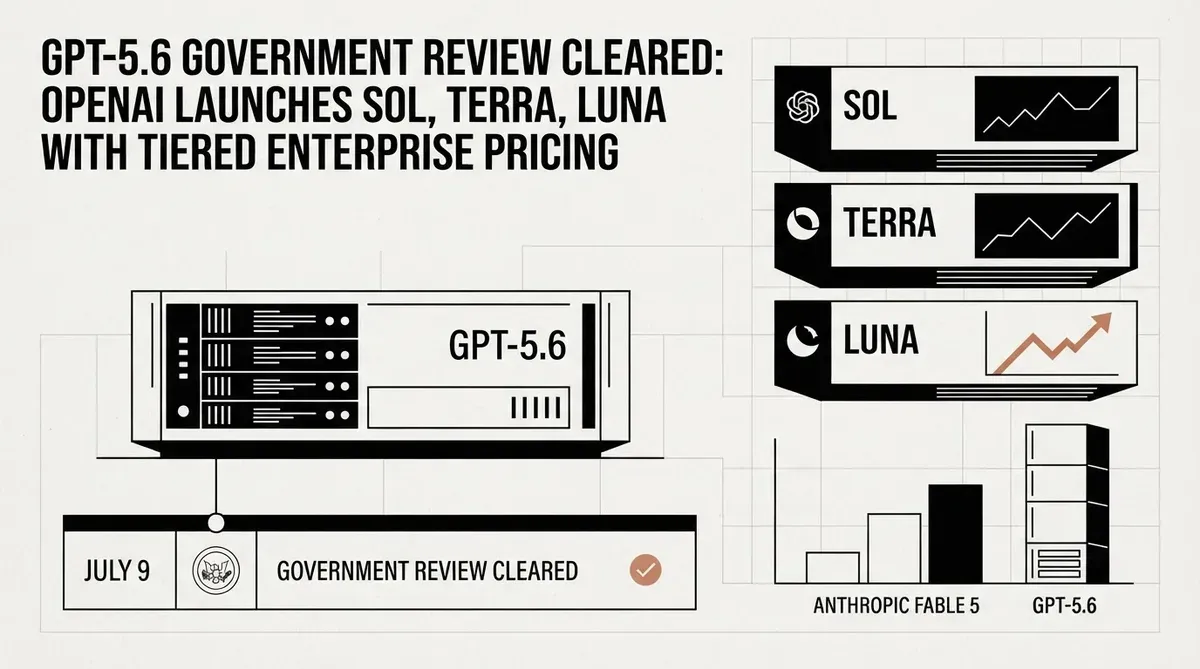
OpenAI has publicly launched its GPT-5.6 model family on July 9 after the GPT-5.6 government review by the Trump administration cleared the release, according to a Commerce Department statement. The department's Center for AI Standards and Innovation conducted additional security testing before granting approval. The three-tier lineup with Sol, Terra, and Luna is the company's most direct attempt to segment the AI market by capability and price, with the flagship Sol priced at $5 per million input tokens and $30 per million output tokens.
The release, confirmed by CEO Sam Altman on X on July 9, is the first major test of the voluntary government review framework established by President Trump's AI cybersecurity order in early June. That order asks companies to submit their most powerful models for government inspection 30 days before public release, a process that initially limited GPT-5.6 to a small group of trusted partners and government-approved entities in late June.
The GPT-5.6 government review process required OpenAI to send technical experts to Washington for meetings with the Commerce Department, according to the company. The Center for AI Standards and Innovation conducted additional testing before granting permission for the broader rollout. OpenAI has stated it does not believe this kind of access process should become the long-term default, but complied fully with the review to secure the public launch.
Three Tiers, Three Markets
OpenAI has structured the GPT-5.6 family, announced on July 9, to address distinct segments of the AI market. Sol is the strongest model OpenAI has ever released, designed for deep reasoning and agent management. OpenAI has stated that Sol makes fewer factual errors compared to earlier models, based on internal benchmarks. Terra targets everyday use cases with performance comparable to GPT-5.5 at roughly half the cost. Luna is optimized for speed and is the lowest-cost entry point.
| Model | Input cost per M tokens | Output cost per M tokens | Positioning |
|---|---|---|---|
| GPT-5.6 Sol | $5.00 | $30.00 | Deep reasoning, agent management |
| GPT-5.6 Terra | $2.50 | $15.00 | Mid-range, matches GPT-5.5 at half cost |
| GPT-5.6 Luna | $1.00 | $6.00 | Budget, speed-optimized |
The pricing ladder gives enterprise buyers a clear path from budget to premium. The spread between Luna and Sol is wide. Luna is five times cheaper on input and output tokens, allowing organizations to match model cost to task complexity. A high-volume customer service operation can route simple queries to Luna while reserving Sol for complex agent workflows.
The Anthropic Counterpoint
The GPT-5.6 pricing tiers position OpenAI directly against Anthropic's enterprise lineup. The US government lifted curbs on Anthropic's Fable 5 and Mythos 5 models last week, just ahead of the GPT-5.6 clearance, meaning both providers now offer reviewed models in the same window. Fable 5 targets the high-end reasoning market where Sol competes, while Mythos 5 is a mid-range alternative comparable to Terra.
OpenAI's three-tier approach gives it a pricing advantage at the low end. Luna at $1 per million input tokens undercuts any comparable offering from Anthropic, creating a low-friction entry point for developers and startups. Once those users build on OpenAI's API, migrating to Terra or Sol later becomes a natural upgrade path rather than a switch to a competing provider. This bundling strategy defends the high-margin enterprise segment where Sol competes directly with Fable 5.
Enterprise Implications of the GPT-5.6 Government Review
For enterprise procurement teams, the GPT-5.6 government review clearance removes a key uncertainty. Companies in regulated industries such as healthcare, finance, and defense now have a Commerce Department-reviewed model from OpenAI alongside the recently cleared Anthropic models. The review process, while voluntary on paper, is a certification signal for buyers who need to demonstrate compliance, per the Commerce Department's guidance.
The cost structure also changes how enterprises budget for AI. Previous model generations forced buyers into a single price point. The GPT-5.6 family allows routing simple customer queries to Luna at $1 per million input tokens while reserving Sol for complex agent workflows at $5 per million input tokens. Organizations that standardize on the OpenAI platform can manage costs dynamically without switching providers.
The 30-day review window matters for planning cycles. Companies that depend on frontier models for product development now need to account for potential delays. OpenAI's experience with a late June limited release followed by a July 9 full launch suggests the review process can clear within weeks, but the timeline is not guaranteed.
What the Pricing Tiers Reveal About OpenAI's Strategy
The three-tier structure, announced on July 9, reveals a deliberate strategy to capture the full enterprise market. Sol at the premium end protects margins on high-value reasoning and agent workloads, where competitors like Anthropic's Fable 5 also compete. Terra at the mid-range directly matches the capability level of GPT-5.5 but at half the cost, potentially driving upgrades from customers still on older models. Luna at the low end functions as an acquisition channel, attracting price-sensitive developers and startups who would otherwise consider open-source alternatives.
This segmentation matters because enterprise AI spending is shifting from experimental to production workloads. Companies are no longer testing one model; they are routing different tasks to different models based on cost and capability requirements. OpenAI's tiered offering allows these buyers to stay within a single API ecosystem rather than managing multiple providers, reducing integration overhead and simplifying procurement.
The pricing also pressures Anthropic on two fronts. At the top end, Sol and Fable 5 compete directly on reasoning quality, and the Commerce Department clearance gives both models equal regulatory standing. At the bottom end, Luna undercuts Anthropic's most affordable option, potentially steering budget-conscious developers toward OpenAI's platform before they evaluate Anthropic's offerings. Over time, this creates a funnel effect where developers who start on Luna upgrade to Terra or Sol without needing to renegotiate vendor relationships.
The timing of the public launch is itself strategic. By receiving clearance on July 9, OpenAI brings GPT-5.6 to market just days after Anthropic's models were cleared, ensuring neither company gains a sustained first-mover advantage under the new review framework. For enterprise buyers evaluating both platforms, the window for comparison is now open and both options are equally available.
Why this matters
The GPT-5.6 government review process, as outlined by the Commerce Department, is establishing a new operating rhythm for frontier AI releases in the United States. Both OpenAI and Anthropic have now passed through the voluntary framework, turning what could have been a one-off event into a de facto industry standard. For enterprise buyers, the immediate consequence is that the two leading AI providers offer reviewed, cleared models with tiered pricing that makes cost management more predictable than in previous generations. The question now is whether this review framework scales as more companies release frontier models, and whether the 30-day window becomes a binding constraint on innovation speed.
AI-generated image.
Related Articles
- Claude Fable 5 Export Controls Lifted as US Drops Restrictions on Anthropic's Top AI Models
- GPT-5.6 Release Restrictions Signal Tougher US AI Oversight
- OpenAI Launches GPT-5.5 with Drastic Cost Cuts and Advanced Agentic Capabilities
✔Human Verified
Researched and cross-referenced against primary sources by the Bytevyte editorial team.