
Alibaba Cloud Launches Qwen 3.7-Max and Global Agentic AI Ecosystem
Alibaba Cloud unveils its agentic AI ecosystem and Qwen 3.7-Max model in Singapore, targeting global enterprise automation and SME training.
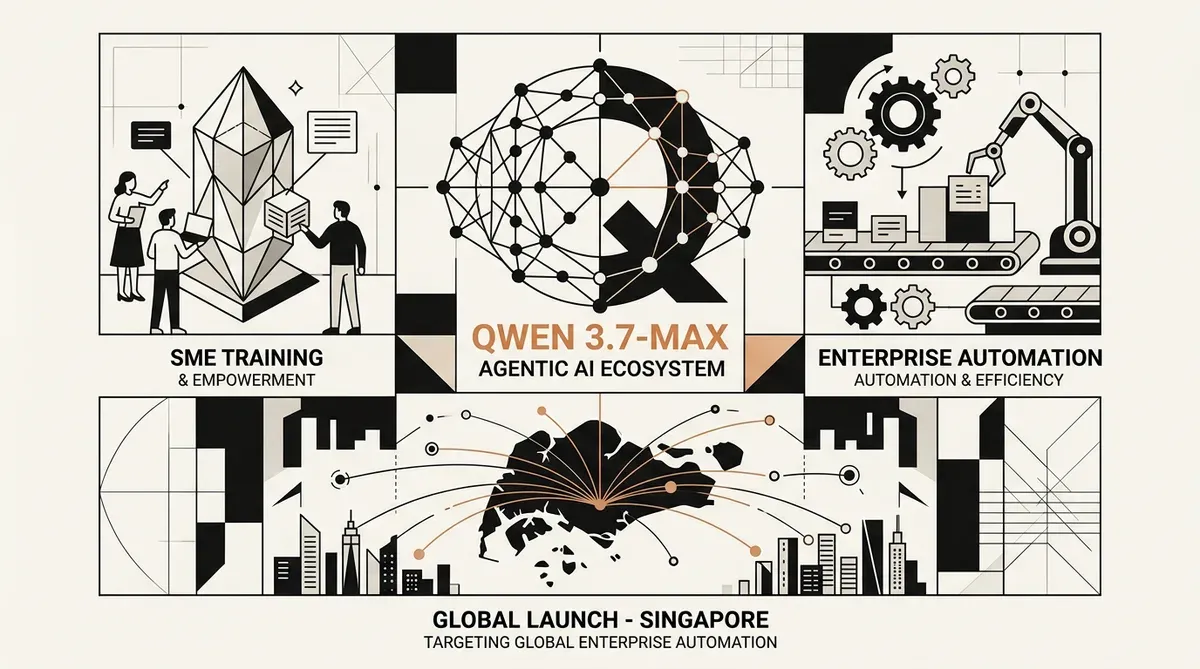
Alibaba Cloud has introduced its agentic AI ecosystem and the Qwen 3.7-Max model, signaling a major expansion of its artificial intelligence capabilities for the global market. The company announced these developments on May 26, 2026, during an event in Singapore, where it detailed a strategy to move beyond static large language models toward autonomous agents that can execute complex tasks within cloud environments.
The centerpiece of this update is Qwen 3.7-Max, a flagship large language model designed to compete with the industry's most advanced systems. To support the deployment of this model, the company launched Qwen Cloud, an AI-native platform specifically built for the development and management of autonomous agents. This platform provides a unified environment where developers can access various models and tools to build software that acts independently rather than just responding to prompts.
Infrastructure for Autonomous Agents
A critical component of the new agentic AI ecosystem is the Skills portal. This interface allows AI agents to invoke standardized cloud services and APIs, effectively giving them the ability to interact with external software and databases. By converting traditional cloud capabilities into formats that agents can easily use, Alibaba Cloud is positioning itself as a provider of the "connective tissue" required for enterprise-grade AI automation.
The company also strengthened its ties to the open-source community by becoming a Platinum member of the PyTorch Foundation. This move suggests a commitment to ensuring its infrastructure remains compatible with the most widely used machine learning frameworks. For business leaders, this compatibility reduces the risk of vendor lock-in when building agentic workflows on the Qwen platform.
Strategic Implications for Global Markets
The launch in Singapore highlights a clear intent to capture the Southeast Asian market. Alibaba Cloud committed to training more than 1,000 small and medium-sized enterprises (SMEs) and students in Singapore on agentic AI workflows. This educational initiative aims to build a local talent pool capable of implementing autonomous AI solutions, which could accelerate adoption across the region's digital economy.
For CTOs and strategists, the shift toward an agentic AI ecosystem is a transition from AI as a chatbot to AI as a functional worker. The combination of the Qwen 3.7-Max model and the Skills portal allows for the creation of agents that can handle end-to-end business processes, such as managing cloud resources or automating customer service workflows, with minimal human intervention.
As of late May 2026, the competition in the cloud AI sector is increasingly focused on these autonomous capabilities. By providing both the high-performance model and the specialized infrastructure to run it, Alibaba Cloud is challenging established Western providers in the race to define the next generation of enterprise automation.
While we strive for accuracy, bytevyte can make mistakes. Users are advised to verify all information independently. We accept no liability for errors or omissions.
AI-generated image.
Related Articles
- Alibaba Adopts Conversational Commerce with Qwen AI for Taobao and Tmall
- Alibaba Launches Qwen AI Shopping Features for Taobao and Tmall Users
- Google Cloud Debuts Gemini Enterprise Agent Platform
✔Human Verified